COPS
Police Pullovers #1
TV Flash files “Police Pullovers #1” as hour 704 of 1267 in the TV Flash guide — COPS (1989–present) on Fox, season 19, episode 25, aired 2007-04-28, 30 min.
From the desk
How this hour is filed
This leaf is S19E25: listed hour 704 of 1267 in the COPS guide, hour 25 of 36 in season 19. It aired 2007-04-28 (30 min). The listed hour before it is “Coast to Coast #124” (S19E24). Next is “Police Pullovers #2” (S19E26). Broadcast log — titles and dates, not a plot bible.
Catalog log
Broadcast listing — not a TV Flash recap.
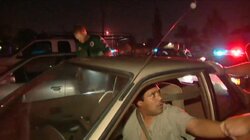
When Deputy Brandon Gish of the Brevard County, FL, Sheriff's Office pulls over a vehicle whose driver matching the description of a battery suspect, the desperate driver panics and attempts to eat a pinch of pot. And Officer Brian Binks of the Fontana, CA, Police Department is shocked when a suspect explains why he led officers on a high-speed chase.
Viewer FAQ
Where does Police Pullovers #1 sit in the COPS guide?
S19E25 is listed hour 704 of 1267 — hour 25 of 36 in season 19, season 19 episode 25.
When did COPS S19E25 air?
Police Pullovers #1 aired 2007-04-28 and is listed at 30 minutes.
Is there a host or a script?
Ride-along vérité: handheld cameras, minimal narration, chaos scored to "Bad Boys." The format is the author.
In the series
Why this series still plays
Handheld ride-alongs set to a reggae hook: policing as weekly spectacle, no narrator required. The format that taught reality TV how to chase, cuff, and cut. Controversial by design — vérité as entertainment, neighborhoods as set, and a chorus that still follows every squad-car clip. View it as craft and as argument; it was always both.
Visual first: handheld grain, a reggae hook, neighborhoods framed as set, no narrator to soften the silhouette. John Langley and Malcolm Barbour's Fox series premiered in 1989 and became a syndication staple through the 1990s. *Ride-along vérité as weekly spectacle.* Inner Circle's *Bad Boys* is inseparable from the brand — the chorus that still follows every squad-car clip. **This was not a procedural costume; this was policing photographed as entertainment.**