The Simpsons
Thank God It's Doomsday
TV Flash files “Thank God It's Doomsday” as hour 354 of 802 in the TV Flash guide — The Simpsons (1989–present) on Fox, season 16, episode 19, aired 2005-05-08, 30 min.
From the desk
How this hour is filed
This leaf is S16E19: listed hour 354 of 802 in the The Simpsons guide, hour 19 of 21 in season 16. It aired 2005-05-08 (30 min). The listed hour before it is “A Star is Torn” (S16E18). Next is “Home Away from Homer” (S16E20). Broadcast log — titles and dates, not a plot bible.
Catalog log
Broadcast listing — not a TV Flash recap.
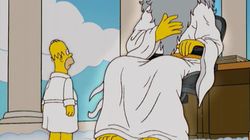
An apocalyptic movie followed by three real-life omens cause a fearful Homer to research the rapture. Believing that he has deduced when the event will happen, he begins warning others as a way to secure his spot in heaven. After a skeptical Kent Brockman reports on Homer's prediction of stars falling from the sky, there's a Krusty Special blimp accident, and Homer attracts a slew of new believers. When the rapture never comes, a discredited Homer discovers an error in his calculations and returns to the Springfield Mesa alone, where he experiences the rapture - or maybe a heat-induced dream - and convinces God to delay doomsday.
Viewer FAQ
Where does Thank God It's Doomsday sit in the The Simpsons guide?
S16E19 is listed hour 354 of 802 — hour 19 of 21 in season 16, season 16 episode 19.
When did The Simpsons S16E19 air?
Thank God It's Doomsday aired 2005-05-08 and is listed at 30 minutes.
Where should I start if I am not watching all 800 episodes?
Start with the 1989 Christmas premiere, then a handful of golden-age hours from seasons four through eight. Treat the rest as a library, not a novel.
In the series
Why this series still plays
Watch it as a living joke encyclopedia, not a series you owe from pilot to present. The early years still teach how American satire learned to reset weekly; the later catalog is optional weather. You already speak Springfield. This is how the grammar got written.
The first image is a couch, and then it is not. The Simpsons treats the opening gag as a weekly contract: we will reset the living room, and we will still find a new joke about the country that owns it. Fox put a yellow family on Sunday nights in 1989 after the Tracey Ullman shorts, and the half-hour that followed did not merely popularize adult animation. It installed a shared vocabulary. People who stopped watching still speak Springfield.
Filed against
- Dan Castellaneta as Homer Simpson
Dan Castellaneta voices Homer Simpson — the yellow everyman who turned “D’oh!” into a global punctuation mark. Decades of The Simpsons mean his throat is half of American cartoon history. TV Flash tips the doughnut to the man behind the…
- Julie Kavner as Marge Simpson
Julie Kavner’s Marge Simpson is the blue-hair patience of Fox’s yellow family — a reference language still adding pages while the country litigates whether the golden age is over. Not a sitcom you finish. On TV Flash she is the…
- Nancy Cartwright as Bart Simpson
Nancy Cartwright’s Bart Simpson is Springfield’s weekly reset in a kid’s voice — the prank as American satire’s engine since Fox put a yellow family on Sunday nights in 1989. The Simpsons is a joke encyclopedia still adding pages; she is…
- Yeardley Smith as Lisa Simpson
Yeardley Smith’s Lisa Simpson is The Simpsons as a living joke encyclopedia — Fox’s yellow family still adding pages while the country litigates whether the golden age is over. On TV Flash she is Springfield grammar: the saxophone, the…
- Hank Azaria as Moe / Chief Wiggum
Hank Azaria voices Moe and Chief Wiggum on The Simpsons — Springfield as a living joke encyclopedia, bar and badge as two dialects in Fox's yellow reference language. TV Flash files him as the show's vocal furniture: the early years still…
- Harry Shearer as Mr. Burns / Ned Flanders
Harry Shearer is Springfield in stereo: Mr. Burns’s death-rattle capital and Ned Flanders’s neighborly hymn, often in the same half-hour. The Simpsons installed a shared vocabulary for American satire; his voices are two of its most…