Doctor Who
Hidden Danger (The Sensorites, Part Three)
TV Flash files “Hidden Danger (The Sensorites, Part Three)” as hour 33 of 700 in the TV Flash guide — Doctor Who (1963–) on BBC, season 1, episode 33, aired 1964-07-11, 25 min.
From the desk
How this hour is filed
This leaf is S01E33: listed hour 33 of 700 in the Doctor Who guide, hour 33 of 42 in season 1. It aired 1964-07-11 (25 min). The listed hour before it is “The Unwilling Warriors (The Sensorites, Part Two)” (S01E32). Next is “A Race Against Death (The Sensorites, Part Four)” (S01E34). Broadcast log — titles and dates, not a plot bible.
Catalog log
Broadcast listing — not a TV Flash recap.
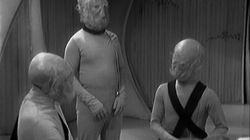
The Doctor, Ian, Barbara and Susan arrive in the TARDIS on board aspaceship. Their initial concern is for the ship's human crew, who are suffering from telepathic interference from the Sensorites, but Susan communicates with the Sensorites and finds the aliens fear an attack by the humans and are just defending themselves. Travelling to the Sense Sphere (the Sensorites' planet) the Doctor seeks to cure an illness to which the Sensorites and Ian have succumbed, but finds it has been caused by deliberate poisoning. The political manoeuvring of the Sensorite City Administrator poses another threat to the TARDIS crew as he seeks to discredit and implicate them.
Viewer FAQ
Where does Hidden Danger (The Sensorites, Part Three) sit in the Doctor Who guide?
S01E33 is listed hour 33 of 700 — hour 33 of 42 in season 1, season 1 episode 33.
When did Doctor Who S01E33 air?
Hidden Danger (The Sensorites, Part Three) aired 1964-07-11 and is listed at 25 minutes.
Where should I start with the 1960s serials?
William Hartnell's First Doctor is the origin of the TARDIS-and-companions contract. Patrick Troughton's Second Doctor is the proof that regeneration works. Start at a serial whose surviving episodes interest you; missing-episode gaps are part of the classic-era weather.
In the series
Why this series still plays
A Time Lord, a police box bigger on the inside, and regeneration as infinite franchise life: Doctor Who launched from the BBC in 1963 and never really parked. Early black-and-white serials built the mythology; Hartnell-to-Troughton proved the lead could change without ending the show. The longest experiment in serialized reinvention — woolly, weird, endlessly renewable.
November 23, 1963, is a drop that never really parked. BBC's *Doctor Who* launched a Time Lord and a blue police box bigger on the inside, then treated the lead as renewable inventory. **Regeneration is the window.** Sydney Newman, C. E. Webber, and Donald Wilson were among the early architects. Early black-and-white serials built the mythology; companions, sonic screwdrivers, and cliffhangers became ritual. Rex wants woolly national inheritance. Fine. The business model is recasting without ending the show.
Filed against
- William Hartnell as The First Doctor
William Hartnell’s First Doctor launched Doctor Who from the BBC in 1963 — a Time Lord, a police box bigger on the inside, regeneration as infinite franchise life. Early black-and-white serials built the mythology; Hartnell-to-Troughton…
- Patrick Troughton as The Second Doctor
Patrick Troughton played the Second Doctor on Doctor Who, the 1960s BBC proof that a Time Lord could change faces without ending the franchise. Police box bigger on the inside, regeneration as infinite life, early black-and-white serials…
- Jon Pertwee as The Third Doctor
Jon Pertwee’s Third Doctor kept Doctor Who’s police box moving — a Time Lord, a box bigger on the inside, regeneration as infinite franchise life. BBC serials launched in 1963 and never really parked; Hartnell-to-Troughton proved the lead…
Also in season 1
- S01E01 An Unearthly Child (An Unearthly Child, Part One)
- S01E02 The Cave of Skulls (An Unearthly Child, Part Two)
- S01E03 The Forest of Fear (An Unearthly Child, Part Three)
- S01E04 The Firemaker (An Unearthly Child, Part Four)
- S01E05 The Dead Planet (The Daleks, Part One)
- S01E06 The Survivors (The Daleks, Part Two)