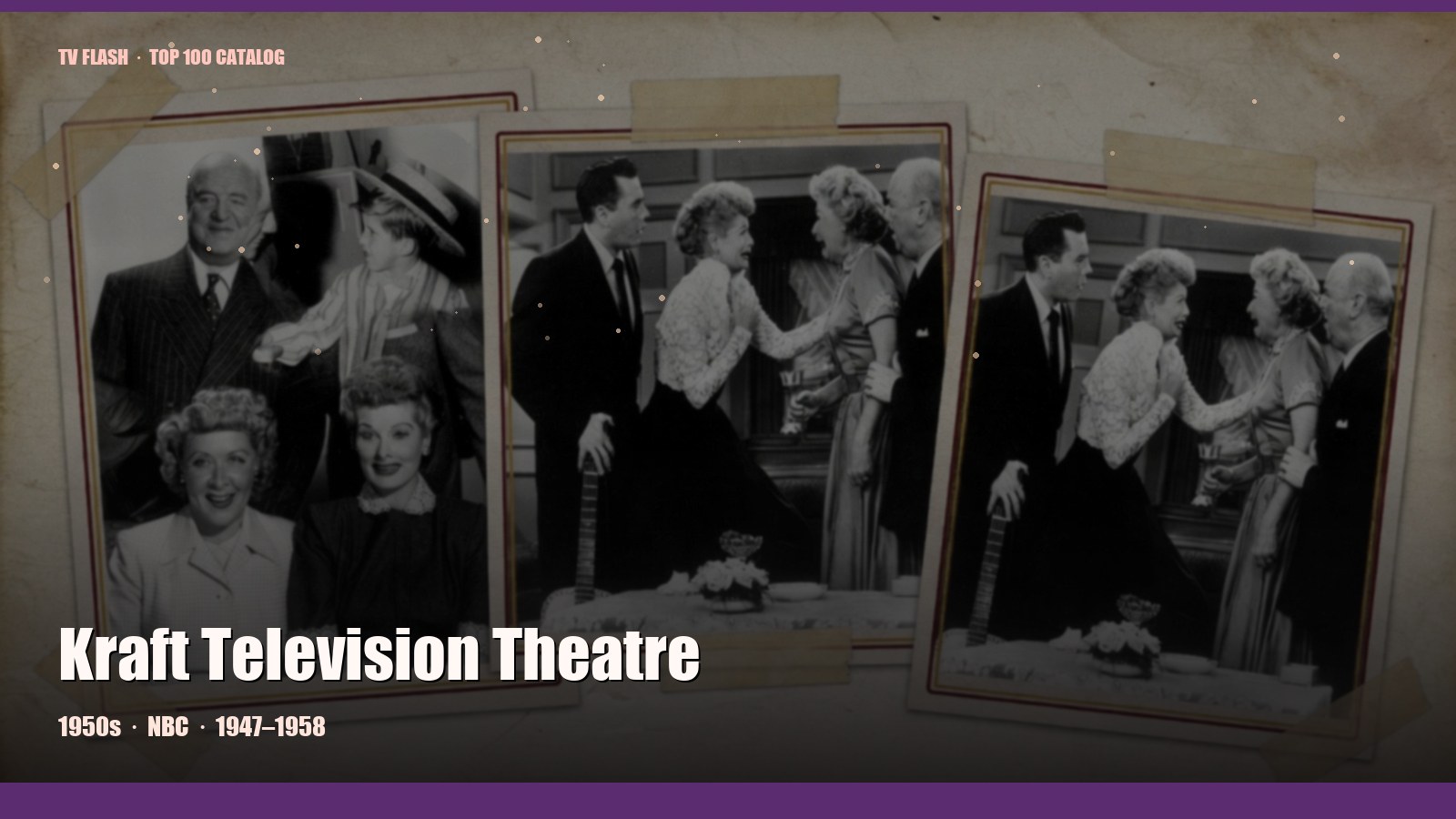
Cornerstone of Golden Age live anthology drama on network television.
Why it matters
From the desk
Why Kraft Television Theatre still plays
The lighting is grocery-brand prestige. Not a red carpet, not a tag: live drama poured into living rooms like a weekly Broadway subscription, Kraft selling product between acts. *Kraft Television Theatre*, primarily NBC, 1947–1958, 526 episodes across 11 seasons — period tallies cite on the order of 650 Kraft productions — stage and screen talent still learning the camera. Young stars and writers cut their teeth in that light. Survival rates for kinescopes are incomplete, which only deepens the lost-library mystique. The look was a curtain made of cheese and nerve.
Stanley Quinn and Maury Holland's shop helped define sponsor-branded prestige drama in television's first decade. Industrial-scale proof that early TV thought of itself as theater first. A cornerstone of Golden Age live anthology. *Kraft Television Theatre* helped establish the commercial anthology as network culture and sponsor-branded prestige. It trained talent and audiences for serious televised drama. Later limited series still chase that single-play event feeling. TV Obscurities notes hundreds of NBC episodes with only a portion surviving in archives — the lost-library mystique is not a vibe, it is an incomplete kinescope survival rate. The timeline can call it mid. The silhouette was a living-room orchestra seat with a stopwatch, a grocery brand daring Broadway, and young stars cutting teeth between product acts. Kraft drama brands also touched ABC in the wider lineage; the NBC night is the gown.
Look board: kinescope gray; sponsor chrome between acts; a title card that behaved like a playbill; incomplete archives as the tax on glamour. *Double Door* opens 1947: live drama between product acts, prestige as a grocery brand daring a living-room Broadway. *The Man in Half Moon Street* is early named teleplay, young stars cutting teeth while Kraft still owned the hour's manners. *Justice* is one-word mid-run title, Golden Age cornerstone still treating the stopwatch like a curtain.
*Whim of Iron* is a mid-1950s named hour, industrial-scale theater with incomplete kinescope survival already the archival tax. *Presumption of Innocence* closes 1958: last titled teleplay in a 500-hour factory, the cheese sponsor packing the live stage. Kraft drama brands also touched ABC in the wider lineage; the NBC night is the gown.
See you at the after-party, which was a kitchen and a kinescope that may not have survived. The second look is always the gap in the archive. That is the real image management of Golden Age drama: what the sponsor lit, and what the tape forgot.
Episode guide
How this series is filed
TV Flash files Kraft Television Theatre (1947–1958) on NBC as a season-first catalog of 526 listed hours across 11 seasons, 1947-05-07–1958-10-01 from “Double Door” (S01E01) to “Presumption of Innocence” (S11E51).
Open the episode guide · S01E01 Double Door · S11E51 Presumption of Innocence
Essential episodes
Live drama with a cheese sponsor — industrial-scale teleplays, kinescope gaps, grocery-brand prestige. Filed by Lana Reyes (Red Carpet Reality).
- S01E01 Double Door
Double Door opens 1947: live drama between product acts, prestige as a grocery brand daring a living-room Broadway.
- S03E01 The Man in Half Moon Street
The Man in Half Moon Street: early named teleplay, young stars cutting teeth while Kraft still owned the hour's manners.
- S05E09 Justice
Justice — one-word mid-run title, Golden Age cornerstone still treating the stopwatch like a curtain.
- S08E28 Whim of Iron
Whim of Iron: mid-1950s named hour, industrial-scale theater with incomplete kinescope survival already the archival tax.
- S11E51 Presumption of Innocence
Presumption of Innocence closes 1958: last titled teleplay in a 500-hour factory, the cheese sponsor packing the live stage.
At a glance
Before series television fully colonized the night, Kraft Television Theatre poured live drama into American living rooms like a weekly Broadway subscription. Running primarily on NBC from 1947 to 1958 (with ABC involvement in the broader Kraft drama lineage), the anthology presented hundreds of plays — CTVA notes roughly 650 productions from a mountain of submissions — starring stage and screen talent still learning the camera. Sponsors got cheese branding; audiences got serious teleplays when the medium was still inventing prestige. Survival rates for kinescopes are incomplete, which only deepens the lost-library mystique. It is the industrial-scale proof that early TV thought of itself as theater first.
Network & studio
- NBC — broadcast network
Why watch now
Kraft Television Theatre is live drama with a cheese sponsor: hundreds of teleplays, young stars cutting teeth between product acts, prestige as a grocery brand. Watch it now as a Golden Age cornerstone — industrial-scale living-room theater, incomplete kinescope survival, and proof early TV thought of itself as Broadway first.
Cultural impact
Kraft Television Theatre helped establish the commercial anthology as network culture and sponsor-branded prestige. It trained talent and audiences for serious televised drama. Later limited series and prestige nights still chase that single-play event feeling.
Creators
Stanley Quinn · Maury Holland
Flash facts
- American anthology drama associated chiefly with NBC, 1947–1958 (Kraft drama brands also touched ABC in the wider lineage).
- Presented hundreds of live plays over roughly eleven-plus years; period tallies cite on the order of 650 Kraft productions.
- TV Obscurities notes hundreds of NBC episodes with only a portion surviving in archives.
- Helped define sponsor-branded prestige drama in television's first decade.
- Part of the Golden Age wave later eclipsed by filmed series and continuing characters.
FAQ
Where should I start?
Start with whatever surviving kinescopes you can find of the live-play form — the point is the weekly Broadway-subscription feel, not a continuing cast.
What can I skip?
Skip expecting a complete 650-production library. Archives hold only a portion; treat gaps as the historical condition, not a failure of your watchlist.
Is it still worth it?
Yes, as context for how dramatic TV learned to breathe. Golden Age anthology at factory scale.
Soap, series, or event plays?
Live dramatic anthology — one-off teleplays under a cheese sponsor, not a continuing soap.
Official & further reading
External sites for further reading — TV Flash is not affiliated with these networks or studios.
Back to the decade
Also on the dial
More after Kraft Television Theatre
- Related showMeet the PressThe longest-running show in television history — Sunday panel combat as civic ritual.
- Related showThe Ernie Kovacs ShowVisual gags, blackouts, and Nairobi Trio — the medium inventing itself for laughs.
- Related showM SquadLee Marvin's hard cop in a hard Chicago — noir procedural with a jazz bite.
- Related showKukla, Fran and OllieAd-lib puppets and Fran Allison — gentle absurdity that adults watched without irony.
- Related showSky KingArizona rancher with a Cessna — aviation adventure for kids who wanted wings.
- Related showBat MastersonDerby hat, gold-tipped cane — Gene Barry's dandy lawman who fought with style.