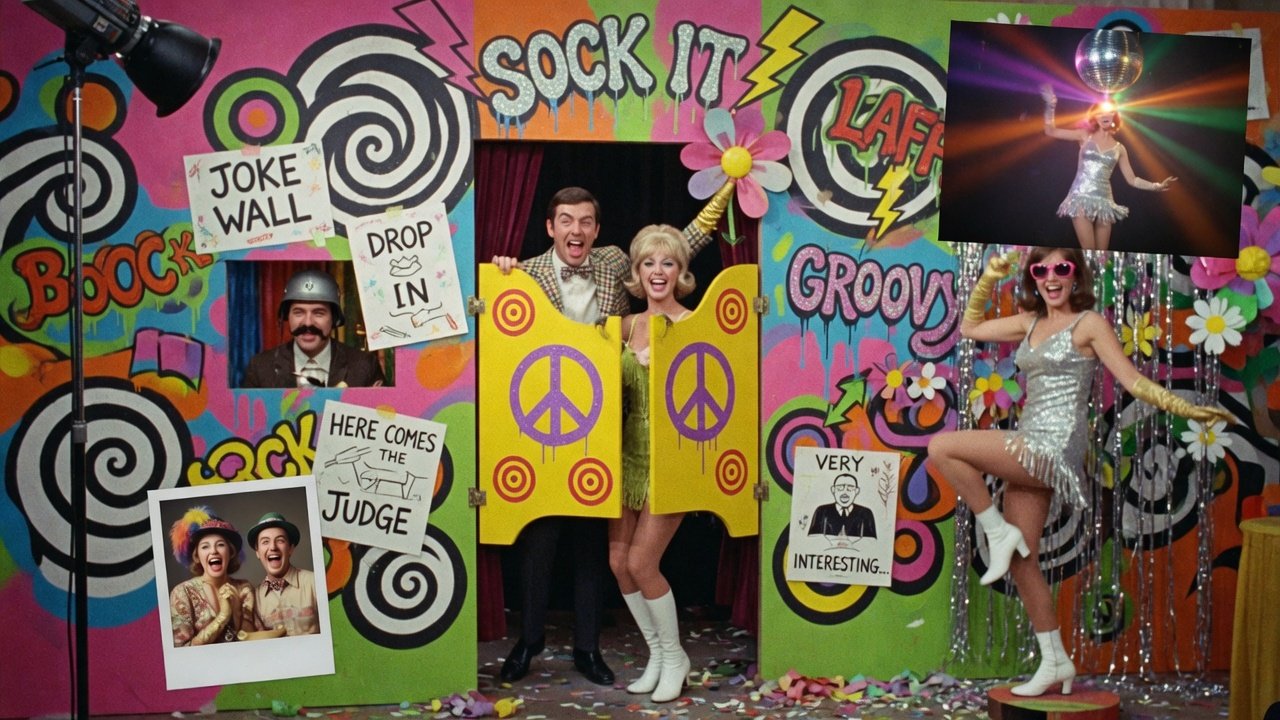
Modern sketch velocity and political comedy variety energy.
Why it matters
From the desk
The After-Party That Got a Timeslot
Rowan and Martin's sketch machine as a red carpet with a laugh track — catchphrases as national sport, guest-star politics in a bikini-joke factory, and the hour a presidential candidate walked into a punchline.
The hand was on the joke wall for exactly one blackout, then gone — sock it to me, beautiful downtown Burbank, a bikini with graffiti that the censors negotiated like a treaty. Rowan & Martin's Laugh-In did not wait for an after-party. It was the after-party, 1968 on NBC, a Monday-night crime scene of catchphrases, guest-star cameos, and a pace that treated the remote like a cocktail shaker. If you only watched the hosts' tuxedos, you missed the show. The heat was in the cutaways, the Tramp, the telephone operator, the body paint, and the PA who had to time a Nixon cameo like a detonation.
Dan Rowan and Dick Martin are the velvet rope: two nightclub hosts who look like they could get you in, or get you thrown out. The regulars are the leak. Goldie Hawn giggling through the graffiti is not an accident of ditz; it is a breakout that the industry still uses as a before-and-after. Lily Tomlin's later arrival is a second heat check — characters that outlive the timeslot. Arte Johnson in a helmet, Judy Carne taking the bucket, Ruth Buzzi's purse as a weapon. George Schlatter's shop ran variety like a gossip column: who is in this week, who is about to be too big to come back, which politician is willing to say the line.
They are not amicable, the mix of counterculture and network sales. Laugh-In sold rebellion to affiliates between tire ads. That is the geometry. Who stands in the bikini wall and who gets the tuxedo two-shot? Which guest is doing damage control by being a good sport — John Wayne in the machine, Johnny Carson leaving his own desk, Richard Nixon in September 1968 saying the line America would not stop repeating? The museum guards of prestige television will tell you this is not "the text." The text is the seating chart of American celebrity agreeing to be a punchline for three minutes. Ask me how I know. The deleted Story, 1960s edition, is the joke the censors cut and the one the living room still quoted at work.
Beat sheet from a typical hour (names on the call sheet, vibes intact): cold-open blackouts faster than a modern For You page; cocktail-party cross-talk as a group chat with better lamps; a guest who is running for something, or running from last week's headline; a regular who is about to get a film contract and a publicist who is "unavailable." One short beat of almost-empathy: the dancers and the cue-card people saw everything — the politician's sweat, the starlet's shiver under the paint, the host who was tired of being the reasonable one. They do not get the retrospective. They got the timeslot.
The people who want just the text, not the text messages, will say catchphrase comedy is noise. Catchphrase comedy is the text. It minted a national vocabulary in a single season, then spent five more years trying not to become a tribute act to itself. By the 1973 closer — Borgnine, Sammy Davis, Jr., Goulet, Rip Taylor, Worley back in the room — the after-party had already moved. Goldie had left for movies. The velocity was now the culture's default, which is the real theft. Last flash: the hour Nixon walked in was never the whole file. There is always a second angle — a campaign, a censors' note, a regular who understood the joke was the access. The door closes on a Monday in March. The catchphrases did not.
Episode guide
How this series is filed
TV Flash files Rowan & Martin's Laugh-In (1968–1973) on NBC as the episode guide: 141 listed hours across 6 seasons, 1967-09-09–1973-03-12 from “Pilot Special” (S01E00) to “Ernest Borgnine, Sammy Davis, Jr., Robert Goulet, Rip Taylor, Jo Anne Worley” (S06E24).
Open the episode guide · S01E00 Pilot Special · S06E24 Ernest Borgnine, Sammy Davis, Jr., Robert Goulet, Rip Taylor, Jo Anne Worley
Essential episodes
Five guest-stack hours — the after-party seating chart, not a recap of every blackout. Filed by Vivian Cross (The Carpet Report).
- S01E01 Leo G. Carroll, Barbara Feldon, Lorne Greene, Buddy Hackett, Sheldon Leonard, The Strawberry Alarm Clock, Tiny Tim, Flip Wilson
The regular-season door: variety as a gossip column, already faster than the tuxedo two-shot.
- S01E08 Barbara Feldon, Anissa Jones, Jerry Lewis, Pat Morita, Dinah Shore, Sonny & Cher, John Wayne, Paul Winchell
John Wayne in the machine — A-list agreeing to be a punchline, which is the show's real stunt.
- S01E10 The Bee Gees, Johnny Carson, Barbara Feldon, Harry Belafonte, Ed McMahon, Flip Wilson, Sivi Aberg
Carson leaving his own desk to sit in someone else's after-party. Late-night as a guest, not a throne.
- S02E01 Zsa Zsa Gabor, Hugh Hefner, Bob Hope, Jack Lemmon, Richard Nixon, Sonny Tufts, John Wayne, John B. Whitney
Nixon on the call sheet, September 1968. Campaign-year access as a three-word joke the country would not drop.
- S02E08 George Gobel, Dick Gregory, Rock Hudson, Rod Serling
Rod Serling, Dick Gregory, Rock Hudson — the seating chart as an argument about who is allowed to be in on it.
At a glance
Rowan and Martin host rapid-fire sketch chaos — blackout gags, political zingers, and a cast of breakout comics. Catchphrases become national sport overnight. Counterculture energy collides with network variety machinery.
Network & studio
- NBC — broadcast network
Why watch now
Watch the after-party that got a timeslot: catchphrases as national sport, guest-star politics in a bikini-joke machine, and the hour a presidential candidate walked into a punchline. Sketch velocity with velvet-rope heat — still the template for treating celebrity as a blackout gag.
Cultural impact
Laugh-In made catchphrase culture a ratings weapon and launched careers that remade comedy. Being “counterculture” on NBC was always a delicious contradiction.
Creators
George Schlatter · Ed Friendly
Key cast
- Dan Rowan as Host
- Dick Martin as Host
- Goldie Hawn as Regular
- Lily Tomlin as Regular
- Arte Johnson as Regular
Flash facts
- Rowan & Martin’s Laugh-In was an NBC sketch-comedy hit (January 22, 1968–March 12, 1973) known for rapid-fire blackout gags.
- Co-hosted by Dan Rowan and Dick Martin; launched or boosted careers including Goldie Hawn and Lily Tomlin.
- Catchphrases and the psychedelic 'joke wall' defined late-1960s TV comedy style.
FAQ
Do I watch Laugh-In in order, or hop?
Hop. It is a sketch variety hour, not a serial. Guest lists are the chapter titles. Start with the 1967 pilot special or a season-2 guest stack if you want the velocity at full boil.
Which episode has Richard Nixon?
Nixon appears as a guest on the season-2 opener (September 16, 1968) and returns later that season. It is a campaign-year cameo, not a policy hour. The line is the point.
Will a first-timer get the 1968 jokes?
Some names and headlines are period. The pace, the blackouts, and the guest-star sport still read. You do not need a civics exam to see why it minted catchphrases.
Is the finale a big goodbye?
March 1973 is a guest-stack closer, not a civic gavel. Several breakouts had already left. Treat it as last call, not as the thesis.
Where should I start if I only know Goldie Hawn from movies?
Any season-1 or season-2 hour with the original regulars. She is in the wall, not above the title. The breakout is the assignment.
Official & further reading
External sites for further reading — TV Flash is not affiliated with these networks or studios.
Back to the decade
Also on the dial
More after Rowan & Martin's Laugh-In
- Related showNight GallerySerling after the Zone — paintings as portals to nastier nightmares.
- Related showThe Andy Williams ShowMoon River hospitality — easy-listening variety with Christmas brand power.
- Related showHullabalooNBC's answer to Shindig — cages, choreography, and chart-topper TV.
- Related showWalt Disney's Wonderful World of ColorDisney's Sunday night showcase — color TV's best salesman in a cardigan empire.
- Related showFlipperSmarter than the average dolphin — Florida Keys family adventure with marine star power.
- Related showDaniel BooneFess Parker's coonskin return — frontier hero TV for the whole family.