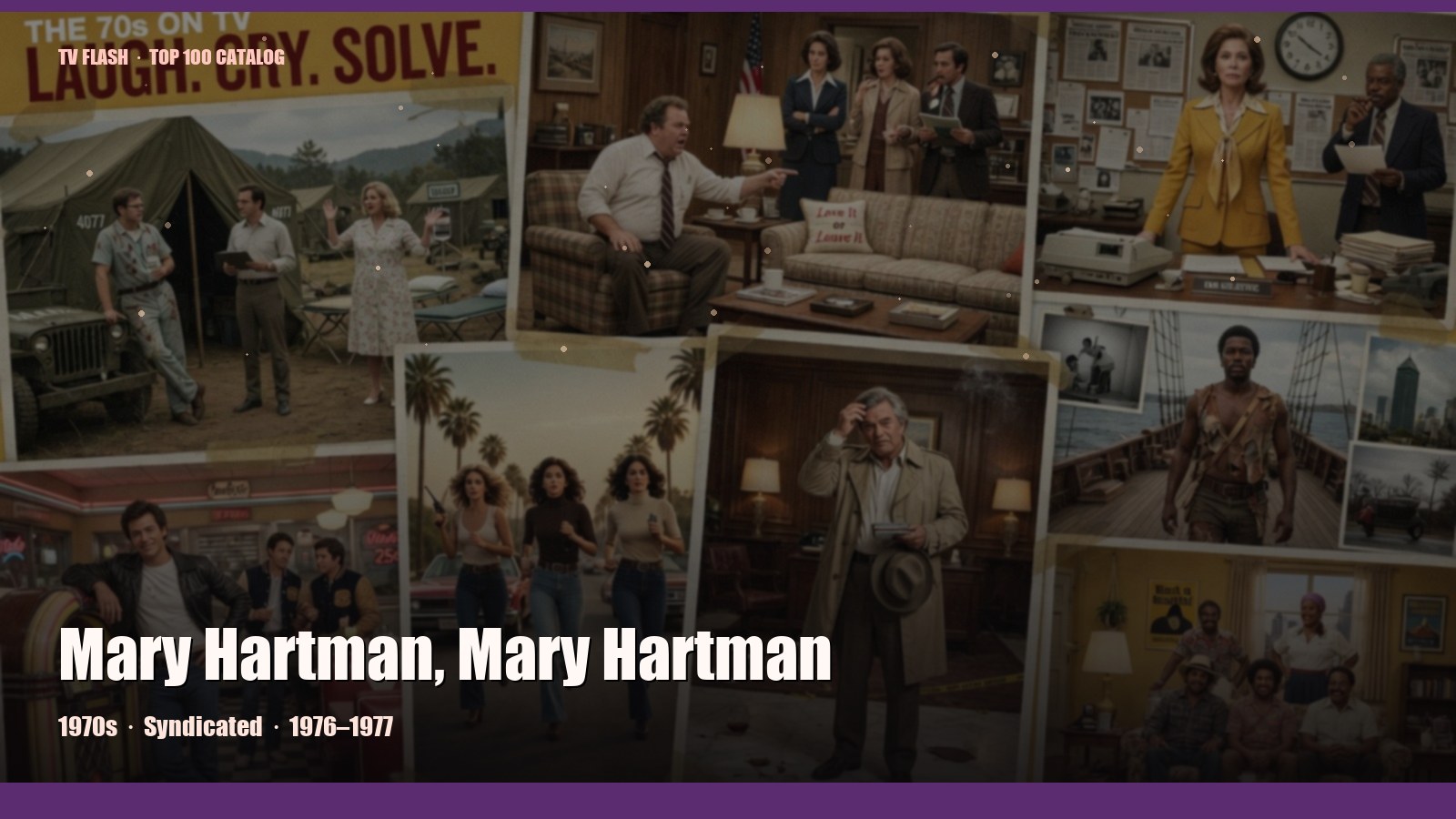
Mary Hartman, Mary Hartman
Consumer angst as serial — waxy yellow buildup and mass-murder next door.
Consumer angst as serial — waxy yellow buildup and mass-murder next door.
Norman Lear's nightly satire soap; experimental TV that became a watercooler freakout.
Why it matters
From the desk
The stare arrives before the news. Syndicated weeknights, 1976–1977: Louise Lasser's Ohio housewife faces a surreal soap-opera America of product anxiety, TV violence, and neighborhood catastrophe — five nights a week, not a traditional network sitcom slot. Mary Hartman, Mary Hartman, from Gail Parent, Ann Marcus, Jerry Adelman, Daniel Gregory Browne, and Norman Lear. Greg Mullavey, Mary Kay Place's Loretta Haggers, Graham Jarvis, Dody Goodman filling Fernwood. *Waxy yellow buildup as a silhouette, kitchen light as a press strategy, a nervous-breakdown performance as the whole look.* Style is the plot. Repeat the name: that is the liturgy and the joke.
**This was not a soft launch of a once-a-week sitcom; this was a hard launch in kitchen cloth.** Three hundred twenty-five hours, two seasons, nightly serial manners with consumer dread as the plot. Experimental TV that became a watercooler freakout and somehow aired right after the news. The experiment overheated; Fernwood 2 Night / Forever Fernwood followed as afterlife. Tessa's tags will want the freakout as stan lore. Fine. The stare came first. Lasser looking down the aisle is the show. Image management as a housewife who cannot manage the products.
Look board for a Fernwood night: yellow buildup as the accessory that will not leave; mass-murder-next-door as a neighboring palette; consumer packaging as costume; a kitchen that photographs as a crime scene; a name said twice like a logo. Episode 001 opens the stare. Episode 109 is a first-year weekday stake. Episode 131 is the second-cycle door. Episode 217 is a late-run public milestone in a 325-hour sprint. Episode 325 is the last filing. One vulnerable note: wearing that much dread five nights a week is labor. The kitchen has to do the emotional work the news will not.
The timeline will call the experiment mid because it overheated. That is not the craft of the look failing; that is the point. Watch it as satire soap, not as a sitcom you can sample on Thursdays. See you at the after-party, which in this case is a fake town with real dread. Or at the airport: the second look is the same stare, worse lighting, the real story in how a household name got said twice until the machine stopped. Nervous-breakdown television. The cloth never came clean.
Episode guide
TV Flash files Mary Hartman, Mary Hartman (1976–1977) on Syndicated as the episode guide: 325 listed hours across 2 seasons, 1976-01-05–1977-07-01 from “Episode 001” (S01E01) to “Episode 325” (S02E195).
Open the episode guide · S01E01 Episode 001 · S02E195 Episode 325
Fernwood nightly: Lasser, waxy yellow buildup, consumer dread, Lear's satire soap until the experiment overheated. Filed by Lana Reyes (Red Carpet Reality).
Episode 001 opens the Fernwood housewife stare. Lasser versus waxy yellow buildup and consumer dread: Lear's satire soap, five nights a week, nervous-breakdown performance as experimental television.
Episode 109 is a first-year weekday stake. Nightly serial density: mass-murder-next-door weather already the joke, the experiment still on the air, the housewife still staring down the aisle.
Episode 131 is the second-cycle door. Five-a-week satire still overheating on purpose: Fernwood as a fake town with real dread, Lasser still the instrument the form was built around.
Episode 217 is a late-run public milestone in a 325-hour sprint. Tiny-pack rule: every listed hour counts. The experiment still nightly, still too much, still the point.
Episode 325 is the last filing. Lear's satire soap until it overheated: five nights a week, then silence. Nervous-breakdown television that somehow became a household name twice.
Ohio housewife Mary Hartman navigates a surreal soap-opera America of product anxiety, TV violence, and neighborhood catastrophe — five nights a week. Mary Hartman, Mary Hartman (1976–1977), from Gail Parent, Ann Marcus, Jerry Adelman, Daniel Gregory Browne, and Norman Lear, was syndicated weeknights rather than a traditional network sitcom slot. Louise Lasser's nervous-breakdown performance became the brand; Greg Mullavey, Mary Kay Place's Loretta Haggers, Graham Jarvis, and Dody Goodman filled Fernwood. Waxy yellow buildup, mass murder next door, consumer dread. Experimental TV that became a watercooler freakout — satire soap that somehow aired right after the news.
Louise Lasser's Fernwood housewife stares down waxy yellow buildup, mass murder next door, and consumer dread as a nightly serial. Norman Lear's satire soap, five nights a week, until the experiment overheated. Nervous-breakdown performance as experimental television that somehow aired right after the news.
Mary Hartman, Mary Hartman was Lear's nightly satire soap: experimental TV that became a watercooler freakout. Syndicated weeknights, not a once-a-week sitcom slot, it made consumer angst a serial and Lasser's breakdown the brand. The experiment overheated; Fernwood 2 Night / Forever Fernwood followed as afterlife. Cult classic of 1970s experimental mainstream television.
Gail Parent · Ann Marcus · Jerry Adelman · Daniel Gregory Browne · Norman Lear
No. Syndicated weeknights, satire soap, five nights a week. Serial manners — consumer dread and neighborhood catastrophe as the diet.
No. This is Lear's nightly experiment, not Archie's living room. Fernwood is its own watercooler freakout.
Afterlife spin, after the experiment overheated. Start with Lasser's Mary Hartman; the talk-show cousin is extra.
Both, on purpose. Nervous-breakdown performance as experimental television — waxy yellow buildup included.
External sites for further reading — TV Flash is not affiliated with these networks or studios.
Also on the dial