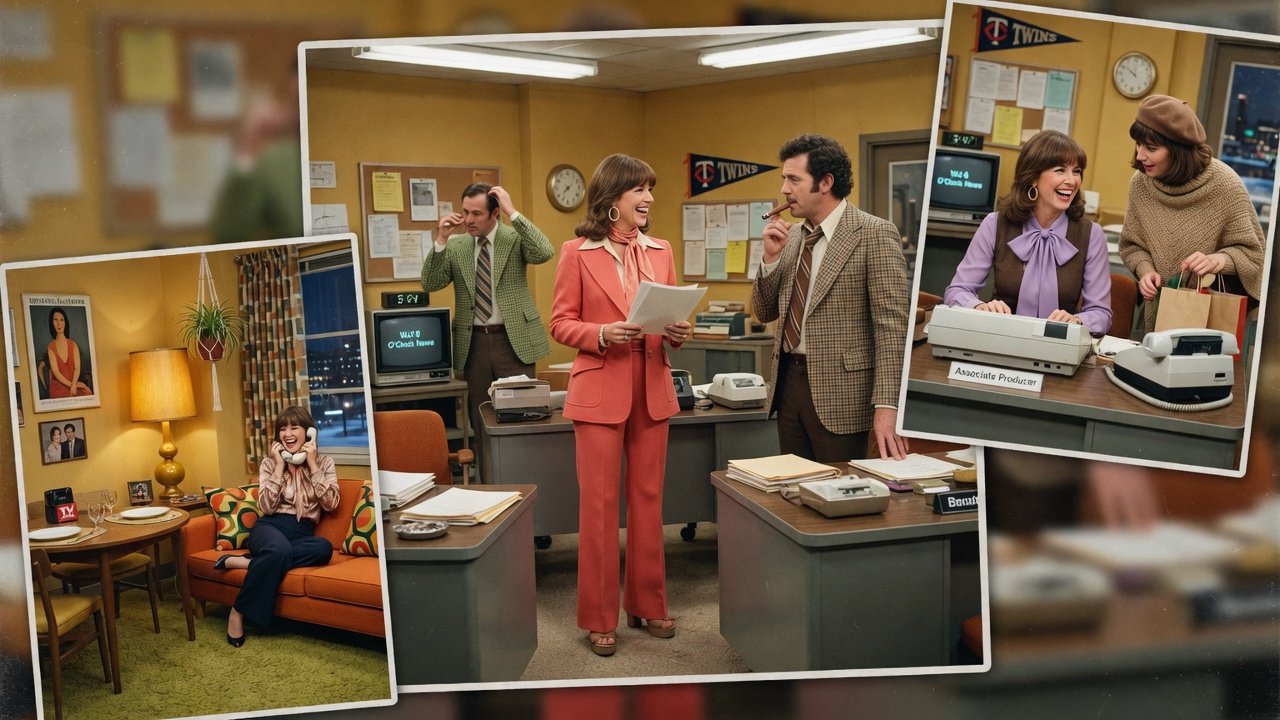
Workplace family sitcom perfected; feminist milestone without a lecture.
Why it matters
From the desk
The Hat Toss Was a Hard Launch
Minneapolis as a fitting room for a new kind of leading lady: newsroom wool, a smile that could file a union grievance, and the most elegant ensemble sitcom American television ever dressed.
The first image is not a joke. It is a woman in a coat, a city that photographs cold, and a hat that leaves her hand as if it had a publicist. Love is All Around does not announce a feminist lecture. It announces a silhouette: Mary Richards as single working woman in a market that still wanted her married by the first commercial. The beret in the air is not cute. It is a premiere look that the rerun still steals. Style is the plot. The newsroom is the closet she will live in for seven seasons.
James L. Brooks and Allan Burns built a workplace family that dressed like adults. Ed Asner's Lou Grant is rumpled authority — the unpressed jacket as character, not costume-shop laziness. Valerie Harper's Rhoda is the friend whose mouth is a second wardrobe. Ted Knight's Ted Baxter is local-TV vanity in a too-perfect blazer, the anchorman as a mannequin who learned to talk. Betty White's Sue Ann arrives later like a hostess cart with knives. Cloris Leachman's Phyllis is a coat that never quite buttons. The ensemble is a look board: textures, status, who gets the close-up when the joke is about loneliness.
This was not a soft launch. It was a hard launch in knitwear. CBS had spent the 1960s watching Mary Tyler Moore play wife on The Dick Van Dyke Show; the 1970s ask was whether that same face could hold a show without a husband as gravity. The answer is in the blocking. Mary is often framed slightly too small for the room, then she takes the room anyway. Today I Am a Ma'am is the title as a clothing tag: how the world addresses you when you have a job and no ring. Support Your Local Mother is the family that still thinks it owns the hemline. The series is generous about beauty and ruthless about the performance of being fine.
Chuckles Bites the Dust is the hour everyone cites, and they should. A funeral that becomes a laugh is not a stunt; it is the show's argument about professionalism as a kind of outfit you cannot take off. The Lars Affair introduces Sue Ann by letting desire walk into the newsroom in a smile that is also a weapon. Put on a Happy Face treats the on-air mask as labor. None of this requires a stan war to be interesting, though the timeline would now litigate who was the real star. Rhoda got the spinoff. Lou got the drama. Mary kept the newsroom. That is image management as industrial fact.
Look board for WJM, not a table of contents: camera-first color in a beige market; one headline accessory (the hat, the M, the smile that is also a wince); seam honesty — if Mary cries, the mascara has to survive the next setup; period or now, pick one — the show chose 1970s working-woman polish and stuck to it; shoe reality — she still has to walk home to that apartment. One vulnerable note: the performance of competence is exhausting. The series knows it. The last image is a group hug in a newsroom that is about to be unemployed. The Last Show does not restyle the company for a victory lap. It lets the cloth wrinkle.
Tessa can have the tags. The gown I want is the one that made a single woman in Minneapolis look like the future without a manifesto on the card. Start at the hat toss. Stay for the funeral laugh. End when they turn out the lights and the silhouette has nowhere left to hide. See you at the after-party — which, for this catalog, is Rhoda, Phyllis, and a generation of workplace comedies still stealing the wool.
Episode guide
How this series is filed
TV Flash files The Mary Tyler Moore Show (1970–1977) on CBS as the episode guide: 168 listed hours across 7 seasons, 1970-09-19–1977-03-19 from “Love is All Around” (S01E01) to “The Last Show” (S07E24).
Open the episode guide · S01E01 Love is All Around · S07E24 The Last Show
Essential episodes
Five looks — first image, newsroom manners, desire, the funeral laugh, the last hug. Filed by Lana Reyes (Red Carpet Reality).
- S01E01 Love is All Around
The hat as premiere thesis. A leading lady launched without a husband as gravity.
- S01E02 Today I Am a Ma'am
The clothing tag as plot: how the world addresses a woman with a job and no ring.
- S04E01 The Lars Affair
Sue Ann walks in. Desire as a smile that is also a weapon — the ensemble's missing texture arrives.
- S06E07 Chuckles Bites the Dust
Professionalism as an outfit you cannot take off. The funeral laugh that still photographs as craft, not a clip.
- S07E24 The Last Show
The last silhouette. A group hug in a newsroom about to go dark — no restyle, no sequel bait in the wool.
At a glance
Mary Richards builds a life and career in a Minneapolis TV newsroom while friends become chosen family. Workplace sitcom craft meets a single working woman who doesn’t need a husband to end the episode. Laughs without a lecture.
Network & studio
- CBS — broadcast network
- MTM Enterprises — production studio
Why watch now
For the silhouette: a single working woman in newsroom wool who made competence look like glamour, an ensemble that dressed like adults, and a hat toss that is still the hardest launch in sitcom photography.
Cultural impact
Mary Tyler Moore made the newsroom a second home for America and proved a woman could anchor a hit without domestic submission. Spinoffs and influence radiated for decades.
Creators
James L. Brooks · Allan Burns
Key cast
- Mary Tyler Moore as Mary Richards
- Ed Asner as Lou Grant
- Valerie Harper as Rhoda Morgenstern
- Ted Knight as Ted Baxter
- Betty White as Sue Ann Nivens
Flash facts
- CBS sitcom created by James L. Brooks and Allan Burns; aired September 19, 1970–March 19, 1977 (7 seasons, 168 episodes).
- Mary Tyler Moore plays single TV news associate producer Mary Richards at WJM in Minneapolis.
- Produced by MTM Enterprises; spun off Rhoda, Phyllis, and Lou Grant.
FAQ
Where should I start?
Love is All Around. The hat, the job interview, and the newsroom manners are the whole silhouette. If you only have two hours, add Chuckles Bites the Dust.
Is it a feminist lecture or a workplace sitcom?
A workplace sitcom that happens to be a feminist fact. Mary Richards is allowed to be lonely, ambitious, and funny in the same outfit. The lecture is in the blocking, not a speech.
What can I skip?
You can sample after Rhoda and Phyllis spin off; the newsroom still holds. Skip nothing in season six if you want the series at full craft. The late party hours are optional champagne.
Is the finale worth it?
Yes. The Last Show is a group hug that refuses a restyle. It is the rare sitcom goodbye that looks like people losing a job, not a brand extension.
Do I need Rhoda or Lou Grant first?
No. Those are after-parties. This is the fitting. Watch Mary, then follow the coat you like.
Cultural eras
Official & further reading
External sites for further reading — TV Flash is not affiliated with these networks or studios.
Back to the decade
Also on the dial
More after The Mary Tyler Moore Show
- Related showThe Paper ChaseLaw school as blood sport — Professor Kingsfield terrifies a generation of pre-law kids.
- Related showThe Sonny & Cher Comedy HourI got you babe — marital sparring as variety gold before the divorce plot twist.
- Related showThe Young and the RestlessGenoa City boardrooms and bedrooms — youth, wealth, and that theme song.
- Related showHee HawCornfield vaudeville — country music, cornball sketches, and rural syndication power.
- Related showMatch GameBlank the blank — celebrity panel innuendo as daytime sport.
- Related showThe White ShadowWhite coach, mostly Black high-school team — gym class as social drama.