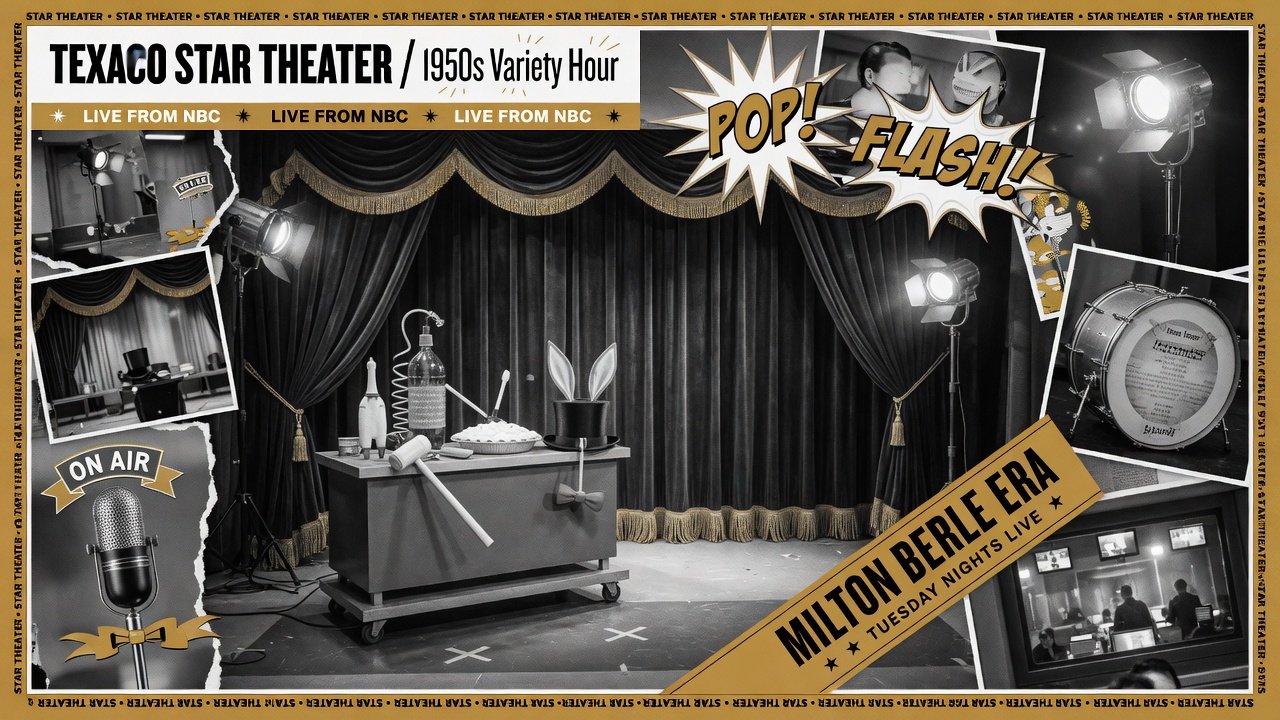
Mr. Television sold sets as much as jokes; variety's first true national addiction.
Why it matters
From the desk
Why Texaco Star Theater still plays
The first thing you see is the trunk. Not a desk, not a tag, not whatever the timeline decided was mid: Milton Berle walking a costume change into a living room that had just bought its first set. *Texaco Star Theater* (later *The Milton Berle Show*) on NBC, 1948 to 1956, eight seasons and 247 episodes of guest-stack variety, drag-costume chaos, and an iron-willed silhouette that treated Tuesday as private property. Uncle Miltie didn't host a night. He dressed it.
The numbers still look like a typesetting error: a reported **61.6 Nielsen** for 1950–51, restaurants emptying, Detroit lore about water pressure dropping after sign-off as viewers flushed en masse. The look sold the boxes. Costume mania was image management before the phrase had a publicist. Berle became Mr. Television, the first true national TV superstar, trunk and all — variety's first national addiction, credited with driving mass set purchases as hard as jokes.
Look board, if we must: sequins under kinescope gray; a dress that was the gag and the brand; a sidekick lane for Arnold Stang; sponsor chrome that later got sanded into a host's own title. The 1948 opener is the listed hour when that trunk walks in. The 1950 season ignition is peak Tuesday monopoly, restaurants emptying, the host still treating the night as private property. Mid-decade, under the Texaco banner, guest-stack variety continues after the first ratings fever has already minted the title.
By the later-season open the monopoly is cracking, the ego still in the trunk, variety-as-addiction looking for a new sponsor look. The 1956 sign-off is the cautionary closer of a host who owned a night, then watched the suite get rented out. Every later variety king still rents a room in that ego suite. The timeline can argue about camp; the silhouette already won.
See you at the after-party, which in 1950 was a dark restaurant and a city water tank. Berle's cautionary legend is not a stan war. It is a wardrobe that sold a medium, then couldn't stop performing ownership. The second look — the rebrand as *The Milton Berle Show* — told the real story: the night was never bigger than the dress, until it was.
Episode guide
How this series is filed
TV Flash files Texaco Star Theater (1948–1956) on NBC as the episode guide: 247 listed hours across 8 seasons, 1948-09-07–1956-06-05 from “Episode 1” (S01E01) to “Episode 13” (S08E13).
Open the episode guide · S01E01 Episode 1 · S08E13 Episode 13
Essential episodes
Uncle Miltie owning Tuesday — costume mania, set-selling ratings, variety as national addiction. Filed by Lana Reyes (Red Carpet Reality).
- S01E01 Episode 1
1948 opener: Berle's costume trunk walks into living rooms and starts selling television sets as hard as jokes.
- S03E01 Episode 1
1950 season ignition — peak Tuesday monopoly, restaurants emptying, the host still treating the night as private property.
- S05E01 Episode 1
Mid-decade restart under the Texaco banner: guest-stack variety after the first ratings fever had already minted Mr. Television.
- S06E01 Episode 1
Later-season open: the monopoly cracking, the ego still in the trunk, variety-as-addiction looking for a new sponsor look.
- S08E13 Episode 13
1956 sign-off — the cautionary closer of a host who owned a night, then watched the suite get rented out.
At a glance
Milton Berle didn't just host Tuesday night — he weaponized vaudeville for a country buying its first television sets. Texaco Star Theater (later The Milton Berle Show) stacked guest acts, drag-costume chaos, and Berle's iron-willed schtick into ratings that still look like typos. In the 1950–51 season the show posted a staggering 61.6 rating, the kind of number that emptied restaurants and, in Detroit lore, dropped water pressure when everyone flushed after sign-off. Uncle Miltie became Mr. Television: the first true national TV superstar, costume trunk and all. By mid-decade the monopoly cracked, but the brand of variety-as-addiction never left the medium.
Network & studio
- NBC — broadcast network
Why watch now
Texaco Star Theater made Milton Berle Mr. Television: costume mania, Tuesday-night monopoly, and ratings so huge cities emptied restaurants. Watch it now as variety's first national addiction — the show credited with selling sets as hard as jokes, and the cautionary ego of a host who owned a night.
Cultural impact
Texaco Star Theater is widely credited with driving mass TV-set purchases in the late 1940s and early 1950s. Berle proved a single host could own a night and a generation's idea of stardom. Every later variety king still rents a room in Uncle Miltie's ego suite.
Creators
Milton Berle
Key cast
- Milton Berle as Host
- Arnold Stang as Sidekick / regular
Flash facts
- NBC comedy-variety series; Milton Berle hosted from 1948 to 1956.
- Top-rated U.S. show of the 1950–51 season with a reported 61.6 Nielsen rating.
- Credited with boosting national television-set sales during TV's early boom years.
- Detroit folklore claimed reservoir/water-pressure drops after the show signed off as viewers flushed en masse.
- Later rebranded simply as The Milton Berle Show as sponsorship and format shifted.
FAQ
Where should I start?
Start with Berle in full costume-mania mode from the peak Tuesday-night years, when guest-stack variety and drag bits were the national habit.
What can I skip?
Skip hunting a complete 1948–56 log. Titles shift toward The Milton Berle Show as sponsorship changes; sample the monopoly years, not every later week.
Is it still worth it?
Yes, as the origin of appointment addiction. The ratings still explain why early Nielsen charts looked like a monopoly board.
Variety hour or stand-up special?
Comedy-variety: a host-owned night of vaudeville, costumes, and stacked guest acts, not a single stand-up set.
Official & further reading
External sites for further reading — TV Flash is not affiliated with these networks or studios.
Back to the decade
Also on the dial
More after Texaco Star Theater
- Related showMeet the PressThe longest-running show in television history — Sunday panel combat as civic ritual.
- Related showThe Ernie Kovacs ShowVisual gags, blackouts, and Nairobi Trio — the medium inventing itself for laughs.
- Related showM SquadLee Marvin's hard cop in a hard Chicago — noir procedural with a jazz bite.
- Related showKukla, Fran and OllieAd-lib puppets and Fran Allison — gentle absurdity that adults watched without irony.
- Related showSky KingArizona rancher with a Cessna — aviation adventure for kids who wanted wings.
- Related showBat MastersonDerby hat, gold-tipped cane — Gene Barry's dandy lawman who fought with style.