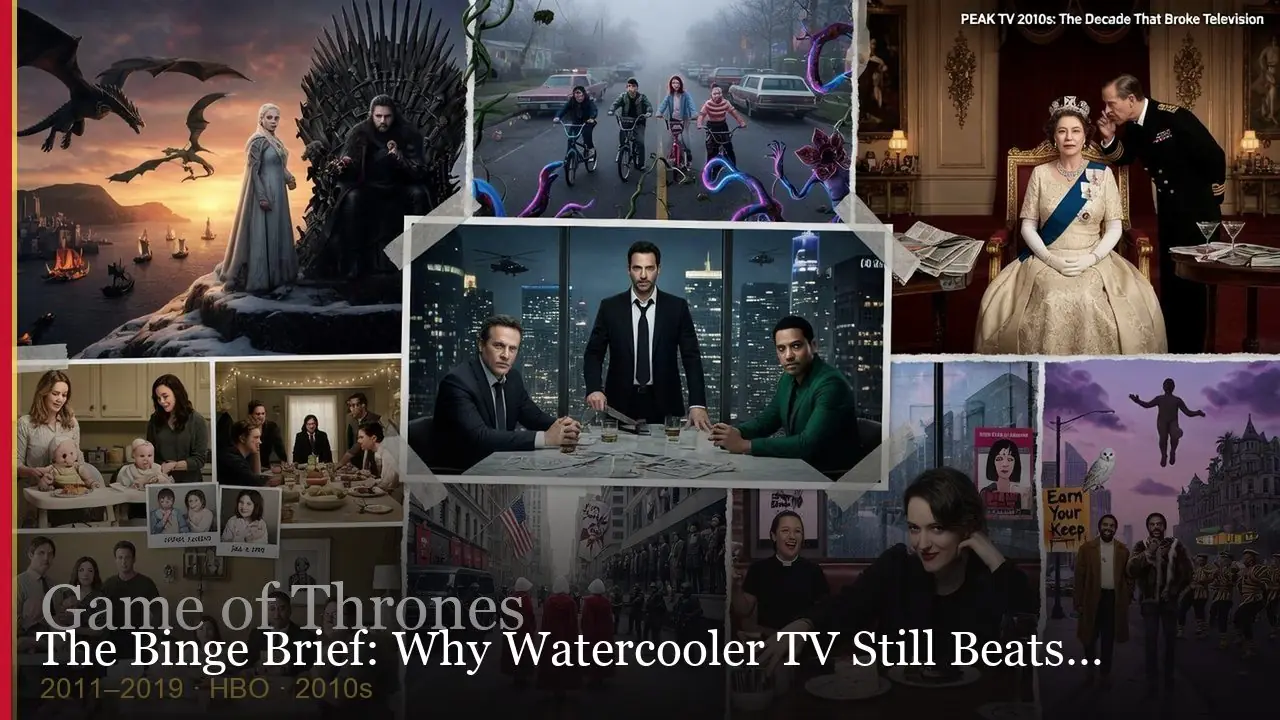
The cut still matters more than the carpet. Event television — the kind that asks a country, or at least a group chat, to show up in the same week — keeps winning the only argument that outlasts a trending topic: did we experience this together, and did the work reward the appointment? Infinite inventory offers convenience and miracles of access. It rarely offers a public square. Watercooler TV, even in diluted modern form, still shapes memory, craft conversation, and the awkward truth that scandal without a shared text is just noise.
What does “watercooler” mean when nobody shares an office?
It means synchronized attention. Not necessarily a single live airtime — Game of Thrones proved Sunday-night appointment culture could survive the DVR and the illegal stream — but a cultural clock. People enter the same narrative weather system while the weather is still moving. The office cooler was always a metaphor; the function was collective interpretation under a deadline. Miss the episode and you missed the language of Monday.
Streaming’s catalog model optimizes for isolation done pleasantly: start when you want, pause forever, finish in a week no one else shares. That can be ideal for certain novels of the screen — slow burns that need privacy. It is weaker at producing the second text of television: argument. The best seasons of the century did not only perform; they provoked structured disagreement about theme, performance, and ending. Gossip arrived, as it always does, but as context. The tabloids will say the finale broke the internet; the cut says whether the finale broke the show’s own logic.
People who treat television purely as a crime blotter miss that it is also literature with better lighting. The heat is real. It should not own the lede when the question is quality.
Why doesn’t infinite inventory create infinite conversation?
Because conversation needs scarcity or simultaneity. When everything is available, nothing is urgent, and urgency is the social accelerant of criticism outside the academy. A drop of eight episodes can still create a weekend of shared language — if the platform and the audience agree to behave as if the weekend matters. Many do not. The algorithm renames the show by Tuesday. The discourse migrates to the next tile.
Craft is what remains when the spike cools. Consider what event TV still does better on average:
- Episode shape as public unit — a weekly chapter teaches audiences to talk about structure, not only vibes.
- Performance under scrutiny — actors live with a role long enough for the culture to watch growth or collapse.
- Ending as civic event — shared finales, for better or worse, become reference points; private binges rarely do.
None of this requires pretending linear networks were a moral paradise. It requires admitting that The Sopranos on Sunday and a prestige drop buried under three other prestige drops are different social objects even when both are excellent. One invites a room; the other invites a queue.
I will grant the other desk its fireworks: leaks, soft launches, chart drama. They sell. They sometimes even illuminate power. They are footnotes when the season is arguing with itself about inheritance, faith, violence, or love — and they become the whole book only when the work was empty enough to need them.
Is binge culture the enemy of serious TV?
No. Binge is a distribution mode, not a sin. Some series are built as novels; reading them in two nights can be faithful. The problem is industrial: when every show is pressured to be both endless engagement bait and complete-on-drop product, form blurs. The watercooler returns whenever a title reintroduces a clock — weekly releases, theatrical-style premieres, short-season events. Audiences keep proving they will gather. The industry keeps acting surprised.
Verdict: event television still wins the long game of cultural memory. Infinite inventory wins the afternoon. Both can host masterpieces. Only one reliably produces a public capable of talking about craft before it talks about the leak. That the scandal often outlives the craft is, unfortunately, also part of television history — which is why the critic’s job is to keep putting the work first, even when the room prefers the lobby fire.
FAQ
What is watercooler television?
Watercooler TV refers to shows that generate widespread, near-simultaneous conversation — traditionally the day after broadcast — so audiences share references, arguments, and reactions while the episode is still culturally “live.”
Does streaming kill watercooler moments?
Not automatically. Global hits with weekly drops or strong premiere events still create shared discourse. Pure catalog dumps more often fragment conversation across weeks and social circles, weakening a single public argument.
Is event TV better quality than bingeable catalog shows?
Not by default. Release strategy is not quality. Event framing can elevate attention to craft; binge framing can suit dense, novelistic series. The critical question remains what the text does — structure, performance, theme — not only how it was scheduled.