Prequel craft ceiling raised permanently.
Why it matters
From the desk
A Prequel That Argued Like a Novel
Vince Gilligan and Peter Gould's Albuquerque coda as moral architecture: color, silence, Kim Wexler, and a closer that keeps the promises Breaking Bad spent.
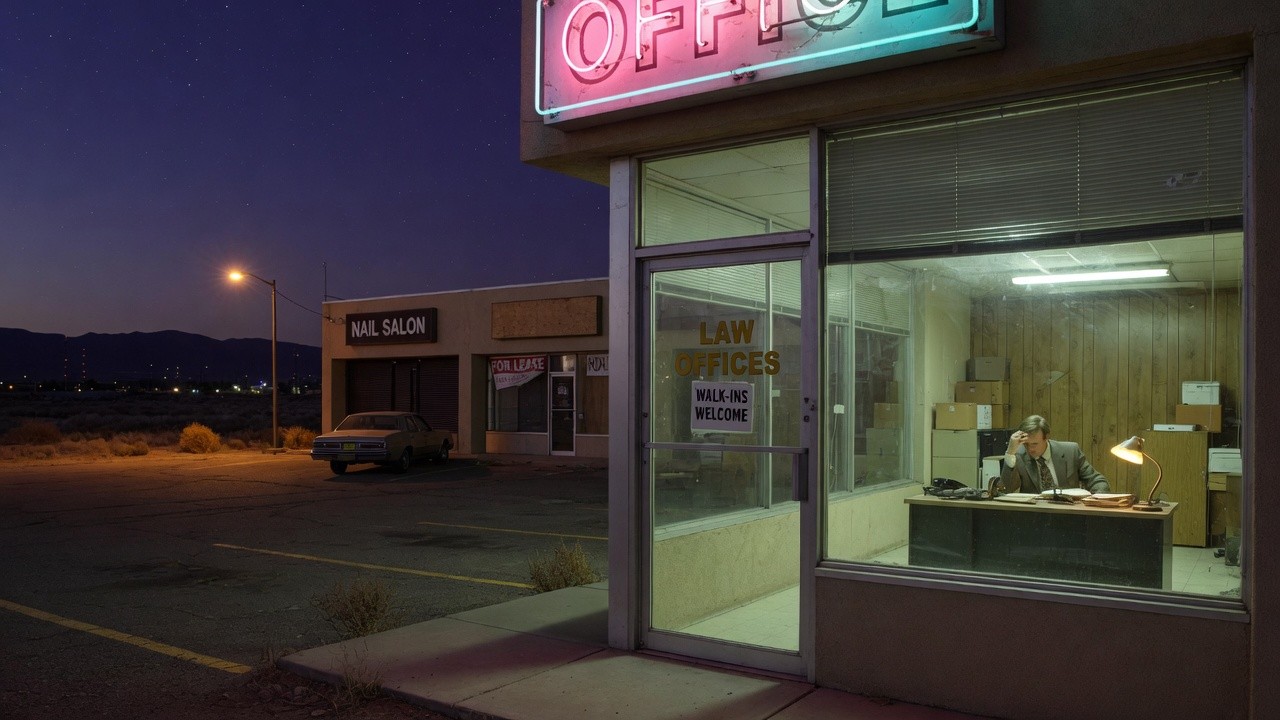
Watch the silence after a con. Not the punchline — the parking lot, the overhead, the man who has already started telling himself a story about why this was technically fine. Better Call Saul is a prequel in the way a moral is a prequel to a crime: you already know the destination, so the show is free to care about the walk. Bob Odenkirk's Jimmy McGill does not enter as a bit. He enters as a man whose hustle still thinks it is charm. The series has six seasons to explain, without shouting, how charm becomes a brand and a brand becomes a cell.
People came for Easter eggs. The text offered patience. Gilligan and Gould, with a camera that loves empty space, built the rare spinoff that is more interested in ethics than in cameos. Mike's hours are procedural grief. Nacho's hours are a vice tightening. Chuck is the brother as institution. Kim Wexler — Rhea Seehorn, giving one of the decade's great television performances — is the argument. Not the girlfriend. The argument. What does a competent, decent-seeming person owe a charming disaster, and at what point is competence complicity? If you are here only to watch the cartel do cartels, you will still be fed. You will also have missed the novel.
What the seasons are arguing, in short: that small cons train large ones; that the law is a costume you can wear until it fits like a joke; that color can tell the truth a scene is lying about; that the funniest man in the room is not safe. Five-O is Mike's ethics in a bottle. Chicanery is a courtroom hour that understands humiliation as craft. Bagman is the desert as a moral climate. Plan and Execution is structure as trap. None of those require a recap blog. They require you to sit still, which is apparently the controversial part.
The comparison sport with Breaking Bad is perpetual and mostly a category error. The first show is combustion. This one is rust. Both are about men who pick a story and then have to live in the wreckage. Saul is louder, Gene is greyer, Jimmy is the person those names are trying not to be. The black-and-white stretches are not a gimmick; they are a tense. Gossip, as a footnote: the internet wanted more Salamanca fireworks every week, and the cut kept giving them a man in a Cinnabon instead. The tabloids will call that slow. The cut is the point. Prestige gossip treats patience like a snub. Sometimes patience is the art.
It ended. Saul Gone, August 2022, is a closer that argues with the louder show's ending rather than begging a sequel. You can prefer the explosions. You cannot say this one failed to finish the sentence. In a decade of prequels that exist to keep IP warm, this is the counter-exhibit: a second series that is often the better-argued object. That is not a dunk on Walter White. It is a note about what happens when the follow-up is allowed to be quieter, longer, and less interested in your dopamine.
Verdict: watch it if you like character as architecture and framing as ethics. Do not watch it as a clip show for the other title. Start at Uno, stay through the desert, let Kim wreck you, and accept that the funny parts are not relief. They are evidence. The scandal of a great prequel is that it makes the original look like a first draft of a moral. The original remains a masterpiece. This one is the brief. Closed.
Episode guide
How this series is filed
TV Flash files Better Call Saul (2015–2022) on AMC as the episode guide: 63 listed hours across 6 seasons, 2015-02-08–2022-08-15 from “Uno” (S01E01) to “Saul Gone” (S06E13).
Essential episodes
Ethics hours — the ones that teach the con as architecture, not as a clip. Filed by Julian Hart (The Binge Brief).
- S01E01 Uno
The small con as thesis. Color, hustle, and a destination you may already know and still have to earn.
- S01E06 Five-O
Mike in a bottle. Grief and procedure without a shootout to hide in.
- S03E05 Chicanery
Courtroom craft as character assassination — humiliation staged like a clock.
- S05E08 Bagman
The desert as climate. A mid-series hour that makes geography do the ethics.
- S06E07 Plan and Execution
Structure as a trap. Late-run plotting that still refuses to become a montage.
At a glance
Jimmy McGill’s transformation into Saul Goodman unfolds as neo-noir legal tragedy with Kim Wexler as moral co-pilot. Quieter than Breaking Bad, often sharper. Cartel threads and moral corners tighten season by season.
Network & studio
- AMC — cable network
Why watch now
Watch it for the walk, not the Easter eggs: a hustler becoming a brand, Kim Wexler as the moral engine, and framing so patient it makes combustion look easy. The rare prequel that is a better argument than a warmer catalog title.
Cultural impact
Better Call Saul permanently raised prequel expectations and made “is it better than Breaking Bad?” a perpetual sport. Rhea Seehorn’s case for greatness is fandom law.
Creators
Vince Gilligan · Peter Gould
Key cast
- Bob Odenkirk as Jimmy McGill / Saul Goodman
- Rhea Seehorn as Kim Wexler
- Jonathan Banks as Mike Ehrmantraut
- Giancarlo Esposito as Gus Fring
- Michael McKean as Chuck McGill
- Patrick Fabian as Howard Hamlin
- Tony Dalton as Lalo Salamanca
- Michael Mando as Nacho Varga
Flash facts
- AMC neo-noir legal crime drama; Breaking Bad spin-off/prequel with epilogue threads (2015–2022).
- 6 seasons, 63 episodes created by Vince Gilligan and Peter Gould.
- Widely argued to match or surpass Breaking Bad in craft, patience, and tragic inevitability.
- Rhea Seehorn's Kim Wexler became one of prestige TV's definitive original characters.
- Visual style — negative space, desert geometry, silent moral pivots — set a high bar for cable drama.
FAQ
Do I have to watch Breaking Bad first?
Recommended, not required. Knowing the destination changes the irony. Starting here is legal; you will just meet some names as strangers that the other show treated as weather.
Why is the first season so quiet?
Because the con is still small. If you need the desert in episode two, you wanted the other Albuquerque. The quiet is the training. Skip it and the later hours have no floor.
What can I skip?
Not Kim's hours. Not the season-six back half. Side texture exists; the spine is Jimmy, Kim, Chuck, Mike, Nacho. If you fast-forward the parking lots, you are fast-forwarding the thesis.
Is the ending a cop-out or a close?
A close. Saul Gone finishes the names the man has been wearing. It does not tease a new con as a season seven. That is the craft, not a lack of ideas.
Comedy or crime drama?
Crime drama that can be very funny. The jokes are character, not a laugh track. If you only want bits, you will hit a wall around the point the bits become bills.
Cultural eras
Official & further reading
External sites for further reading — TV Flash is not affiliated with these networks or studios.
Back to the decade
Also on the dial
More after Better Call Saul
- Related showHalt and Catch Fire1980s PC and internet pioneers — ambition, code, and heartbreak in beige boxes.
- Related showThe Walking DeadZombie apocalypse as endless road series — ratings juggernaut with spinoff mitosis.
- Related showMad MenCigarettes, suits, and the American century in a whiskey glass.
- Related showBreaking BadMr. Chips to Scarface — chemistry as destiny.
- Related showInterview with the VampireAnne Rice reborn — toxic immortal marriage with modern bite.