Fantasy sitcom that smuggled social change into a pretty house.
Why it matters
From the desk
A Nose Twitch in Perfect Chiffon
Elizabeth Montgomery's suburban chic as the whole plot — magic smuggled into a pretty house, a recast sold as weather, and eight seasons of look-as-power before the timeline had the word soft launch.
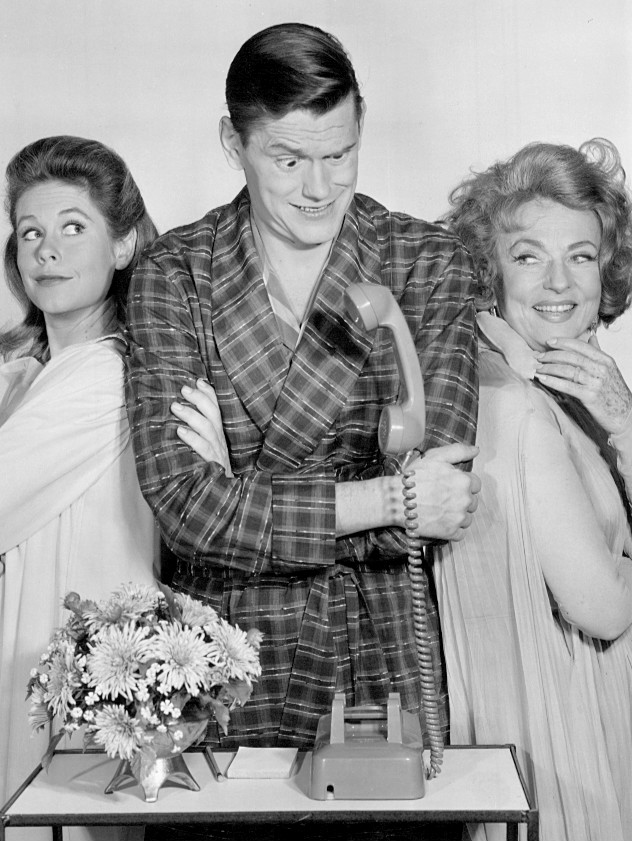
She twitches, and the living room rearranges itself — chiffon still falling, blonde still behaving, the house in Westport already a set decoration for a secret. That is not a special effect. That is a silhouette doing the plot. Bewitched, 1964 on ABC, is glamour as suburban camouflage: Samantha Stephens in perfect hostess clothes, a nose twitch as the only jewelry that matters, and a marriage that keeps asking her to dress like she is not a witch. Style is the argument. If you only track the gags, you are watching half the show.
Elizabeth Montgomery's line is the whole press-tour armor: clean, comic, slightly otherworldly, never sloppy even when the spell misfires. Agnes Moorehead's Endora is the mother as message dress — extra fabric, extra contempt for mortals, a color story that photographs as trouble. The Darrins are the scandal the publicist would have called continuity. Dick York through the first five seasons; Dick Sargent from season six, after York's back could no longer take the fall. This was not a soft launch; this was a hard recast in a gray suit. The audience noticed. The show smiled and kept the twitch. Hollywood still does this. The 1960s just did it without a crisis-comms deck.
Look board for a witch who has to pass at the neighbors': architecture in pastel walls; message color in Samantha's blonde-and-cream versus Endora's jewel tones; fabric that moves when the laugh needs a swirl; one mortal detail — a cocktail, a vacuum, a mother-in-law's hat — so the armor still looks like a sitcom. Seasons one and two arrive in black and white, which makes the chic sharper, the magic cheaper, the house a fashion plate in gray. Color from season three is the streaming-era side quest of its day: more sparkle, more of the same assignment. Virtual carpets did not exist. The living room was the carpet.
The timeline will call a recast mid. I will defend the gown — and the twitch — against that. A look can be both strategy and art. Samantha's power is not the special-effects budget. It is the refusal to let the pretty house win. A Is for Aardvark is the marriage as a closed circuit of want. Nobody's Perfect is the baby as a new silhouette. Divided He Falls is York-era Darrin at full mortal panic. And Something Makes Four is the Sargent-era household expanding, the recast already normalized like a new hemline. Sisters at Heart is the hour that still gets cited when people want the show to have been braver than the network — a Christmas look that is also a civic one. None of that requires a plot sandwich. It requires watching who is allowed to shimmer.
One vulnerable note, then we put the champagne mic back on: eight seasons of pretending your face is ordinary is exhausting. Montgomery did the emotional labor the interview cannot. The Darrin recast remains one of television's most meme'd production scandals because the audience is not stupid about jaws. They clocked the swap the way we clock a missing ring. That is not cruelty. That is visual literacy.
The Truth, Nothing But the Truth, So Help Me Sam closes March 1972 without a national-event bow. Honest finale: the house lights just go down. See you at the after-party, which in this case is syndication, Halloween costumes, and every later witch who stole the twitch. Watch the second look — the airport departure of the franchise, the recast still walking beside her. That frame tells the story the photocall negotiated away.
Episode guide
How this series is filed
TV Flash files Bewitched (1964–1972) on ABC as the episode guide: 254 listed hours across 8 seasons, 1964-09-17–1972-03-25 from “I, Darrin, Take This Witch, Samantha” (S01E01) to “The Truth, Nothing But the Truth, So Help Me Sam” (S08E26).
Open the episode guide · S01E01 I, Darrin, Take This Witch, Samantha · S08E26 The Truth, Nothing But the Truth, So Help Me Sam
Essential episodes
Five hours of shimmer and scandal — the twitch as jewelry, the recast as weather. Filed by Lana Reyes (Red Carpet Reality).
- S01E17 A Is for Aardvark
The marriage as a closed circuit of want. Montgomery's line doing the plot the special effects only underline.
- S02E33 Divided He Falls
York-era Darrin at full mortal panic — the gray suit as a man who cannot keep up with chiffon.
- S03E01 Nobody's Perfect
The baby as a new silhouette. Color-era household expanding without dropping the twitch.
- S06E05 ...And Something Makes Four
Sargent-era expansion: the recast already walking like a new hemline the publicist called continuity.
- S07E13 Sisters at Heart
A Christmas hour still cited when people want the show braver than the network — civic look, not only camp.
At a glance
Witch Samantha Stephens marries mortal Darrin and tries suburban normalcy while magic keeps spilling into dinner parties. Mother Endora’s disapproval is a running supernatural side-eye. Fantasy sitcom smuggles social change into a pretty house.
Network & studio
- ABC — broadcast network
Why watch now
Watch the twitch as a fashion cue: Samantha's suburban chic smuggling power into a pretty house. The recast is the scandal; the look is the argument — magic as silhouette, marriage as costume change, chiffon doing the plot.
Cultural impact
Bewitched made fantasy suburbia a weekly brand and left the Darrin recast as eternal production lore. Nose-twitch magic became a pop-culture hieroglyph.
Creators
Sol Saks
Key cast
- Elizabeth Montgomery as Samantha Stephens
- Dick York as Darrin Stephens
- Dick Sargent as Darrin Stephens
- Agnes Moorehead as Endora
Flash facts
- ABC fantasy sitcom about a witch married to a mortal ad man; aired September 17, 1964–March 25, 1972 (8 seasons, 254 episodes).
- Dick York played Darrin for seasons 1–5; Dick Sargent replaced him for seasons 6–8.
- Produced by Screen Gems; Elizabeth Montgomery starred as Samantha Stephens.
FAQ
Why do Darrin Stephens look different after a certain season?
Dick York played Darrin through season 5. Dick Sargent took over in season 6 after York left because of back injuries. The show did not pause to explain the face. Audiences still notice.
Are the black-and-white seasons worth it if I like the color episodes?
Yes. Seasons 1–2 are sharper chic: less sparkle, more silhouette. Color from season 3 adds production gloss. Same assignment, different lighting.
Do I have to watch eight seasons?
No. The premise is weekly. Sample the York years for the original marriage comedy, then a handful of Sargent-era hours if you want the recast as a viewing experiment.
Is it only camp, or is there a real look to study?
Both. Montgomery's hostess chic, Moorehead's jewel-tone contempt, and the house as camouflage are the fashion text. The camp is the delivery system.
Where should I start?
The pilot, “I, Darrin, Take This Witch, Samantha,” is the contract: twitch, marriage, in-laws. For the look at full boil, jump to “A Is for Aardvark.”
Cultural eras
Official & further reading
External sites for further reading — TV Flash is not affiliated with these networks or studios.
Back to the decade
Also on the dial
More after Bewitched
- Related showThe Green HornetBritt Reid and Kato — martial-arts sidekick energy that made Bruce Lee a U.S. star.
- Related showThe F.B.I.Efrem Zimbalist Jr. vs. the ten most wanted — Bureau procedural as national myth.
- Related showABC's Wide World of SportsThe thrill of victory, the agony of defeat — anthology sports as global window.
- Related showShindig!Prime-time rock variety — go-go dancing and British Invasion heat on ABC.
- Related showF TroopFort Courage farce — cavalry, Hekawi schemes, and slapstick frontier corruption.
- Related showMcHale's NavyPT-73 hijinks — wartime sitcom with Ernest Borgnine's sneaky skipper.