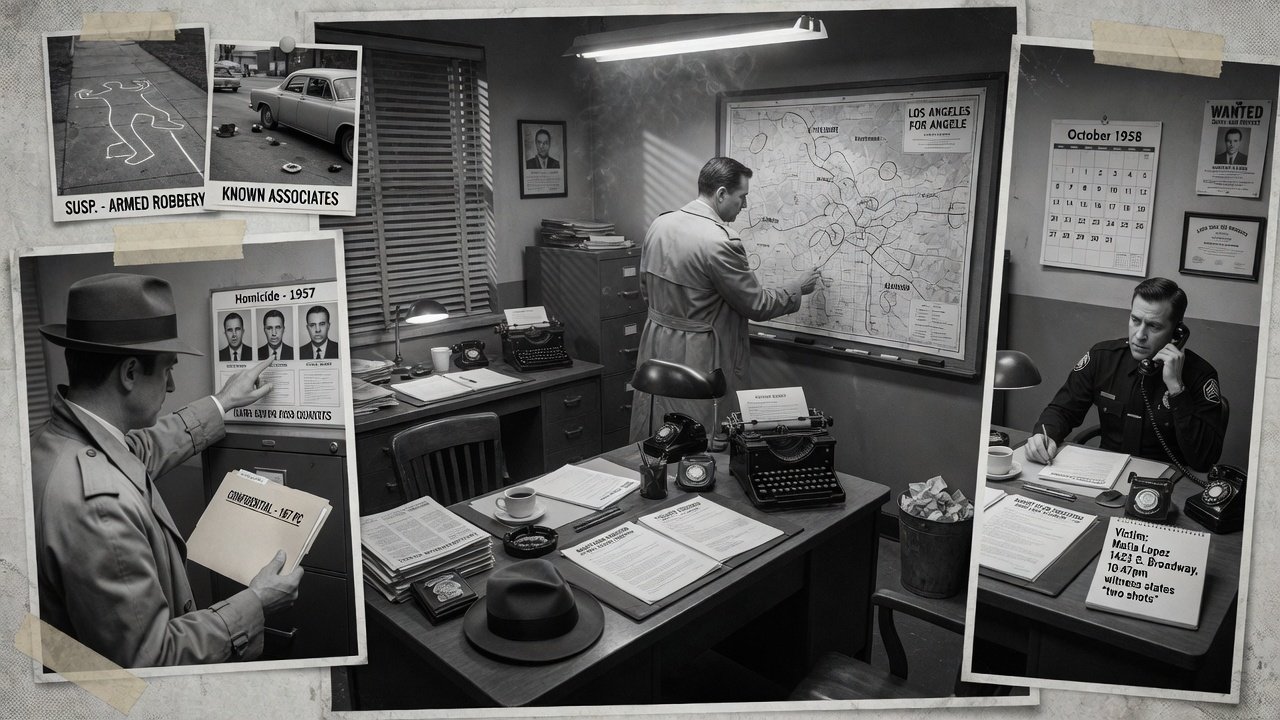
Police procedural grammar starts here; every badge drama owes the cadence.
Why it matters
From the desk
Just the Facts — How a Cadence Became a Badge
Jack Webb’s 1950s machine: clipped narration, dum-da-dum-dum authority, and a Los Angeles that sounded like a report until the report became American slang.
December 1951, NBC: a bomb threat, a sergeant who talks like a filing cabinet, and a country learning that procedure could be entertainment if you said it dry enough. Dragnet did not arrive as cop glamour. It arrived as paperwork with a pulse. Jack Webb had already built the property on radio; television just gave the monotone a crew cut and a city to walk through. The historical claim the room forgets is simple. Every later badge drama that confuses mood with method is still answering this cadence, whether it admits the debt or hides it under neon.
On the palate: linoleum, cigarette haze, and a four-note brand that still means authority in cartoons. Joe Friday wants facts. Frank Smith supplies the human temperature so the audience does not freeze. Cases close because the hour is a report, not because a tortured genius has a feeling in a parking garage. Webb’s production legend is half the mystique — control-freak timing, amateur-hour suspicion of anything that smelled like acting-class sweat. Old-Hollywood dirt is fair game; cruelty is not. The man ran a closed set the way some people run a church. You can taste the discipline in the cuts.
What a network night looked like around this show:
1. Radio grammar surviving the move to cameras — narration as a second cop.
2. A living-room America that liked being talked to as if it were on the jury, not on the ride-along.
3. Christmas hours that became civic ritual, which is how a procedural sneaks into folklore.
Max will sell you a vending machine with a PR department and a tortured antihero. Cute. Webb would have filed the antihero under unprofessional and gone back to the typewriter. Dragnet’s 1951–59 run is the original series, the black-and-white one, before the color revival put Harry Morgan in the passenger seat and a later decade’s anxieties in the case file. Watch this one for the invention of the sound. The human-bomb opener is the thesis in miniature: crisis as procedure. The juvenile-crime hour and the Christmas hours are why people remember a cop show as a kind of public weather. The producer hour is Hollywood looking in a mirror Webb could not resist polishing.
How to watch without the documentary cosplay: it is not a documentary. It is a style. The just-the-facts line became slang because it was a performance of restraint. Later cop shows either keep the restraint (rare) or spend an hour apologizing for the badge while still selling the badge. Both are descendants. You do not need two hundred-plus cases. You need the cadence in your ear, one holiday hour to see how the machine handles sentiment, and the 1959 closer as a last stamp on the original run. The revival is a different filing cabinet.
A toast to the control freak who made America hear a police report as music — and to the partner who had to supply the warmth so the sergeant could remain a filing cabinet. Glory, slightly deflated: the catchphrase outlived the cases, as catchphrases do. Start with the bomb. Stay for the facts. Leave the neon descendants in the lobby until you can hear what they stole.
Episode guide
How this series is filed
TV Flash files Dragnet (1951–1959) on NBC as the episode guide: 276 listed hours across 8 seasons, 1951-12-16–1959-08-23 from “The Human Bomb” (S01E01) to “The Big Red” (S08E39).
Open the episode guide · S01E01 The Human Bomb · S08E39 The Big Red
Essential episodes
Cadence first, then the hours that turned a report into folklore. Filed by Rex Fontaine (Golden Age Dispatch).
- S01E01 The Human Bomb
Crisis as procedure — the thesis in a crew cut.
- S02E04 The Big Seventeen
Juvenile crime as public weather; the badge talking to a living room, not a ride-along.
- S02E07 The Big .22 Rifle for Christmas
A holiday hour that shows how the machine handles sentiment without abandoning the report.
- S03E17 The Big Little Jesus
Christmas as civic ritual — the procedural sneaking into folklore.
- S04E01 The Big Producer
Hollywood in the mirror: Webb polishing the industry that paid for the monotone.
At a glance
Sgt. Joe Friday and partner chase Los Angeles crime with clipped narration, badge authority, and “just the facts” austerity. Cases unfold like official reports with a pulse. Jack Webb’s production style made procedure itself the star.
Network & studio
- NBC — broadcast network
Why watch now
Webb turned a police report into appointment television: clipped narration, a four-note brand, cases that close because the hour is a filing. Watch the 1950s original for the sound every later badge drama still steals — then notice how little sweat the camera required.
Cultural impact
Dragnet turned law enforcement into appointment TV and stamped “just the facts” into American slang. Its minimalism still haunts every cop drama that confuses mood with method.
Creators
Jack Webb
Key cast
- Jack Webb as Sgt. Joe Friday
- Ben Alexander as Officer Frank Smith
- Harry Morgan as Officer Bill Gannon
Flash facts
- Police procedural franchise created by Jack Webb; original TV series on NBC ran 1951–1959 (276 episodes), later syndicated as Badge 714.
- Color revival Dragnet 1967–1970 paired Webb’s Friday with Harry Morgan as Bill Gannon.
- Famous for documentary-style case files and the 'Danger Ahead' theme derived from Walter Schumann’s score.
FAQ
Where should I start?
Start with the 1951 human-bomb opener to get the cadence, then one Christmas hour. The sound is the show; once you hear it, sampling works.
What can I skip?
Skip the idea of watching every Big-titled case in order. The original run is a style engine. Formula weeks exist on purpose; they are not failures of serialization.
Is the 1959 closer worth it?
Yes, as the end of the original black-and-white machine. It is a last stamp, not a universe handoff. The 1967 color revival is a separate filing.
Is this the color revival with Bill Gannon?
No. This pack is the 1951–59 NBC original. Harry Morgan’s Gannon belongs to the later revival, which is its own series in this catalog.
Cop glamour or cop paperwork?
Paperwork with a pulse. The entertainment is procedure, narration, and restraint — not car chases or a tortured genius in a parking garage.
Cultural eras
Official & further reading
External sites for further reading — TV Flash is not affiliated with these networks or studios.
Back to the decade
Also on the dial
More after Dragnet
- Related showMeet the PressThe longest-running show in television history — Sunday panel combat as civic ritual.
- Related showThe Ernie Kovacs ShowVisual gags, blackouts, and Nairobi Trio — the medium inventing itself for laughs.
- Related showM SquadLee Marvin's hard cop in a hard Chicago — noir procedural with a jazz bite.
- Related showKukla, Fran and OllieAd-lib puppets and Fran Allison — gentle absurdity that adults watched without irony.
- Related showSky KingArizona rancher with a Cessna — aviation adventure for kids who wanted wings.
- Related showBat MastersonDerby hat, gold-tipped cane — Gene Barry's dandy lawman who fought with style.