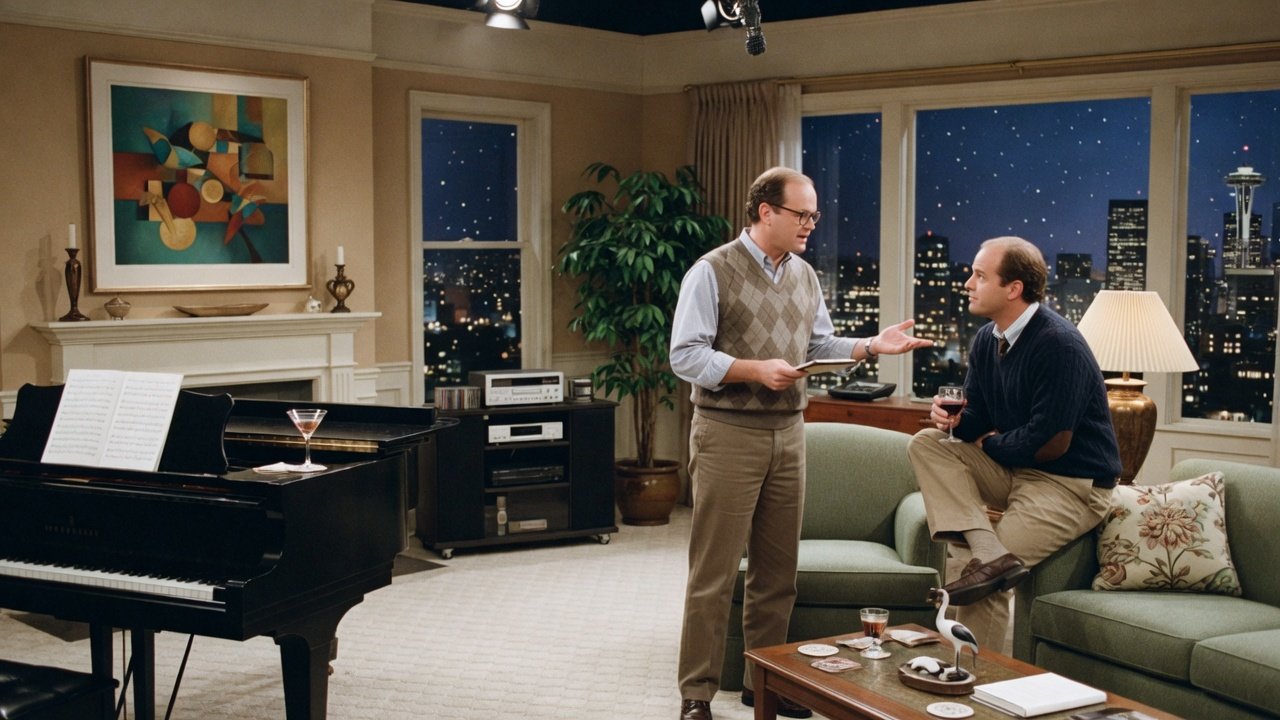
Proof a spinoff can become the sharper instrument.
Why it matters
From the desk
Farce at Opera Volume, Spinoff as Sharper Instrument
Eleven NBC seasons of radio-booth vanity, door-slamming championship craft, and a Seattle apartment that proved Cheers was the opening act.
The Good Son (September 16, 1993) is a relocation and a dare. Frasier Crane — already famous from a Boston bar — returns to Seattle, puts his father in the spare life, and tries to live at a cultural altitude the sitcom format is not supposed to support. The dare works. Kelsey Grammer's spinoff does not sand the Cheers character into a mascot; it builds a farce engine around vanity, filial friction, and a radio show that treats advice as performance. David Hyde Pierce's Niles is not a copy. He is a second instrument. John Mahoney's Martin is gravity. Jane Leeves's Daphne and Peri Gilpin's Roz keep the opera from becoming a duet of cranes. The apartment is a set you could draw from memory, which is how you know the blocking will matter.
Farce is the point, not the garnish. The Matchmaker (season 2) is the engine in miniature: a social mix-up that would die in a lesser show's tag, here wound until the door has to do ballet. Ham Radio (season 4) is production as joke — a play-within-the-sitcom that trusts the audience to enjoy failure as architecture. The Ski Lodge (season 5) is the door-farce masterpiece, the hour critics mean when they say physical comedy survived the 1990s in high-culture drag. Something Borrowed, Someone Blue (2) (season 7) is the long game paying out: Niles and Daphne's will-they was never a ratings stunt if you were watching the acting. It was a structure. When it resolves, the show has to become a different machine. It mostly does, for a while.
Gossip will lead with the reboot's high-wire nostalgia and whether a later series should have tried the radio again. The tabloids will say X; the cut says Y. The original eleven seasons (1993–2004) are the object. They won the comedy-series Emmy until the streak became a statistic people recite instead of watching the blocking. People who treat television as a crime blotter of who dated whom will miss that this was championship multi-cam: live-audience timing, overlapping exits, a dog as punctuation, and language pitched at people who know what a first edition costs. It is snob comedy that loves the snobs enough to humiliate them weekly. That is affection, not a lecture.
Do you need Cheers first? It helps the way knowing a novel's prequel chapter helps. It is not required. Frasier is comprehensible as a man too large for his booth. The later original seasons thin as the farce engine shares space with romance administration; graze if the doors stop slamming for you. Goodnight, Seattle (2) (May 13, 2004) is a genuine closer — Martin's wedding weather, a career question, a city saying the title out loud. It is warmer than Seinfeld's verdict and less of a photocall than Friends. It is also, for once, earned by eleven years of people failing to live at the altitude they advertised.
Verdict: watch it as farce school, not as prestige cosplay. Start at The Good Son, then the lodge, then the wedding payout. Comparable titles: Cheers as the warmer ancestor; Frasier's own 2023 revival as a separate argument you are not assigned. The scandal of reboot discourse will outlive the original's blocking. That is, unfortunately, also part of television history. The doors were better the first time. Put the work first anyway.
Episode guide
How this series is filed
TV Flash files Frasier (1993–2004) on NBC as the episode guide: 264 listed hours across 11 seasons, 1993-09-16–2004-05-13 from “The Good Son” (S01E01) to “Goodnight, Seattle (2)” (S11E24).
Open the episode guide · S01E01 The Good Son · S11E24 Goodnight, Seattle (2)
Essential episodes
Farce syllabus — the hours that still teach doors, vanity, and the long game. Filed by Julian Hart (The Binge Brief).
- S01E01 The Good Son
The dare: relocate a Cheers character and build a farce engine around vanity and a father in the spare life.
- S02E03 The Matchmaker
The mix-up as miniature. Social disaster wound until the door has to dance — the engine in one night.
- S04E18 Ham Radio
Production as joke. A play-within-the-sitcom that trusts the audience to enjoy failure as architecture.
- S05E14 The Ski Lodge
Door-farce masterpiece. Physical comedy in high-culture drag; the hour critics mean by championship blocking.
- S07E24 Something Borrowed, Someone Blue (2)
The long game pays. Niles and Daphne resolve as structure, not as a ratings stunt — then the machine has to change.
At a glance
Psychiatrist Frasier Crane returns to Seattle for radio fame, farce at opera volume, and family friction with dad and brother Niles. Spinoff that out-fancified Cheers. Physical comedy in high culture drag.
Network & studio
- NBC — broadcast network
Why watch now
For championship multi-cam farce that outplayed its parent show: door ballet, radio-booth vanity, and a second Crane who is an instrument, not a copy. Eleven seasons of people failing to live at the altitude they advertised — on purpose.
Cultural impact
Frasier made highbrow sitcom farce a ratings winner and reboot nostalgia a high-wire act years later. Kelsey Grammer’s tenure is longevity as brand.
Creators
David Angell · Peter Casey · David Lee
Key cast
- Kelsey Grammer as Frasier Crane
- David Hyde Pierce as Niles Crane
- John Mahoney as Martin Crane
- Jane Leeves as Daphne Moon
- Peri Gilpin as Roz Doyle
- Dan Butler as Bulldog Briscoe
Flash facts
- NBC sitcom (1993–2004) spinning Frasier Crane off from Cheers to a Seattle radio-psychiatry life.
- Created by David Angell, Peter Casey, and David Lee.
- Multiple Outstanding Comedy Series Emmy wins across its original run.
- David Hyde Pierce’s Niles became a critical and awards standout.
- A Paramount+ revival series premiered in 2023 with Grammer returning.
FAQ
Do I need to watch Cheers first?
No. It enriches Frasier's vanity and the Sam Malone cameo, but The Good Son explains the new contract: father in the apartment, radio as performance, brother as second instrument. Cheers is extra credit, not homework.
What can I skip in eleven seasons?
Holiday filler and some late-run romance administration. Do not skip the farce hours — The Ski Lodge, Ham Radio, The Matchmaker — or the season-7 wedding payout. Seasons 1–7 are the instrument at concert pitch.
Is the 2023 revival required?
No. This package is the NBC original (1993–2004). The revival is a separate argument about nostalgia. The original closer is Goodnight, Seattle (2). Stop there unless you want the later experiment.
Snob comedy or character comedy?
Both. The language is high; the humiliation is democratic. Martin, Daphne, and Roz keep the Cranes from becoming a two-man opera. If you only hear the wine jokes, you are missing the blocking.
Is the finale worth it?
Yes, as a closer. May 13, 2004, two parts. It resolves the Seattle contract without turning the last look into a trailer. Warmer than a verdict, less of a photocall than a fountain. Earned.
Cultural eras
Official & further reading
External sites for further reading — TV Flash is not affiliated with these networks or studios.
Back to the decade
Also on the dial
More after Frasier
- Related showBlossomHats, fourth-wall bits, and Very Special Episodes — Mayim Bialik’s first era.
- Related showJAGNavy lawyers with jet fuel — procedural that quietly built a franchise navy.
- Related showUnsolved MysteriesRobert Stack’s trench coat and that theme — true crime as living-room séance.
- Related showWingsNantucket airline brothers — Cheers-adjacent comfort with a one-plane airline.
- Related showNewsRadioWNYX workplace farce — Phil Hartman perfection in a radio station madhouse.
- Related show3rd Rock from the SunAliens in human suits discover emotions, bureaucracy, and Jane Curtin.