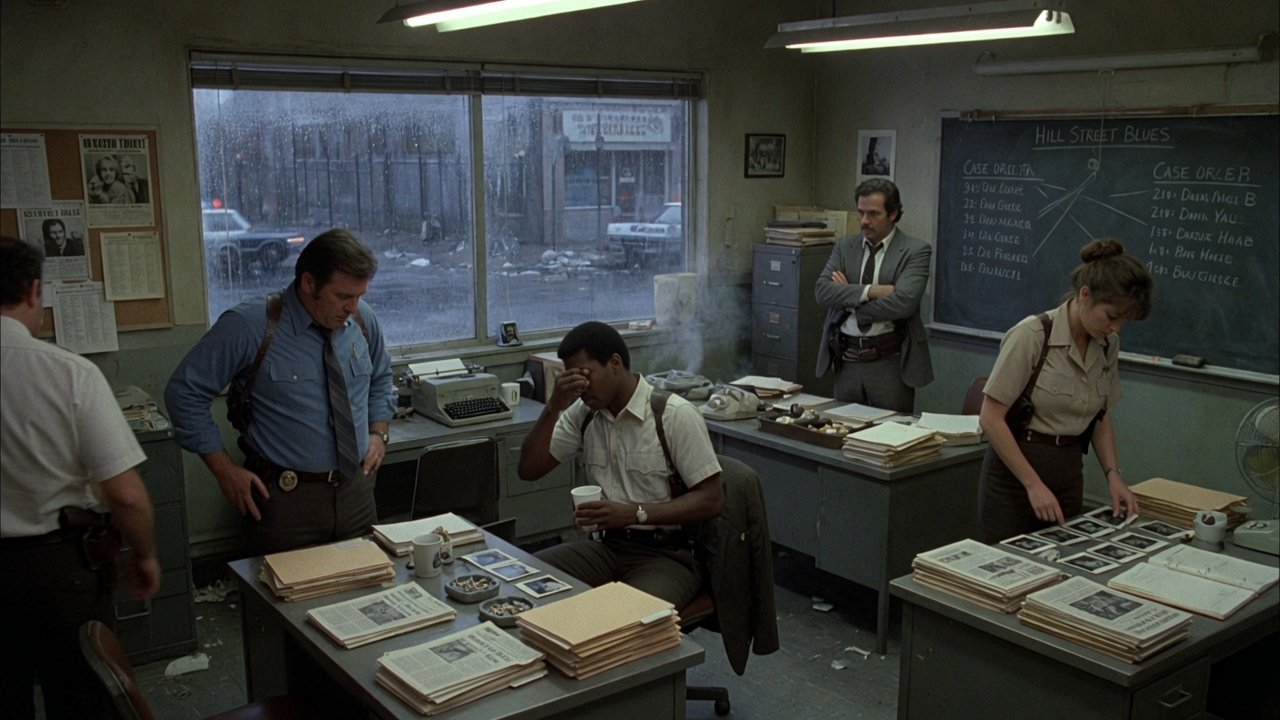
Serialized ensemble drama language for everything from ER to The Wire's cousins.
Why it matters
From the desk
Roll Call, Then Chaos: How a Precinct Learned to Overlap
Hill Street Blues made network police drama sound unfinished on purpose — serialized ensemble, messy cop lives, and a roll call that still teaches the form.
The roll call is the thesis. A precinct room, overlapping voices, a sergeant sending people into a city that will not resolve in 48 minutes. Hill Street Blues premieres in January 1981 like a dare to NBC’s idea of a cop show: handheld restlessness, serialized personal lives, humor that does not apologize for sitting next to a body. Steven Bochco and Michael Kozoll are not inventing grit as a brand. They are inventing a grammar — how many stories a week can carry, how much a hero can fail, how a workplace can sound like a workplace instead of a podium. Let’s be careful out there is not a catchphrase. It is stage direction.
Daniel J. Travanti’s Furillo is the still center: a captain whose control is a performance with cracks. Veronica Hamel’s Joyce is the public defender as counter-argument, not as a date-night accessory. Michael Conrad’s Esterhaus owns the briefing-room music until the show has to learn what to do without him. Hill and Renko, Belker, Bates, Goldblume — the ensemble is the form. When the series is working, no single case is the point. The point is the stack: a domestic, a political fever, a joke in the hallway, a romance that does not get a swelling string section. Network notes about tone — too real, too messy, too many plots — are the production lore. Useful footnotes. The cut says the mess was the sophistication.
What the season is arguing: that police work is a system of interruptions; that serialized television can live on a broadcast schedule; that moral exhaustion is a more honest engine than a car chase. Early Emmy hauls, including Outstanding Drama Series, did not mean the ratings were easy. They meant a slice of the industry recognized a new language while the affiliates still wanted cleaner heroes. The lineage is not a parlor game. You can hear this precinct in later Bochco, in hospital ensembles, in any drama that lets scenes step on each other. People treating television like a crime blotter will remember the “too real” panic. The work is the overlapping sound.
You do not need seven seasons of every arc. You need the premiere’s contract, the first-season two-parters that let the city stay ugly overnight, and a handful of hours where a side character becomes the argument. Freedom’s Last Stand is the show taking a street philosopher seriously enough to hurt. The Second Oldest Profession is workplace comedy with bruises. The later years thin, as long ensembles do — replacements, fatigue, a form that other shows had already stolen. That is not a scandal. That is what happens when you teach the industry your trick.
Verdict: Hill Street Blues is required if you care how modern drama learned to sound unfinished. It is not a binge in the contemporary sense; it is a weekly novel with a siren. Watch it for the roll call, for Travanti’s restraint, for the nerve to let plots dangle. The gossip about network fear will outlive some of the mid-run hours. The craft of the first two seasons will outlive the gossip. Put the work first. The lobby fire is already in the script, and it is called the city.
Episode guide
How this series is filed
TV Flash files Hill Street Blues (1981–1987) on NBC as the episode guide: 146 listed hours across 7 seasons, 1981-01-15–1987-05-12 from “Hill Street Station” (S01E01) to “It Ain't Over Till It's Over” (S07E22).
Open the episode guide · S01E01 Hill Street Station · S07E22 It Ain't Over Till It's Over
Essential episodes
The hours that still teach the form — roll call, mess, and the city that will not resolve. Filed by Julian Hart (The Binge Brief).
- S01E01 Hill Street Station
The grammar lesson: overlap, roll call, no podium hero. The contract in 48 messy minutes.
- S01E17 Jungle Madness (2)
First-season two-part close. The city stays ugly overnight; the form proves it can hold.
- S02E04 The Second Oldest Profession
Workplace comedy with bruises. Proof the precinct can laugh without becoming a sitcom.
- S02E11 Freedom's Last Stand
A street voice taken seriously enough to hurt. Serialization as moral bill.
- S07E22 It Ain't Over Till It's Over
A precinct closer, not a universe bow. The title already knows it is not over.
At a glance
A chaotic urban precinct runs overlapping stories, imperfect cops, and serialized personal lives. Handheld energy and ensemble depth grow the police drama up. Roll call is just the beginning of the mess.
Network & studio
- NBC — broadcast network
Why watch now
Watch it to hear modern ensemble drama being invented in a precinct: overlapping voices, unfinished weeks, cops who fail in public. The roll call is the thesis. The city is the other lead. Seven seasons of network nerve, thickest at the start.
Cultural impact
Hill Street Blues rewired ensemble serialized drama language for ER, The Wire’s cousins, and everything between. “Too real” panic became a prestige badge.
Creators
Steven Bochco · Michael Kozoll
Key cast
- Daniel J. Travanti as Capt. Frank Furillo
- Veronica Hamel as Joyce Davenport
- Michael Conrad as Sgt. Phil Esterhaus
- Bruce Weitz as Det. Mick Belker
- Betty Thomas as Lucy Bates
- Joe Spano as Lt. Henry Goldblume
- Charles Haid as Officer Andy Renko
- Michael Warren as Officer Bobby Hill
Flash facts
- NBC ensemble police drama (1981–1987) created by Steven Bochco and Michael Kozoll.
- Serialized arcs, handheld-style energy, and overlapping workplace stories reshaped network drama.
- Won many Emmys early, including Outstanding Drama Series multiple times.
- Direct creative lineage to later Bochco hits and quality TV drama craft.
- Famous roll-call tagline culture (“Let’s be careful out there”).
FAQ
Where should I start?
The premiere is the grammar lesson: roll call, overlap, no neat bow. Stay through the first-season two-parters before you decide the mess is for you. If it is, seasons one and two are the argument.
What can I skip?
Later-season fatigue and some replacement-cop weeks. The form was so influential that imitators learned it while Hill Street was still on air. Sample the early peak; treat the back half as optional civic homework.
Is the finale a statement or a shrug?
It closes a precinct, not a universe. Worth it if you have lived with the ensemble. It is not a reason to force every remaining arc. The title already knows the city does not end.
Is it a cop show I can dip into weekly?
Less than Dragnet, more than a modern binge mystery. Serialized personal lives reward sequence. You can sample, but the pleasure is accumulation — faces, unfinished business, the sound of the room.
Do I need NYPD Blue or The Wire first?
No. Those are descendants and cousins, not prerequisites. Hill Street is the network ancestor. Watch it without treating later prestige as a decoder ring.
Cultural eras
Official & further reading
External sites for further reading — TV Flash is not affiliated with these networks or studios.
Back to the decade
More from the 1980s — Glitz, Soaps & Nighttime Neon. All shows.
Also on the dial
More after Hill Street Blues
- Related showBaywatchSlow-mo lifeguards, red swimsuits, and Hasselhoff's second global export.
- Related showGimme a Break!Nell Carter's powerhouse voice and housekeeper-mom energy in a police chief's home.
- Related showSilver SpoonsRich kid, toy-filled mansion, and Jason Bateman before Arrested Development.
- Related showPunky BrewsterOrphan optimism, neon fashion, and earworm theme energy.
- Related showEmpty NestGolden Girls neighbor doctor with adult daughters home again — Miami shared-universe comedy.
- Related showAmenSherman Hemsley takes the pulpit — church politics as sitcom battleground.