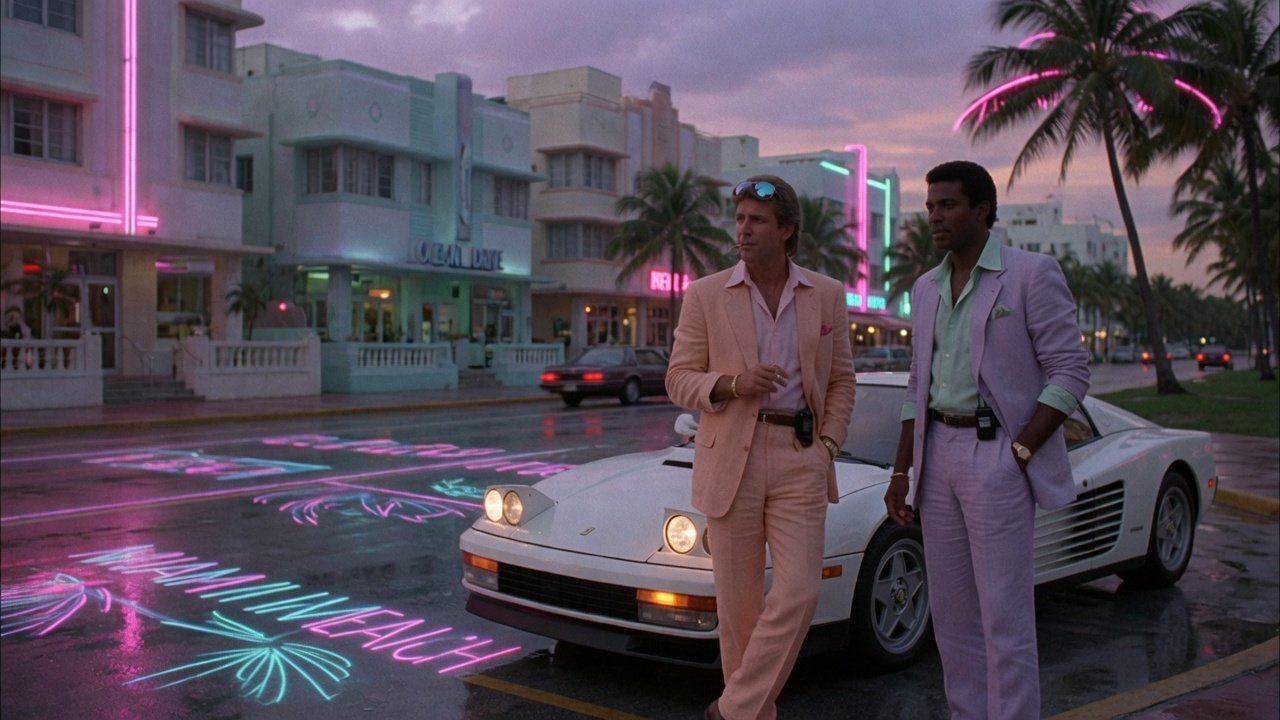
Proved style could be substance for a generation of directors.
Why it matters
From the desk
Pastel Armor: When a Cop Show Dressed Like a Nightclub
Miami Vice made linen, no-socks loafers, and a needle drop into thriller grammar — five seasons of fashion as plot armor, with Don Johnson’s silhouette as the franchise.
The jacket is unstructured, the shirt is open, the socks are a rumor. Night on Biscayne, neon in the gel, a Testarossa that photographs like jewelry. Miami Vice did not arrive as a police procedural that happened to look expensive. It arrived as a look that happened to carry a badge. Anthony Yerkovich created it; Michael Mann produced the temperature. NBC wanted MTV cops. What shipped was *liquid linen, no jewelry except the Rolex, message dressing for undercover work*. Style is the plot. If you only listen to the case file, you are watching half the show.
Don Johnson’s Crockett is a silhouette before he is a cop: peach and white, stubble as costume, sunglasses that do the acting in the two-shot. Philip Michael Thomas’s Tubbs is the sharper tailoring, the contrast pairing, the man who makes the partnership photograph as a brand. Edward James Olmos as Castillo is the anti-look — dark, still, a rebuke to the pastels — and that is also fashion. **This was not a soft launch of cool; this was a hard launch in silk and linen.** The music budget was an arms race. Needle drops were not seasoning; they were scene partners. Smuggler’s Blues still plays like a video the network forgot to send to MTV.
Look board for a Vice night (textures, not teas): unstructured jackets that move on a boat; no-socks loafers as a moral position; pastels that read as daylight even at 2 a.m.; black as Castillo’s veto; a Ferrari that is less car than accessory. Press-tour logistics were romance and warfare in the same call sheet — Don Johnson’s contract brinkmanship, the white suits that became a tourist uniform, the city used as a fitting room. Hollywood glamour with a vice-squad side quest. One vulnerable note, then the champagne mic goes back on: the performance is exhausting. Five seasons of looking unbothered on camera is labor. The clothes had to do emotional work the interrogation room could not.
The timeline will tell you it was mid once the pastels dated. That is not the craft failing; that is the replies refusing to be directed. I will defend the gown — here, the jacket — against the people who only want the case closed. Fashion on Vice is always both: the character they play for the department, and the character they need you to believe in the club. Watch the New York hour if you want the palette to argue with itself. Watch the later seasons if you want the tan to fade and the linen to look tired on purpose. The designed closer is a last image; the leftover hour that followed is the airport departure — softer light, less armor, the look that tells you the tour is over. Five seasons of unbothered is still a costume.
See you at the after-party, which in 1985 was a nightclub the camera already paid for. Or, more honestly, at the marina in the second look: jacket off, stubble honest, city still performing. The carpet was the neon. The sidewalk was the humidity. Both were the show.
Episode guide
How this series is filed
TV Flash files Miami Vice (1984–1989) on NBC as the episode guide: 110 listed hours across 5 seasons, 1984-09-28–1990-01-25 from “Heart of Darkness” (S01E01) to “Too Much, Too Late” (S05E21).
Open the episode guide · S01E01 Heart of Darkness · S05E21 Too Much, Too Late
Essential episodes
The hours where the wardrobe, the needle drop, and the city do the talking. Filed by Lana Reyes (Red Carpet Reality).
- S01E01 Heart of Darkness
The silhouette contract: unstructured linen, neon gel, partnership as a brand launch.
- S01E14 Smuggler's Blues
Music-video grammar in a cop slot. The needle drop is not seasoning; it is a scene partner.
- S02E01 The Prodigal Son
Miami’s palette argues with New York tailoring. A press-tour of two cities in one hour.
- S02E03 Out Where the Buses Don't Run
The look goes street-level. Style as dread, not only as club lighting.
- S05E17 Freefall
The designed last image. Watch it as the intended closer, not as leftover inventory.
At a glance
Undercover detectives Crockett and Tubbs chase Miami crime in pastel armor with music-video direction and needle drops. Style is substance; fashion is plot armor. Nightclub neon meets federal case files.
Network & studio
- NBC — broadcast network
Why watch now
Watch it as a fitting room with a badge: pastel armor, needle drops as scene partners, and two detectives whose clothes argue louder than the case files. Five seasons of night photography that taught network TV how to look expensive after dark.
Cultural impact
Miami Vice turned music budgets and menswear into thriller grammar and left Don Johnson negotiations as 80s industry legend. Pastel cops remain a cultural hieroglyph.
Creators
Anthony Yerkovich
Key cast
- Don Johnson as James "Sonny" Crockett
- Philip Michael Thomas as Ricardo "Rico" Tubbs
- Edward James Olmos as Lieutenant Martin Castillo
- Saundra Santiago as Detective Gina Calabrese
- Olivia Brown as Detective Trudy Joplin
- Michael Talbott as Detective Stan Switek
- John Diehl as Detective Larry Zito
Flash facts
- NBC crime drama (1984–1989) created by Anthony Yerkovich; Michael Mann executive-produced.
- Stylized undercover Miami policing with fashion, music, and glossy night visuals.
- Often linked to Brandon Tartikoff’s “MTV cops” network brainstorming era.
- Five seasons; music supervision and contemporary pop/rock cues were signature.
- Helped define 1980s network aesthetic and later influenced crime-drama style TV.
FAQ
Where should I start — the first case or the first look?
Start with the 1984 premiere for the silhouette contract: linen, neon, partnership as brand. Then go to the music-video hours in season one. The look teaches the show faster than a plot summary.
Do later seasons still photograph?
The pastels cool and the linen looks more exhausted, which is also information. If you want peak fashion-as-thriller, seasons one and two. If you want the armor loosening, stay into the later run.
Is the finale the last image that matters?
Freefall is the designed closer. Too Much, Too Late aired later as leftover inventory. Watch the intended last look first; treat the final airdate as the airport departure.
Is it a cop show or a style show?
Yes. Undercover Miami policing is the alibi; menswear, music supervision, and night photography are the text. Come for the cases if you must — stay for how clothes and needle drops do the arguing.
Can I sample without five seasons?
Yes. Premiere, Smuggler’s Blues, the New York opener, and the hour people still cite for street-level dread will give you the palette. The rest is variation on a tan.
Cultural eras
Official & further reading
External sites for further reading — TV Flash is not affiliated with these networks or studios.
Back to the decade
More from the 1980s — Glitz, Soaps & Nighttime Neon. All shows.
Also on the dial
More after Miami Vice
- Related showBaywatchSlow-mo lifeguards, red swimsuits, and Hasselhoff's second global export.
- Related showGimme a Break!Nell Carter's powerhouse voice and housekeeper-mom energy in a police chief's home.
- Related showSilver SpoonsRich kid, toy-filled mansion, and Jason Bateman before Arrested Development.
- Related showPunky BrewsterOrphan optimism, neon fashion, and earworm theme energy.
- Related showEmpty NestGolden Girls neighbor doctor with adult daughters home again — Miami shared-universe comedy.
- Related showAmenSherman Hemsley takes the pulpit — church politics as sitcom battleground.