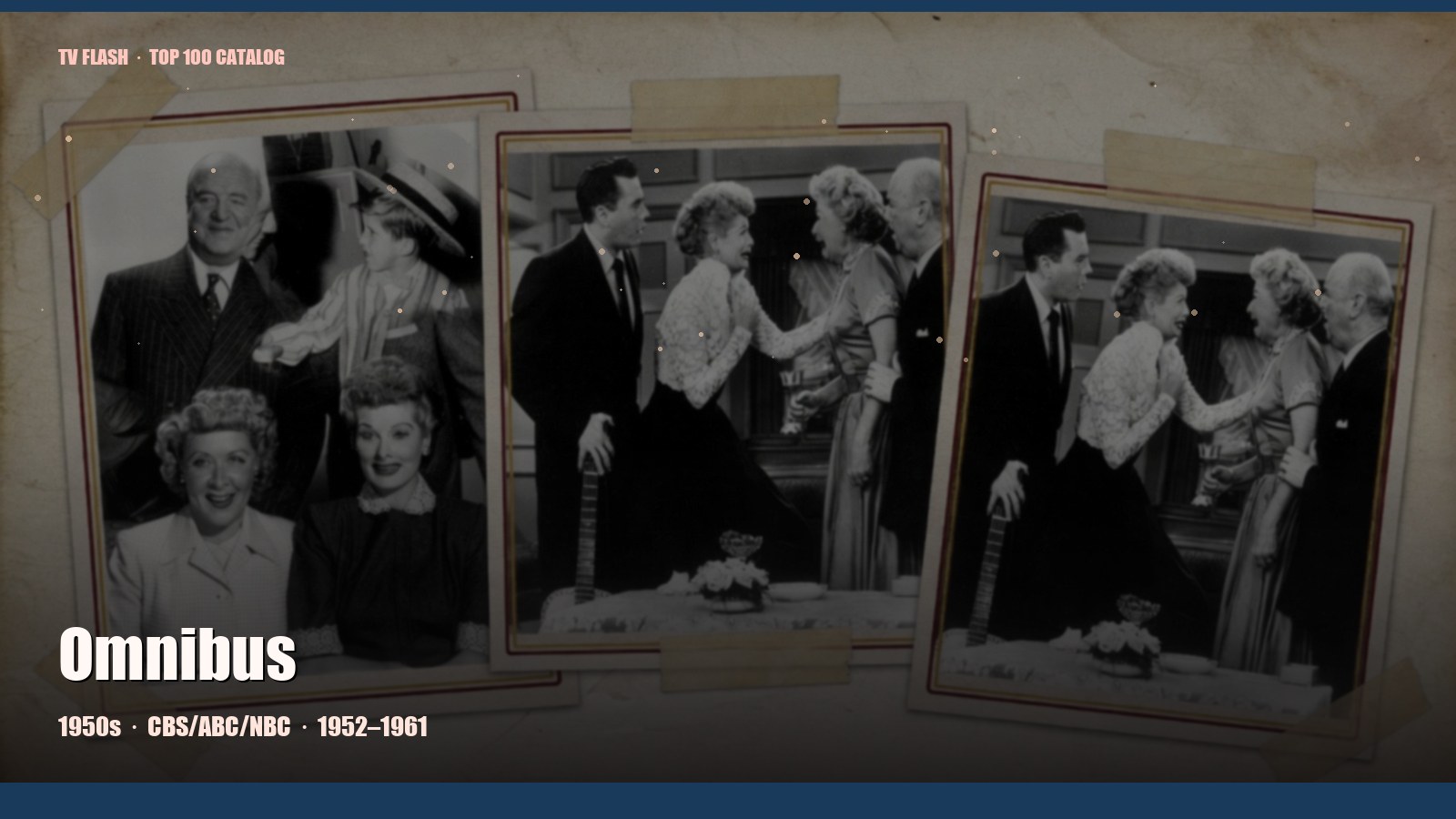
High-arts magazine show that treated TV viewers as curious adults.
Why it matters
From the desk
Why Omnibus still plays
So about Sunday seriousness. (Spoiler-free: there is no twist. The lecture is the event.) Omnibus (CBS/ABC/NBC, 1952–1961) treated viewers as curious adults: Leonard Bernstein, Orson Welles, Ford Foundation money, Alistair Cooke's urbane hosting, Robert Saudek producing. High-arts magazine television — seriousness, ballet, lectures without a second-screen apology. Aloft culture for the masses. Tiny pack here, two listed hours. The group chat would have called it anti-algorithm before algorithms, and then someone would have posted the Bernstein clip like a relic. Prestige that assumed a mass audience could sit still.
Lana wants the gown of the concert hall. The replies are Cooke's manners. **Bernstein and Welles were not 'content.' They were the pitch.** Non-negotiable. Watch it now as the anti-algorithm arts hour. Prestige that felt public because foundation money and Cooke's hosting made curiosity look like a civic habit. Later television would niche the highbrow; this one still bet that Sunday could be a magazine you did not have to already subscribe to. The carpet can keep the gala look. This fandom is about a mass audience being trusted. (I said the timeline would call it homework. The hour called it Sunday.)
What the timeline decided at 1 a.m.: Cooke is the original urbane host; Ford money is the plot twist; hopping three networks is a messy ship; ballet counts as appointment TV; item four already wants a recap and the series will not give you one. That is the form. Magazine, not serial. Curiosity as a habit.
The listed premiere is Cooke's urbane magazine, Ford Foundation money, Sunday viewers treated as curious adults instead of a demographic. The second listed hour is Bernstein on television culture — public-milestone arts hour, prestige that assumed a mass audience could sit still for serious music talk. Two bookmarks. You do not binge a magazine. You sit still. That was the dare.
See you in the tags. I need sleep and a rewatch of a Sunday that trusted me. Poll energy: would we sit still now? The gown can go to the gala. This room came for the lecture and stayed for the bet — Ford money, Cooke's manners, three networks, no apology for seriousness. That was the whole ship.
Episode guide
How this series is filed
TV Flash files Omnibus (1952–1961) on CBS/ABC/NBC as a desk landmark file, not a complete episode guide, 1952-11-09–1954-01-01 from “Series premiere” (S01E01) to “Bernstein on television culture” (S01E02).
Open the episode guide · S01E01 Series premiere · S01E02 Bernstein on television culture
Essential episodes
Sunday as curious adults — Bernstein, Ford Foundation, Cooke, the anti-algorithm arts hour. Filed by Tessa Quinn (Spoiler-Free (Mostly)).
- S01E01 Series premiere
Series premiere: Alistair Cooke's urbane magazine, Ford Foundation money, Sunday viewers treated as curious adults instead of a demographic.
- S01E02 Bernstein on television culture
Bernstein on television culture — public-milestone arts hour, prestige that assumed a mass audience could sit still for serious music talk.
At a glance
A live arts and ideas magazine featuring drama, music, science, and features for a general audience. Omnibus (CBS/ABC/NBC, 1952–1961), hosted by Alistair Cooke and produced with Ford Foundation support under Robert Saudek, made high-culture guests appointment viewing for the aspiring mid-century mind. Leonard Bernstein, Orson Welles, ballet, lectures, documentaries and original features — educational TV before PBS owned the lane. It treated viewers as curious adults. Prestige that assumed a mass audience could sit still for seriousness without a second-screen apology. Aloft culture for the masses: foundation money and Cooke's urbane manners making curiosity look civic.
Network & studio
Why watch now
Omnibus treated Sunday viewers as curious adults: Leonard Bernstein, Orson Welles, Ford Foundation money, Alistair Cooke's urbane hosting. High-arts magazine television. Watch it now as the anti-algorithm arts hour — prestige that assumed a mass audience could sit still for seriousness, ballet, and lectures without a second-screen apology.
Cultural impact
Omnibus was the high-arts magazine hour that treated television viewers as curious adults. Ford Foundation money and Cooke's manners moved drama, music, science, and features across CBS, ABC, and NBC without talking down to Sunday. Later television niched the highbrow; this one still bet a mass audience would sit still for ballet and lectures. Educational TV before PBS owned the lane. Bernstein and Welles were not extras. They were the pitch.
Creators
Robert Saudek · Ford Foundation
Key cast
- Alistair Cooke as Host
Flash facts
- U.S. arts anthology/magazine 1952–1961 across CBS, ABC, and NBC at times.
- Hosted by Alistair Cooke; produced with Ford Foundation support under Robert Saudek.
- Presented high culture, documentaries, and original features to a mass audience.
- Live arts-and-ideas mix of drama, music, science, and features.
- High-culture guests included Leonard Bernstein and Orson Welles.
FAQ
Where should I start?
Start with Cooke's hosting and a landmark arts night — Bernstein or Welles if you can find them. The magazine mix is the form.
What can I skip?
Skip expecting a continuing cast or a plot. It is an arts anthology. Network hopping is the funding trail, not a serialized story.
Is it still worth it?
Yes, as high-arts magazine TV that treated viewers as curious adults. The anti-algorithm Sunday.
Variety, lecture, or anthology?
High-arts magazine anthology — culture as a Sunday mix, not a sitcom and not a quiz.
Official & further reading
External sites for further reading — TV Flash is not affiliated with these networks or studios.
Back to the decade
Also on the dial
More after Omnibus
- Related showMeet the PressThe longest-running show in television history — Sunday panel combat as civic ritual.
- Related showThe Ernie Kovacs ShowVisual gags, blackouts, and Nairobi Trio — the medium inventing itself for laughs.
- Related showM SquadLee Marvin's hard cop in a hard Chicago — noir procedural with a jazz bite.
- Related showKukla, Fran and OllieAd-lib puppets and Fran Allison — gentle absurdity that adults watched without irony.
- Related showSky KingArizona rancher with a Cessna — aviation adventure for kids who wanted wings.
- Related showBat MastersonDerby hat, gold-tipped cane — Gene Barry's dandy lawman who fought with style.