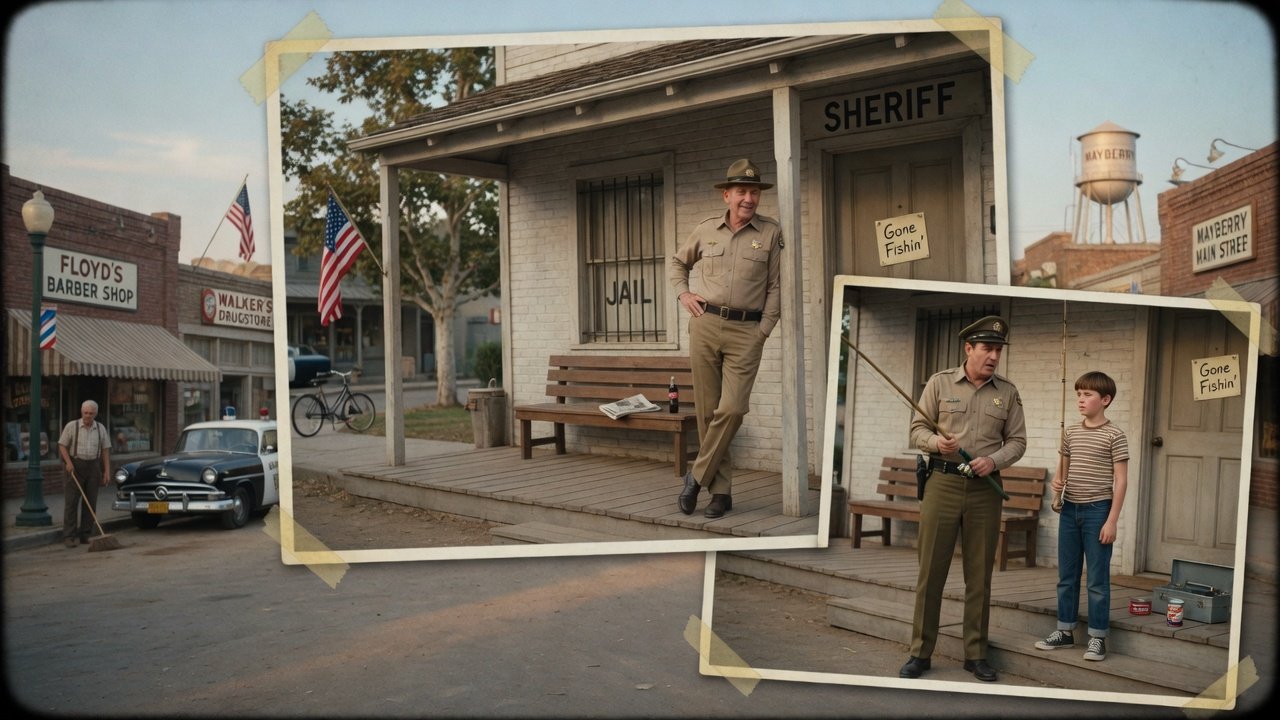
Peak rural sitcom craft; character comedy without cruelty.
Why it matters
From the desk
Mayberry Kept the Volume Knob at Human
Eight seasons of character comedy without cruelty — a CBS sheriff who barely needed a gun, a deputy with one bullet, and a small town that treated kindness as plot engine instead of slogan.
Picture a Monday on CBS when the nation had three doors and still chose a sheriff who rarely raised his voice. No infinite scroll, no "drop," no algorithm dressing a burial as a complete story. The Andy Griffith Show arrived in 1960 like a living-room handshake: Andy Taylor, Opie, Aunt Bee, and a North Carolina town that looked gentler than the decade assembling outside the studio gates. That gentleness is the trick people misremember. Mayberry is not simpler times. It is craft. Character comedy without cruelty, which is harder than a roast.
On the palate: courthouse stillness, Knotts panic, a fishin' pole as punctuation. Andy Griffith played warmth on camera and ran a tight ship off it — a favorite biographer sport, and fair game if you keep the cruelty toward the dead in your pocket. Don Knotts made Barney Fife a study in overconfidence as love language; one bullet in the shirt pocket is still the funniest prop in American sitcom history. Ron Howard's Opie is the moral GPS with a slingshot. Frances Bavier's Aunt Bee keeps the kitchen as a second courthouse. Sheldon Leonard's shop knew how to let a scene breathe until the laugh arrived honest.
What a network night looked like around it: westerns still thundering, variety still sequined, rural sitcoms about to become a whole CBS weather system. Mayberry owned a piece of Monday, then the schedule shuffled, and the show learned color the way the country did — later, after the black-and-white seasons had already minted the mythology. Three habits that would trend today: a star who could stop a scene with a look instead of a speech; a deputy whose incompetence never became contempt; a child performance that did not wink at the adults in the room. Max's world will sell you a vending machine with a PR department and call it discovery. This was linear event comedy that asked you to show up weekly and remember names.
The hours that still teach are not the ones that shout. Man in a Hurry is the thesis: a city tempo trapped in a town that will not be rushed, and the joke is on the rush. The Pickle Story is farce as household diplomacy. Mr. McBeevee is a father deciding to believe his son — faith as comic structure, not treacle. Opie the Birdman is consequence without a lecture padded for awards. Citizen's Arrest is Barney and Gomer as a closed loop of procedure, the kind of small-town legality that would break a modern writers' room in twelve minutes. You do not need 249 episodes to hear the music. You need to stop treating rural as a slur.
Don Knotts left after the fifth season to chase features; the show continued, went fully into color, and the temperature changed. That is not betrayal. That is a series outliving its most combustible chemistry, which television has been doing since Lucy's candy line. Later Mayberry has charms and a softer engine. Gomer spun off into the Marines. The last hour, Mayberry R.F.D., is a backdoor into a sequel series — less a finale detonation than a handoff, which is how three-network shops often said goodbye: keep the town, change the mailbox. Appointment culture did not always empty stadiums. Sometimes it just passed the courthouse keys.
Watch it against the grain of algo nostalgia. This is not comfort food because it is beige. It is comfort food because the jokes land on character, not on humiliation. Plenty of 1960s sitcoms were porridge. This one earned the rerun that never really ended. Raise a glass to the sheriff who hated making a fuss, and to the actor who knew exactly how much fuss the scene could take. The remote had three bullets. Mayberry spent them on people.
Episode guide
How this series is filed
TV Flash files The Andy Griffith Show (1960–1968) on CBS as the episode guide: 249 listed hours across 8 seasons, 1960-10-03–1968-04-01 from “The New Housekeeper” (S01E01) to “Mayberry R.F.D.” (S08E30).
Open the episode guide · S01E01 The New Housekeeper · S08E30 Mayberry R.F.D.
Essential episodes
Five hours that prove rural is a craft, not a slur — Knotts-forward, cruelty-free, still funny. Filed by Rex Fontaine (Golden Age Dispatch).
- S02E11 The Pickle Story
Household farce as diplomacy. The pickle jar is a prop; the love is the structure.
- S03E01 Mr. McBeevee
A father deciding to believe his son — faith as comic architecture, not treacle.
- S03E16 Man in a Hurry
The thesis hour: city tempo trapped in a town that will not be rushed, and the joke is on the rush.
- S04E01 Opie the Birdman
Consequence without an awards-padded lecture. Opie, a slingshot, and stillness that still works.
- S04E11 Citizen's Arrest
Barney and Gomer as a closed loop of procedure — small-town legality as pure timing.
At a glance
Sheriff Andy Taylor keeps Mayberry peaceful with folksy wisdom, a wide-eyed son named Opie, and deputy Barney Fife’s best intentions. Small-town problems rarely need a drawn gun. Character comedy without cruelty is the whole point.
Network & studio
- CBS — broadcast network
Why watch now
Watch for character comedy that never needs a mean laugh. Mayberry is a moral GPS with actual craft: Knotts' panic, Griffith's stillness, and a small town that treats kindness as a plot engine instead of a slogan.
Cultural impact
Mayberry became America’s moral GPS for a certain brand of small-town myth. The show still anchors debates about gentleness versus grit in comedy.
Creators
Sheldon Leonard
Key cast
- Andy Griffith as Sheriff Andy Taylor
- Ron Howard as Opie Taylor
- Don Knotts as Deputy Barney Fife
- Frances Bavier as Aunt Bee Taylor
Flash facts
- CBS sitcom set in fictional Mayberry, North Carolina; aired October 3, 1960–April 1, 1968 (8 seasons, 249 episodes).
- Produced with Danny Thomas Enterprises/Mayberry Enterprises; spun off from a Danny Thomas Show episode.
- Don Knotts’ Barney Fife won multiple Emmys; series led to spin-off Mayberry R.F.D.
FAQ
Do I need all eight seasons of The Andy Griffith Show?
No. The black-and-white years with Don Knotts (seasons 1–5) are the core chemistry. Later color seasons continue the town after Knotts leaves; they are optional, not counterfeit.
Should I start at the first episode?
“The New Housekeeper” is a clean door — Aunt Bee arrives, Opie objects, the household locks. If you want the show at full music, jump to a Knotts-forward hour such as “Man in a Hurry” and circle back.
Is it only “wholesome,” or is it actually funny?
It is funny because it is specific. The cruelty-free tone is a craft choice, not a vitamin. Barney's panic, Andy's stillness, and small-town procedure still play if you listen to the timing.
What happened to Barney Fife?
Don Knotts left after season 5. He returns for guest hours. The series keeps going with Andy, Opie, Aunt Bee, and a shifting bench of deputies and neighbors.
Is the last episode a real finale?
“Mayberry R.F.D.” is a handoff into a sequel series more than a stadium goodbye. Honest bookend: the town continues; this particular sheriff's weekly hour does not.
Cultural eras
Official & further reading
External sites for further reading — TV Flash is not affiliated with these networks or studios.
Back to the decade
Also on the dial
More after The Andy Griffith Show
- Related showDennis the MenaceGood ol' Mr. Wilson! — comic-strip kid chaos in midcentury suburbia.
- Related showMister EdA horse is a horse, of course — talking-animal sitcom that shouldn't work and did.
- Related showMy Favorite MartianUncle Martin the antennaed alien — sci-fi sitcom before Trek made space serious.
- Related showRoute 66Two guys, a Corvette, and America as open-road anthology.
- Related showScooby-Doo, Where Are You!Meddling kids, a cowardly Great Dane, and monsters who are always Mr. Whoever.
- Related showPetticoat JunctionShady Rest Hotel, three daughters, and the Cannonball train — rural comedy's cozy hub.