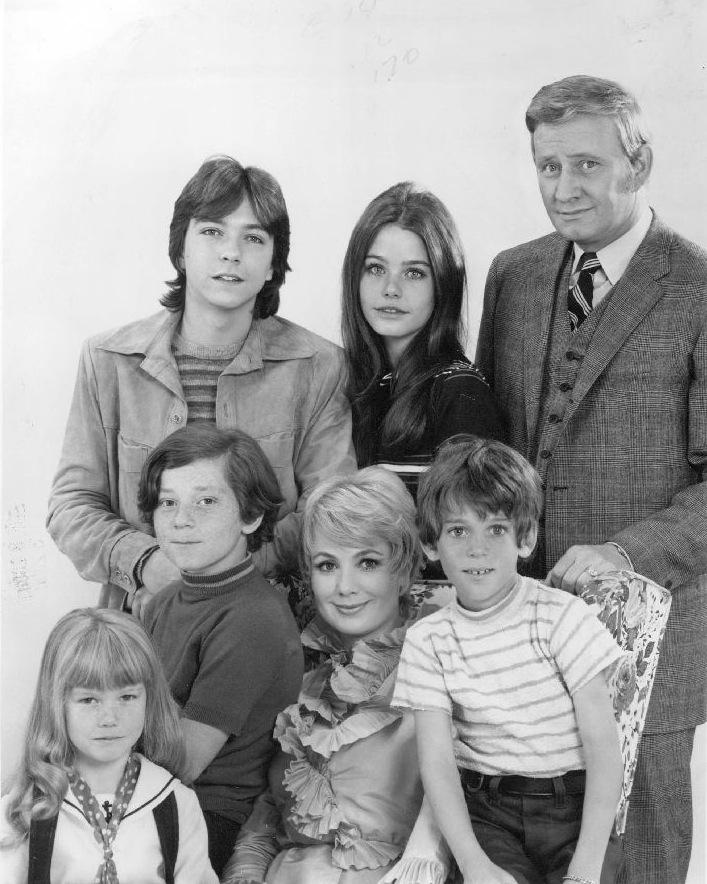
Music-sitcom hybrid that made David Cassidy a teen idol industrial complex.
Why it matters
From the desk
Why The Partridge Family still plays
The Mondrian bus arrives before the hit. ABC, 1970–1974: Shirley Jones in the driver's seat of a candy-colored coach, a widowed mom touring as pop with her kids while sitcom plots and chart singles collide. Bernard Slade's The Partridge Family made David Cassidy a teen-idol industrial complex with actual records — including I Think I Love You — and sold lunchboxes like they were look books. Susan Dey, Danny Bonaduce, and Dave Madden's Reuben Kincaid completed the family-and-manager math. *Primary-color panels, clean California light, a grin that is a press strategy.* Style is the plot. Come on get happy is weekly branding.
**This was not a soft launch of a sitcom; this was a hard launch in a painted bus.** Soundtrack singles were real. Concert fame outgrew the show. Cassidy's fame spiral became the extra-textual weather he never fully escaped — image management as a full-time industry riding shotgun. Jones is stepmom-to-the-world as a silhouette: the adult in the frame who still has to smile for the merch. Dey later reinvented herself on L.A. Law; that is the afterlife, a second look. Tessa's tags will want the spiral as stan lore. Fine. The bus came first.
Look board for a Partridge night: Mondrian geometry as a moving billboard; matching-family stage clothes that pretend not to be costumes; teen-idol hair as a product; lunchboxes as the real accessory drop; a California longing so clean it photographs as innocence. What? And Get Out of Show Business? opens Jones driving. Whatever Happened to the Old Songs? is the catalog arguing with itself. This Male Chauvinist Piggy Went to Market puts protest-button clothes on a season open. Hate Thy Neighbor admits a fence. . . . - - -. . . (S.O.S) is the 1974 closer in Morse. Four seasons, ninety-six hours. One vulnerable note: wearing that much happy on a soundstage while the charts get louder than the laugh track is labor.
The timeline will call it mid once the idol industry leaves the living room. That is not the craft of the look failing; that is a music-machine grin discovering the records outlived the bus. Family-band television treated the charts as part of the joke, then learned they were the joke. See you at the after-party, which in this case is a concert the sitcom could not contain. Or at the airport the morning after a hit: sunglasses, the second look, the real story in how the fame never fully got off the coach.
Episode guide
How this series is filed
TV Flash files The Partridge Family (1970–1974) on ABC as the episode guide: 96 listed hours across 4 seasons, 1970-09-25–1974-03-23 from “What? And Get Out of Show Business?” (S01E01) to “. . . - - -. . . (S.O.S)” (S04E22).
Open the episode guide · S01E01 What? And Get Out of Show Business? · S04E22 . . . - - -. . . (S.O.S)
Essential episodes
Mondrian bus, Cassidy as teen-idol industry: family-band sitcom that sold records, lunchboxes, clean California longing. Filed by Lana Reyes (Red Carpet Reality).
- S01E01 What? And Get Out of Show Business?
What? And Get Out of Show Business? opens Shirley Jones driving the Mondrian bus. Cassidy already a teen-idol industry with chart hits; family-band sitcom as a music-machine grin.
- S01E03 Whatever Happened to the Old Songs?
Whatever Happened to the Old Songs? is the catalog arguing with itself. Clean California longing: the bus still the set, the records still the real merchandising, the fame-spiral still off-camera.
- S03E01 This Male Chauvinist Piggy Went to Market
This Male Chauvinist Piggy Went to Market is a season-open in protest-button clothes. Family-band sitcom noticing the decade; lunchboxes still shipping, Cassidy still the industry inside the living room.
- S04E01 Hate Thy Neighbor
Hate Thy Neighbor is late-run sitcom friction. The music-machine grin admitting a fence: still a bus, still a band, still the clean longing the later gossip never fully escaped.
- S04E22 . . . - - -. . . (S.O.S)
. . . - - -. . . (S.O.S) is the 1974 closer in Morse. Four seasons of family-band merch, then a distress-code bow: the records outlived the bus; the idol industry did too.
At a glance
A widowed mom and her kids tour as a pop band in a candy-colored bus while sitcom plots and chart singles collide. Bernard Slade's ABC series (1970–1974) put Shirley Jones in the driver's seat of a Mondrian coach and made David Cassidy a teen-idol industrial complex with actual hits, including "I Think I Love You." Susan Dey, Danny Bonaduce, and Dave Madden's manager Reuben Kincaid complete the family-and-handler math. Soundtrack singles were real; concert fame outgrew the show. Clean California longing as product — come on get happy as weekly branding, with Cassidy's fame spiral riding shotgun as extra-textual weather.
Network & studio
- ABC — broadcast network
- Screen Gems — production studio
Why watch now
Shirley Jones drives a Mondrian bus while David Cassidy becomes a teen-idol industry with actual chart hits. A family-band sitcom that sold records, lunchboxes, and a kind of clean California longing. Music-machine grin up front; the fame-spiral gossip Cassidy never fully escaped rides shotgun.
Cultural impact
The Partridge Family made a family-band sitcom into a teen-idol industrial complex and put actual chart singles inside a multi-cam. Cassidy's concert fame outgrew the series; lunchboxes and longing did the rest. Susan Dey later reinvented herself on L.A. Law — the afterlife of a show that treated the charts as part of the joke, then discovered the charts were louder.
Creators
Bernard Slade
Key cast
- Shirley Jones as Shirley Partridge
- David Cassidy as Keith Partridge
- Susan Dey as Laurie Partridge
- Danny Bonaduce as Danny Partridge
- Dave Madden as Reuben Kincaid
Flash facts
- ABC music sitcom (1970–1974) created by Bernard Slade.
- Shirley Jones starred as Shirley Partridge; David Cassidy as Keith Partridge.
- Several soundtrack singles were real hits, including "I Think I Love You."
- David Cassidy's concert fame outgrew the show.
- Susan Dey later reinvented herself on L.A. Law.
FAQ
Do the songs actually chart?
Yes. Soundtrack singles were real hits, including I Think I Love You. The sitcom sold records, not only lunchboxes.
Jones, Cassidy, or the whole bus?
The whole bus. Jones drives; Cassidy detonates as teen idol; Dey, Bonaduce, and manager Kincaid keep the sitcom math.
Can I skip once the formula is obvious?
Four seasons is a short music-machine run. Sample for the bus and the hits; you do not need every tour stop.
Sitcom or record commercial?
Music-sitcom hybrid on purpose. Chart singles collide with family plots — feature, not a hidden ad.
Official & further reading
External sites for further reading — TV Flash is not affiliated with these networks or studios.
Back to the decade
Also on the dial
More after The Partridge Family
- Related showHart to HartWhen the Harts take a case — champagne detective couple energy.
- Related showBensonSoap's butler takes the statehouse — deadpan competence vs. political chaos.
- Related showThe RookiesYoung cops learning the badge — Spelling-Goldberg earnest street drama.
- Related showWhat's Happening!!Rerun, Raj, and Dwayne — soda-shop hangouts and Mama's basement rules.
- Related showKung FuGrasshopper walks the West — martial arts mysticism in a frontier serial.
- Related showSuper FriendsHall of Justice roll call — Justice League for the cereal-hour crowd.