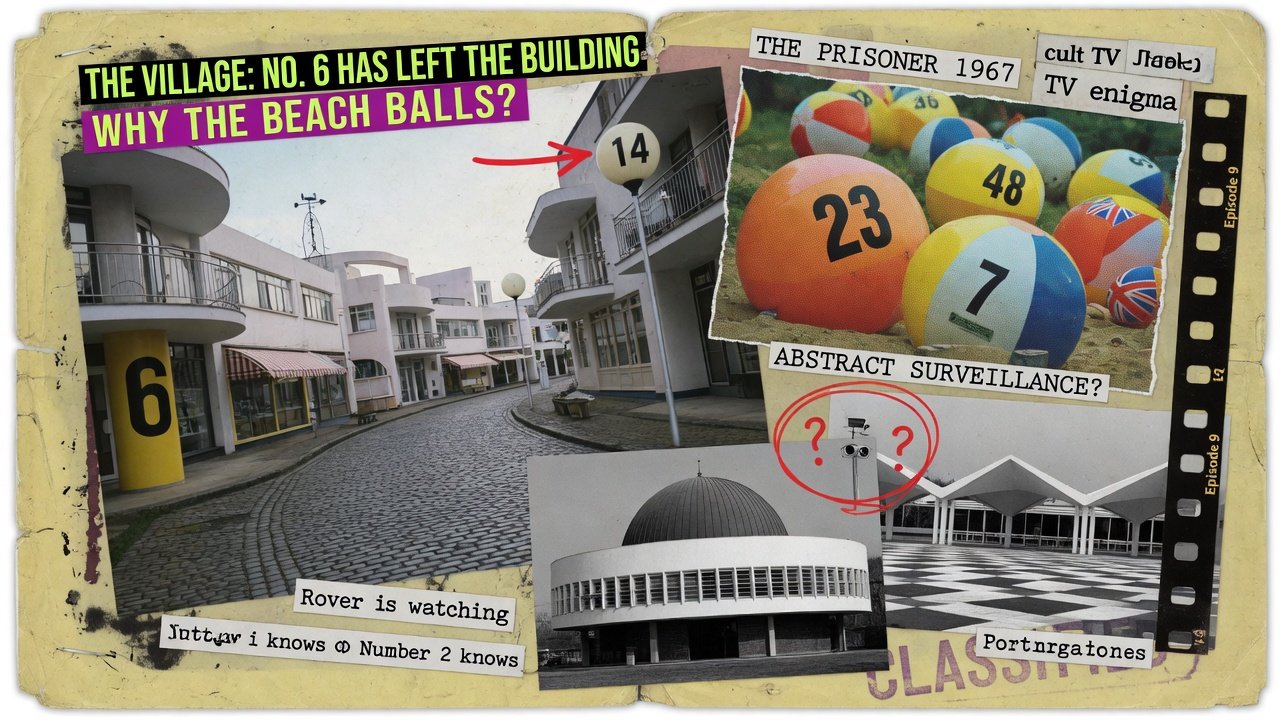
Cult anti-authoritarian masterpiece that rewired what TV espionage could mean.
Why it matters
From the desk
Why The Prisoner still plays
A secret agent resigns; a Village claims him. Patrick McGoohan's Number Six spends **seventeen episodes** (ITV, 1967–1968) demanding identity in a pastel prison of surveillance, mind games, and untrustworthy faces. George Markstein co-shaped the thing with him. Angelo Muscat's Butler and Leo McKern's Number Two orbit the refusal to be numbered. Each escape fails differently. *Arrival* is the capture. *Fall Out* is the closer that still starts fights. On the palate: penny-farthings, Rovers, and a greeting that is also a threat. *Be seeing you.*
This is not a vending machine with a PR department. Seventeen hours, one season, originally associated with ITV, then a major cult import — the shortest path to the enigmatic limited-run argument. McGoohan's control-freak authorship is the gossip that survived the barstools; the **historical claim the room forgets** is that British adventure television had already turned into allegorical sci-fi politics before anyone named the mystery box. Spy drama, science fiction, and political allegory in one Village. Design immortality without a dump calendar.
What the network night actually offered: 1. *Arrival* — resignation and capture; identity as the only plot. 2. *Free for All* — Village politics as farce with teeth. 3. *The Schizoid Man* — surveillance as costume change. 4. *Checkmate* — people as pieces, McGoohan's freeze as craft. 5. *Fall Out* — seventeen episodes of pastel prison ending as a dare, not a tidy bow.
Later series still pay homage, knowingly or not. Max will chart the binge. Fine. These hours were built to sit in the argument overnight. You cannot snack a Village. The finale remains one of television's most debated endings because it refuses the vending-machine courtesy of a receipt.
A toast to Number Six, who would not be a number, and to the import audience that kept the penny-farthing rolling when the original night ended. Glory, slightly deflated, as usual: stylish, stubborn, endlessly rewatchable — and still not a season-two announcement. The Village imagery is design immortality; the finale is a catalog dare. Start with the resignation. Stay for the identity demand. Leave the algorithm's 'ending explained' list in the lobby. McGoohan already declined to be inventory. Be seeing you is a greeting and a threat.
Episode guide
How this series is filed
TV Flash files The Prisoner (1967–1968) on ITV as the episode guide: 17 listed hours across 1 seasons, 1967-10-01–1968-02-04 from “Arrival” (S01E01) to “Fall Out” (S01E17).
Essential episodes
Seventeen hours of pastel surveillance — Number Six, the Village, and a finale that still starts arguments. Filed by Rex Fontaine (Golden Age Dispatch).
- S01E01 Arrival
Arrival is the resignation and the capture: McGoohan's Number Six in a Village of untrustworthy faces, identity as the only plot.
- S01E04 Free for All
Free for All — mid-run Village politics as farce with teeth, the spy-allegory still refusing to name Number One.
- S01E05 The Schizoid Man
The Schizoid Man doubles the prisoner: stylish stubbornness, surveillance as costume change, the identity demand at full wattage.
- S01E09 Checkmate
Checkmate plays the Village as a board: people as pieces, McGoohan's freeze as craft, hop-friendly and still argumentative.
- S01E17 Fall Out
Fall Out is the closer that still starts fights — seventeen episodes of pastel prison ending as a catalog dare, not a tidy bow.
At a glance
A secret agent resigns; a village claims him. Patrick McGoohan's Number Six spends 17 episodes (1967–1968) demanding identity in a pastel prison of surveillance, mind games, and untrustworthy faces. The Prisoner — which McGoohan co-shaped — turned British adventure TV into allegorical sci-fi politics. Each escape fails differently; the finale still starts arguments. Be seeing you is a greeting and a threat.
Network & studio
- ITV — broadcast network
Why watch now
A secret agent resigns; a Village claims him. Patrick McGoohan's Number Six spends seventeen episodes demanding identity in a pastel prison of surveillance and untrustworthy faces. Stylish, stubborn, endlessly rewatchable spy-allegory — and a finale that still starts arguments. Be seeing you.
Cultural impact
The Prisoner became the patron saint of enigmatic limited-run television and anti-authoritarian pop myth. Its imagery — penny-farthings, rovers, the Village — is design immortality. Later mystery-box series still pay homage, knowingly or not.
Creators
Patrick McGoohan · George Markstein
Key cast
- Patrick McGoohan as Number Six
- Angelo Muscat as The Butler
- Leo McKern as Number Two
Flash facts
- British series starring and co-created/shaped by Patrick McGoohan; 17 episodes (1967–1968).
- Originally associated with ITV; became a major cult import internationally.
- Premise: a resigned agent is held in a mysterious Village and stripped of identity as Number Six.
- Blends spy drama, science fiction, and political allegory.
- The finale remains one of television's most debated endings.
FAQ
Where should I start?
Episode one is the resignation-and-Village contract. The series is only 17 hours; starting at the beginning is the point, not a sample platter.
Can I skip around?
Less than most 1960s hours. Some installments play as closed missions, but the identity argument and the finale's reputation reward watching the short run in order.
Is the ending worth the fight?
It is one of television's most debated endings — which is the cultural afterlife. Go in knowing Number Six will not hand you a tidy briefing.
Spy drama or sci-fi puzzle?
Both: espionage stripped into political allegory. Stylish anti-authoritarian limited-run television, not a gadget-of-the-week Bond copy.
Official & further reading
External sites for further reading — TV Flash is not affiliated with these networks or studios.
Back to the decade
Also on the dial
More after The Prisoner
- Related showDanger ManPatrick McGoohan's John Drake — spy craft without the cartoon gadgets (mostly).
- Related showThe SaintRoger Moore's haloed rogue — charming thief-hero before Bond made him official.
- Related showThe AvengersBowler hats, catsuits, and mod spy cool — Steed and Peel redefine TV style.
- Related showDownton AbbeyEdwardian upstairs/downstairs comfort epic — tea, titles, and soft class warfare.
- Related showThe Adventures of Robin HoodRichard Greene's Robin — British export that American kids treated like native folklore.
- Related showSpace: 1999Moonbase Alpha torn from Earth — British design porn in deep space.