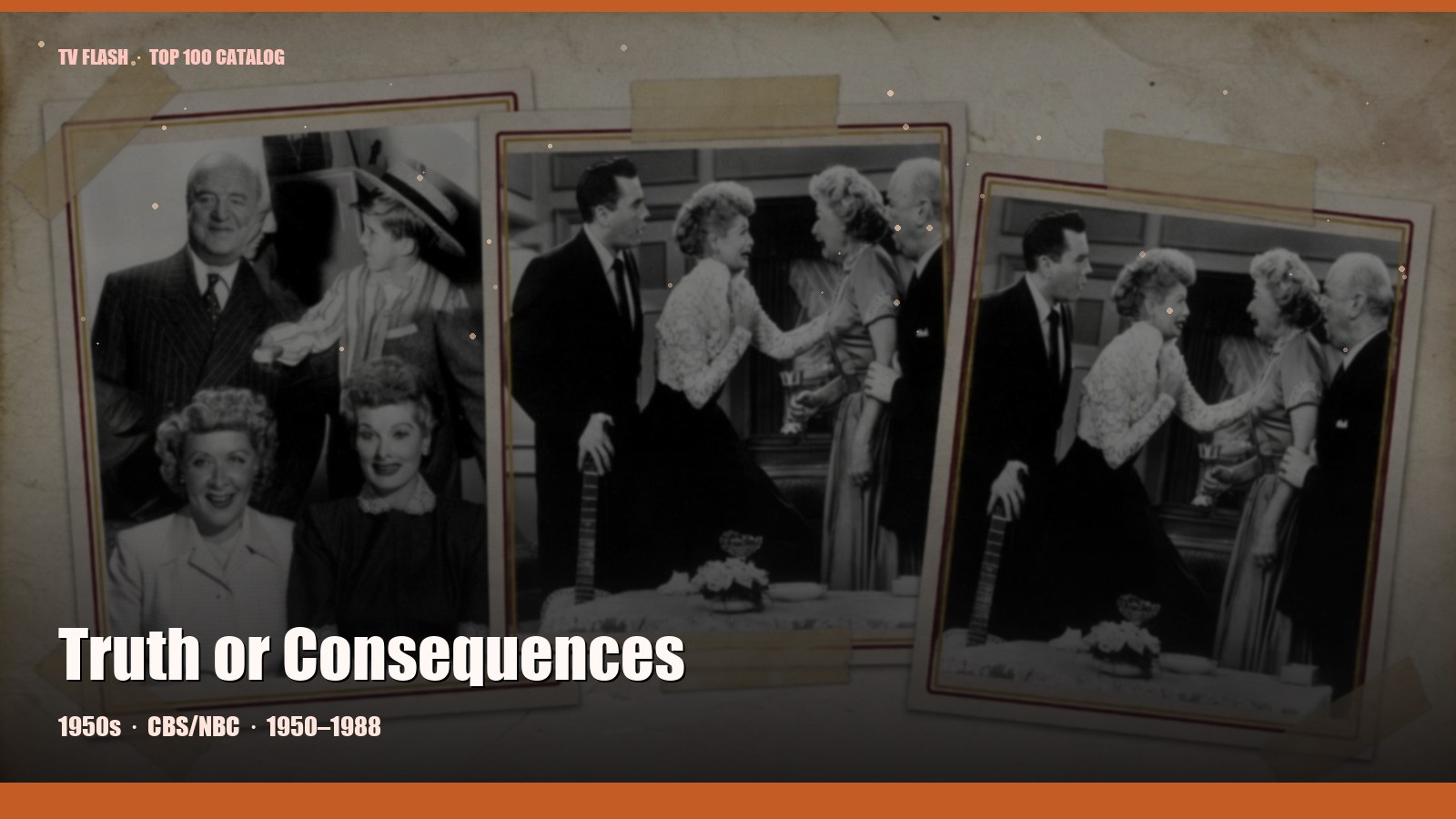
TV's early stunt game show; pioneered audience humiliation-as-fun.
Why it matters
From the desk
Why Truth or Consequences still plays
Wrong answer? Do the stunt. The radio chaos crossed to cameras in 1950 and kept humiliating volunteers, cheerfully, across CBS and NBC and beyond through 1988. Truth or Consequences, Ralph Edwards's dare-show: audience humiliation sold as fun, whipped-cream disorder, sometimes real stakes. Early television stunt game, the ancestor of every later dare hour. Bob Barker hosted a long later run starting in 1956 on NBC; Jack Bailey also took a turn. Formal-wear dignity never stood a chance against the consequence. On the palate: a buzzer, a mess, and a grin that is not entirely kind.
The historical claim: first major TV game-show lineage built on stunts rather than pure trivia. Max's vending-machine culture will drop a dare franchise on a Thursday and call the humiliation new. Cute. Edwards had the whipped cream and the civic legend — the night the show surprised a returning POW's family, a gag that briefly felt like news. Patterns are old. Stunt comedy and public ambush share a hallway. Linear event television, martini-dry, with a towel.
What the night looked like: a volunteer who thought they were playing a quiz; a consequence that was the real program; a host who sold chaos as manners. Tiny catalog pack here — a listed pilot as the door. The long run is proof humiliation-as-entertainment had legs. Do not confuse longevity with innocence. The POW-family lore is the reminder that a stunt show could, on one night, pretend to be something like public service. The rest of the nights were cream.
The listed pilot is wrong answers becoming stunts, Edwards's radio chaos now with cameras, audience humiliation sold as fun on a ticking dare. One bookmark for a franchise that ate decades. Sample the dare. Notice the towel. That is the assignment — not a complete log of 1950–1988, which no living room ever finished as a binge.
A toast to the consequence, and to the slightly deflating detail that the civic night was the exception, not the brand. Glory always had a human, slightly sticky detail. Barker took the later NBC years; Edwards owned the radio-to-camera dare. The vending machine can keep its dare windows. This one needed a studio that could not pause the mess.
Episode guide
How this series is filed
TV Flash files Truth or Consequences (1950–1988) on CBS/NBC as the episode guide: 1 listed hours across 1 seasons, 1950-09-07 opening on “Pilot” (S01E01).
Essential episodes
Wrong answers into stunts — Edwards's radio chaos with cameras, dare-show ancestor in one surviving hour. Filed by Rex Fontaine (Golden Age Dispatch).
- S01E01 Pilot
Pilot: wrong answers become stunts, Ralph Edwards's radio chaos now with cameras, audience humiliation sold as fun on a ticking dare.
At a glance
Contestants who failed trick questions had to perform zany consequences on stage. Truth or Consequences (CBS/NBC and beyond, TV from 1950, radio origin 1940 under Ralph Edwards) normalized stunt comedy as daytime and primetime sport. Jack Bailey hosted; Bob Barker took a long later run starting in 1956 on NBC. Audience humiliation sold as fun: whipped-cream chaos, sometimes real stakes. Edwards once used the show to surprise a returning POW's family — a gag that briefly felt civic. First major TV game-show lineage built on stunts rather than pure trivia. Wrong answer? Do the stunt.
Network & studio
Why watch now
Truth or Consequences turned wrong answers into stunts: Ralph Edwards's radio chaos, now with cameras, and audience humiliation sold as fun. Early TV stunt game, sometimes with real stakes. Watch it in 2026 as the dare-show ancestor — whipped-cream chaos, plus the legend of a POW-family surprise that made a gag feel civic.
Cultural impact
Truth or Consequences pioneered audience humiliation-as-fun and built TV's early stunt-game lineage on dares rather than trivia. Edwards's radio chaos crossed to cameras and stayed for decades of whipped-cream grammar. Barker's long NBC run from 1956 proved the consequence had legs. Later dare shows still rent this bargain: a trick question as pretext, the stunt as the product, and the rare night a gag pretended to be civic.
Creators
Ralph Edwards
Key cast
- Ralph Edwards as Host
- Jack Bailey as Host
- Bob Barker as Host (later)
Flash facts
- TV versions from 1950; originated on radio in 1940 under Ralph Edwards.
- Jack Bailey hosted; Bob Barker hosted a long later run starting in 1956 on NBC.
- Contestants who failed trick questions performed zany on-stage consequences.
- First major TV game-show lineage built on stunts rather than pure trivia.
- Edwards once used the show to surprise a returning POW's family.
FAQ
Where should I start?
Start with Edwards, a wrong answer, and a messy consequence. The stunt-as-punishment brief is the show; the POW-family surprise is the famous civic footnote.
What can I skip?
Skip a 1950–88 slog. Stunt grammar repeats. Later decades are other hosts wearing the same dare.
Is it still worth it?
Yes, as the dare-show ancestor — whipped-cream chaos, plus the occasional stunt that grew a conscience.
Quiz or stunt show?
Stunt game — wrong answers become dares, humiliation as entertainment, not a knowledge contest.
Official & further reading
External sites for further reading — TV Flash is not affiliated with these networks or studios.
Back to the decade
Also on the dial
More after Truth or Consequences
- Related showMeet the PressThe longest-running show in television history — Sunday panel combat as civic ritual.
- Related showThe Ernie Kovacs ShowVisual gags, blackouts, and Nairobi Trio — the medium inventing itself for laughs.
- Related showM SquadLee Marvin's hard cop in a hard Chicago — noir procedural with a jazz bite.
- Related showKukla, Fran and OllieAd-lib puppets and Fran Allison — gentle absurdity that adults watched without irony.
- Related showSky KingArizona rancher with a Cessna — aviation adventure for kids who wanted wings.
- Related showBat MastersonDerby hat, gold-tipped cane — Gene Barry's dandy lawman who fought with style.