Picture a Thursday when the nation had three doors and still chose chaos. No infinite scroll — just ABC, CBS, NBC, a rabbit-ear argument, and a watercooler already loading for morning. The three-network night was not gentler than streaming; it was louder per square inch of choice. Appointment viewing meant your show either owned the hour or died in the lead-in. The gossip traveled by columnist, commissary, and cousin in Cleveland — and somehow arrived before the affiliate’s late news. That pattern should feel familiar. The gadgets changed. The soap opera did not.
What did a network night actually feel like?
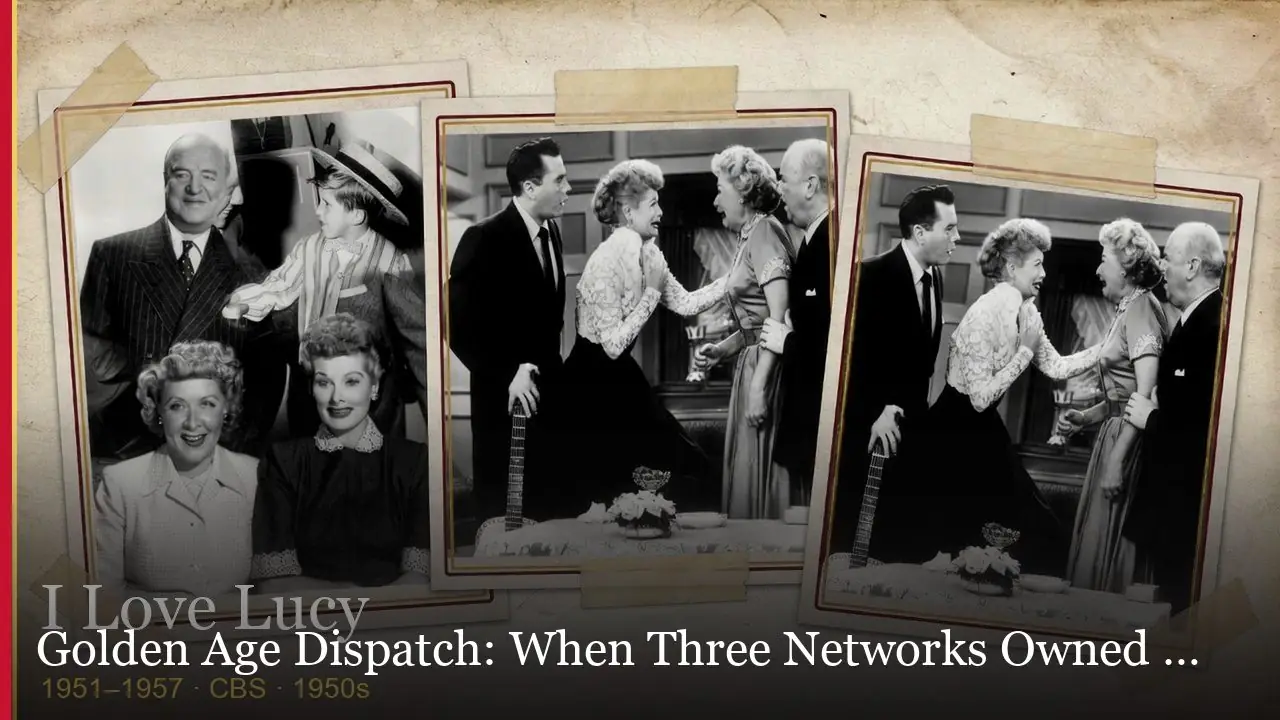
Scarcity with sequins. Schedules were weapons: must-see blocks, counterprogramming, and sweeps months when the ratings book decided whose drama got a full-season order and whose star got a softer dressing room. Families negotiated the set like a tiny UN. Teenagers learned diplomacy by lobbying for one sitcom over another. When I Love Lucy owned Monday in an earlier age, it was not merely popular — it was infrastructure. Miss it and you missed the country’s shared joke supply.
On the palate: cigarette haze in the writers’ room lore, perfect three-act commercials interrupting the climax, and affiliate stations as feudal lords who could bump your finale for a local parade if they felt bold. Standards & Practices hovered like a nervous priest. Guest-star mythology paid the rent; a single variety booking could mint a career or freeze one out.
Three scandals that would trend today (and did, in their analog way):
- Contract brinkmanship — leads holding out while the press printed salary figures like box scores.
- Recasts sold as weather — smile, pretend continuity, pray the audience forgives the jawline.
- Finale events that stopped the country — ratings myths that executives still cite like scripture.
None of this requires ancestor worship. It requires memory. When the modern catalog behaves like a vending machine with a PR department, it is worth recalling that linear television already knew how to bury a show: bad timeslot, no promos, a shrug dressed as “the audience spoke.” The burial just happened on-air, in public, between a newsbreak and a used-car spot.
Was appointment TV better — or simply inescapable?
Inescapable is not the same as better. Plenty of hours were beige porridge with laugh tracks. But appointment culture forced a kind of civic craft: writers wrote to the week; performers lived with the country overnight; endings could not hide inside a silent interface. You felt the flop. You felt the phenomenon. Dallas cliffhangers and MASH* goodbye ratings were not “engagement metrics.” They were weather reports.
Streaming’s defenders (I can hear the chart boys sharpening pencils) will say discovery is richer now, and they are half right. Choice is a gift. Amnesia is not. The industry still runs on old sins — hyping a show that cannot stand, rewriting a star mid-flight, calling a retreat a “complete story.” If you only study the For You page, you will think these tricks were invented by a dashboard. They were refined under three logos and a lot of martini lunches.
The historical claim the room forgets: shared nights manufactured shared language faster than abundance does. That language included gossip — who was feuding on set, who married in a rushed Vegas footnote, which comic killed on Sullivan and which one bombed with the censors watching. Old-Hollywood dirt is fair game; cruelty toward the dead is not. Prefer the anecdote that survives three barstools and still checks out in a biography’s footnotes.
What should we steal from the three-network map?
Not the oligopoly. The event. Weekly chapters. Finales that risk a nation’s mood. Promos that treat the audience as a public, not a cohort. And a little humility: the remote used to be a weapon with three bullets, and people still found ways to make drama. Imagine what they would have done with a group chat. Actually — better not. Some living rooms barely survived the volume knob.
A toast, then, to the night that ended at eleven whether the algorithm liked it or not — and to the star who privately hated the theme song America hummed in the grocery line. Glory always had a human, slightly deflating detail. That, my dears, is continuity.
FAQ
What was the three-network era in U.S. television?
For much of the mid-20th century, ABC, CBS, and NBC dominated American primetime. Most viewers chose among those broadcasters each night, which made hit shows national events and schedule placement a form of power.
What is appointment viewing?
Appointment viewing means watching a program at a scheduled time (or within a tight cultural window) so audiences share the experience together — as opposed to purely on-demand viewing whenever an individual prefers.
How does classic network competition relate to streaming today?
Both systems fight for attention with timing, promotion, and talent deals. Linear TV used timeslots and sweeps; streamers use drop calendars and homepage placement. The tools differ; burying weak titles and amplifying hits is an old habit in new packaging.