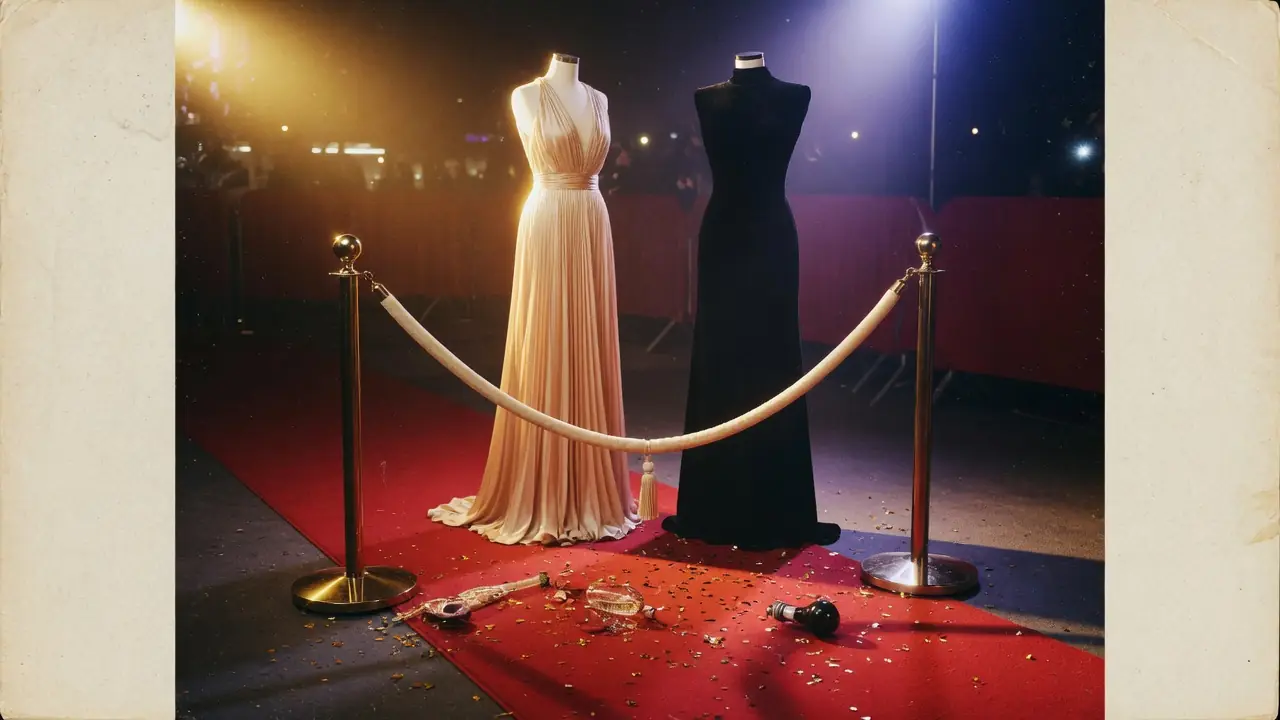
The first flash is champagne silk under a cruel white strobe — a hem that has not yet learned the show’s weather. The last flash is black column, no jewelry, a throat left bare on purpose. Same rope. Same photographers. Different sentence. Premiere fashion night is a thesis. Finale fashion night is the last image the rerun will steal. This was not the same dress in two cities; this was a beginning and an ending wearing each other as alibi.
Tessa can have the tags. Vivian can have the kitchen exit. I will be where the cloth tells on the press release.
What does a premiere look actually sell?
Permission. Not plot. The first carpet teaches the camera how expensive, how dirty, how period, how modern the next six years are allowed to feel. A pilot can argue in dialogue. A premiere gown argues in one second from a bad angle.
Sex and the City — Sex and the City (1998) sold nameplate glamour as civic infrastructure. Manhattan as a fitting room. The closer, An American Girl in Paris (Part Deux), had to dress a goodbye that still wanted to be a postcard. Package: Sex and the City.
Mad Men — Smoke Gets in Your Eyes (2007). Gray flannel as character, not costume-shop. The last hour, Person to Person, is quieter cloth — the silhouette has nowhere left to hide. Package: Mad Men.
The Crown — Wolferton Splash (2016) opened in state fabric: weight, protocol, the dress as institution. Sleep, Dearie Sleep closed the ledger. Royal fashion is never “just clothes.” It is the show’s argument about power wearing a face. Package: The Crown.
Succession — Celebration (2018) taught quiet luxury as a weapon. With Open Eyes dressed a funeral that refused to call itself one. Package: Succession.
Look board for the first night (textures, not teas):
- Camera-first color — jewel or ink that survives livestream white-balance.
- One headline accessory — so the still has a noun.
- Seam honesty — if it pulls on the stair, the meme will be the garment, not the show.
- Period or now, pick one — mixed signals read as stylist panic.
- Shoe reality — the after-party is the second look; budget for it.
One vulnerable note: talent is exhausted before the first question. A premiere “fail” is sometimes a body that flew eleven hours into a sample size. I will still defend craft against “the timeline said it was mid.” Mid is a mood. Silhouette is a fact.
How should a finale look close the book?
It should rhyme with episode one without repeating it. The last carpet is not a victory lap unless the show earned a parade. More often it is a soft eulogy in good wool: darker, simpler, a face that has been photographed too many times to pretend this is week one.
Friends — The One Where Monica Gets a Roommate dressed six people as a city. The Last One, Part 2 dressed the same city as memory. Fountain mythology is a silhouette problem as much as a set problem. Package: Friends.
Fleabag — Episode 1 invented a black-dress confession booth. Episode 6 did not need more jewelry. The look was always the ethics. Package: Fleabag.
Game of Thrones — Winter is Coming sold scale in fur and mud. The Iron Throne sold a last photocall industrial complex. Whether you loved the cut, the image of the last night is now part of the folklore. Package: Game of Thrones.
Euphoria still belongs on the premiere board — Pilot taught a generation that TV carpets can be editorial, not merely “nice suit.” I will not call a later season a series goodbye just because a calendar has a last listed hour. Style is the plot. Honesty is the hem.
Look board for the last night:
- Subtract, don’t add — one less jewel, one cleaner line.
- Rhyme the color story from the first carpet, then cool it.
- Let the face work — finale flash is unkind to over-architecture.
- No apology tuxedo unless the character was always a tuxedo.
- Airport departure is the real last look — I will be on the sidewalk.
Why do premiere and finale nights need each other?
Because a first look without a last look is a trailer. A last look without a first look is a funeral for a stranger. The pair is the magazine story: hello in gold, goodbye in ink. Julian will tell you the cut has to keep the promise. Max will check whether the opener sold and the closer held. Rex will toast the living room. Vivian will ask who left through the kitchen. I will ask whether the cloth remembered episode one.
See you at the after-party. Or, more honestly, in the unapproved departure frame — coat on, stomach dropped, the second silhouette telling the truth the step-and-repeat was too well-lit to admit. For craft openers, Julian filed the pilot syllabus. For event endings as history, Rex has the cathedral list. For who sold week one vs who held the room, Max has pilot sell / finale hold. For the rope-line as wake, Vivian’s finale-night exits. For the group chat that ruins a perfectly good hemline, Tessa’s discourse wars.
FAQ
What is “premiere-to-finale fashion night”?
It is reading a series’ first public carpet and its last public carpet as a pair — the opening silhouette as thesis, the closing silhouette as last image — rather than as two unrelated photo galleries.
Do finale looks have to match the premiere?
They should rhyme, not photocopy. Repeating week-one glamour on the last night often reads as denial; a total costume reboot often reads as a different show. The best last looks subtract.
Where can I open these first and last hours on TV Flash?
Episode links above cover Sex and the City, Mad Men, The Crown, Succession, Friends, Fleabag, Game of Thrones, and the Euphoria pilot — each page is a single episode entry with airdate context.