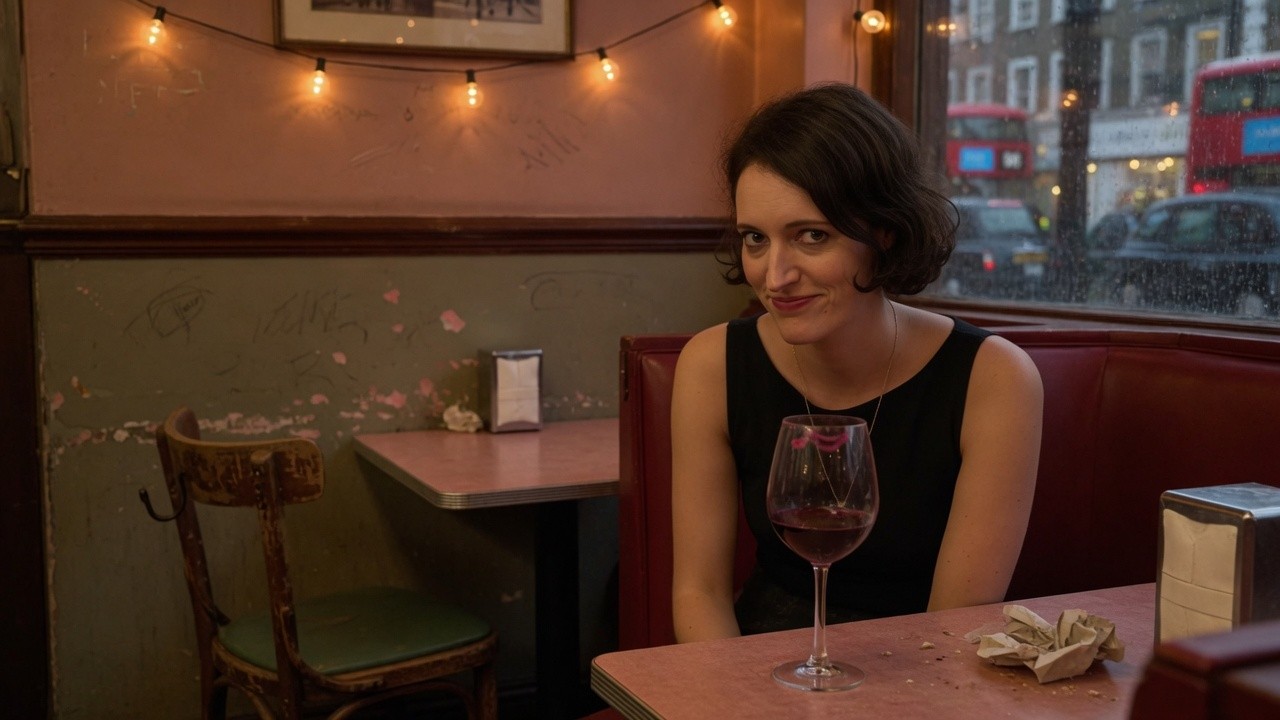
Fleabag
Fourth-wall confession as weapon — hot priest discourse included.
Fourth-wall confession as weapon — hot priest discourse included.
Short-run perfection argument; auteur comedy-drama.
Why it matters
From the desk
Phoebe Waller-Bridge's confession machine as a closed novel: fourth-wall grammar, a second season that risks a priest, and the rare comedy-drama that treats stopping as craft.
The look to camera is a cut, not a wink. Fleabag does not break the fourth wall so much as she employs it: an aside as a defense, then as a habit, then as a problem she can no longer afford. Twelve episodes. Two seasons. BBC Three to a global afterlife on Amazon. Phoebe Waller-Bridge writes, stars, and — this is the part the industry should study more than the hot-priest memes — stops. In a decade that treats every half-hour as a seed for eight more, that stop is the art.
Season one is the grief engine in a guinea-pig cafe. Family dinners that curdle, a sister who is trying, a godmother who collects the room, a woman who would rather be funny than be seen. The asides are hilarious until they are not, which is the structure. Episode four is where a lot of first-time viewers realize the joke has a body count. Episode six is where the confession stops being a bit. I will not recap the wound. The series does not want you to meet it as trivia. It wants you to meet it as a look you cannot unsee.
Season two is the dangerous second movement. Andrew Scott's priest walks in, the internet loses its manners, and the show has to decide whether chemistry is the point or the test. It chooses the test. The fox, the confession, the line about love passing — craft, not a merch drop. What the season is arguing: that wanting to be saved is not the same as being saved, that family will forgive you in the wrong order, that a fourth wall is an intimacy you can abuse. People came for the priest. The priest is a device. The device works because Waller-Bridge still aims the camera at the woman who cannot stop performing long enough to be held.
Gossip, as a footnote: the awards were a sweep, the press tour was a second show, and the discourse treated a clerical collar like a dating app. Fine. Prestige comedy is allowed a carnival. The text still ends when she looks at the lens and the lens, for once, does not follow her into the next bit. That last refusal is the closest thing contemporary television has to a period at the end of a sentence. Season three would have been money. Season three would also have been a betrayal of the grammar. She knew. The rest of us can be greedy in the comments.
Is it comedy? Yes, until the laugh is a tell. Is it drama? Yes, until the drama remembers to be funny so it can survive the dinner. Comparisons to other auteur half-hours are mostly a way to avoid saying the thing: this one is short on purpose. You can watch both seasons in a night. You should not, unless you like emotional whiplash as a sport. Better to let the asides sit. Better to notice that the supporting work — Olivia Colman, Sian Clifford, the whole uncomfortable table — is not furniture. It is the cage.
Verdict: a complete object. Start at episode one of season one, do not skip the ugly bits, take the priest season as a second novel rather than a sequel hook, and accept the ending as a craft decision, not a cliff. The scandal will outlive the look — someone will always want more. The look is the literature. Closed, on purpose, which is unfortunately rarer than a good joke about a cafe.
Episode guide
TV Flash files Fleabag (2016–2019) on BBC/Amazon as the episode guide: 12 listed hours across 2 seasons, 2016-07-21–2019-04-08 from “Episode 1” (S01E01) to “Episode 6” (S02E06).
Open the episode guide · S01E01 Episode 1 · S02E06 Episode 6
Grammar hours — asides, wounds, and the second-season test. The whole run is short; these five teach the instrument. Filed by Julian Hart (The Binge Brief).
The look-to-camera contract. Funny as a defense, already a tell.
The joke grows a shadow. First-run viewers often date the turn to this hour.
Season one puts the confession down. The aside is no longer free.
The second movement walks in. Chemistry as a test, not a renewal strategy.
The hour the grammar pays for: wanting, saying, not being saved on schedule.
Flash columns that open this package’s pilots, finales, or fandom heat:
A grieving, chaotic woman confides in the camera while relationships implode with surgical comedy. Fourth-wall confession as weapon; hot-priest discourse included. Short-run perfection argument in two seasons.
Watch it because it is twelve hours and then it stops: a fourth-wall confession that becomes a moral problem, a second season that risks a priest without becoming a sequel hook, and an ending that treats the camera as a relationship you can finally refuse.
Fleabag made breaking the fourth wall feel newly dangerous and Phoebe Waller-Bridge a multi-hyphenate myth. The finale boundary is part of its legend.
Phoebe Waller-Bridge
You can, and you will miss why the asides are a problem. Season two is a second movement, not a pilot. Start at season one, episode one. Twelve hours is not a homework sentence.
Nothing essential. It is twelve episodes. If you skip the awkward dinners you skip the show. There is no filler season. That was the deal.
Both, on a timer. If you need a laugh track, no. If you need a hug every episode, also no. If you can take a joke that turns into a confession, this is the room.
The series ended in 2019 with season two, episode six. Waller-Bridge has treated that close as a boundary, not a tease. Wanting more is allowed. Getting more would be a different show.
It is blunt about sex and worse about manners. The clips are the joke; the hours are the bill. If you only know the priest from GIFs, you do not know the show yet.
External sites for further reading — TV Flash is not affiliated with these networks or studios.
Also on the dial