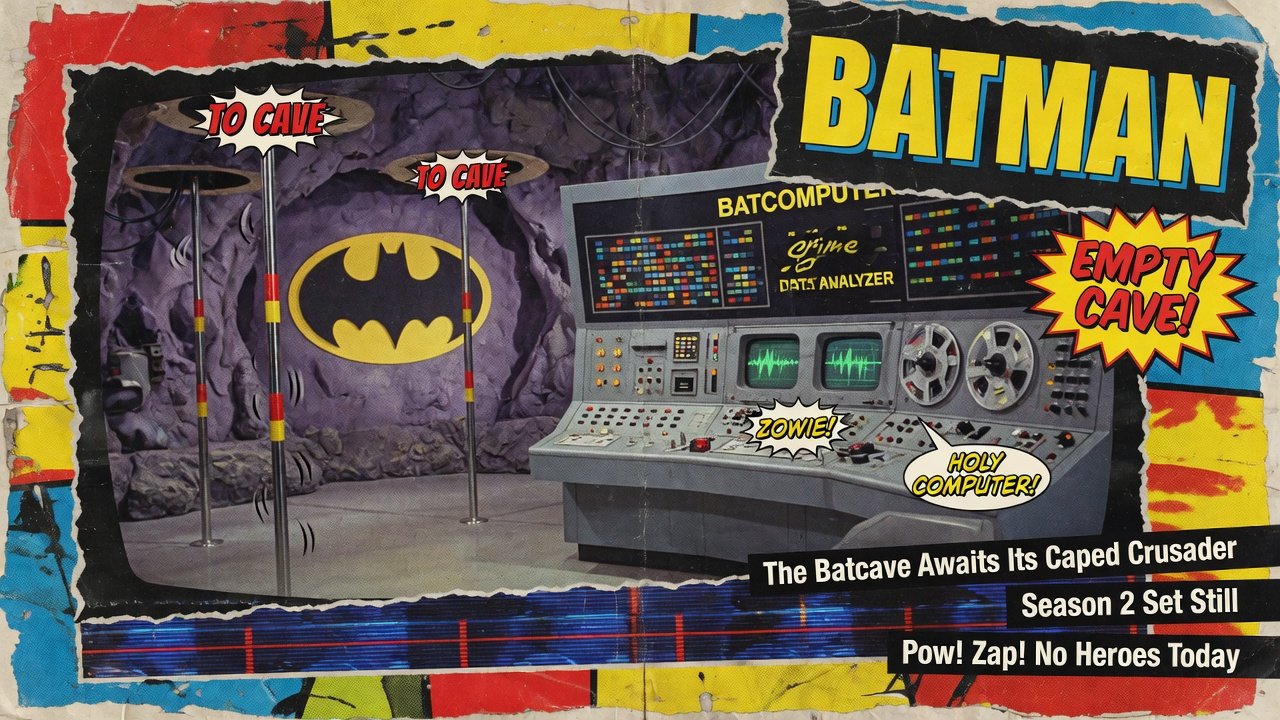
Locked Adam West's Batman into pop culture and made comic-book TV a primetime event.
Why it matters
From the desk
Why Batman still plays
The freeze-frame is the argument. ABC's *Batman* (January 12, 1966–March 14, 1968) does not wink after the fight; it prints the onomatopoeia on the air itself — Pow, Zap, the candy-colored grammar of a color-TV generation. Adam West plays Bruce Wayne / Batman as deadpan virtue. Burt Ward plays Dick Grayson / Robin as earnestness without an exit. Sincerity is the gag; the gag is the point. William Dozier leaned into camp until camp became a national style guide.
Twice-weekly cliffhangers, a 1966 feature film between seasons, and 120 episodes locked the brand into lunchboxes. Villain-of-the-week casting was a celebrity revolving door — Joker, Penguin, Riddler, Catwoman, whoever else wanted the same Bat-time, same Bat-channel slot. Alan Napier's Alfred and Neil Hamilton's Commissioner Gordon hold the civic furniture while the guest chews scenery. The blotter will file the casting as sport. The cut files it as design.
Three seasons is a short lease for a myth this loud. *Hi Diddle Riddle* opens the twice-weekly contract. *The Joker Is Wild* teaches the freeze-frame as grammar. Mid-run *Pop Goes the Joker* keeps the house style hop-friendly and cliff-hungry. Season three restocks the costume rack with Batgirl without dropping the camp assignment. *Minerva, Mayhem and Millionaires* closes the candy-colored run: the bright pole every later grim Batman still has to answer.
The series made comic-book television a prime-time event and permanently split fan culture over tone. Superhero TV still oscillates between this bright pole and grim reboot gravity. The people who want only the leak — who treated the guest list as a crime blotter and forgot the lighting — miss the permission Dozier actually granted: play it straight enough that the pop-art reads as craft.
West's deadpan and Ward's earnestness are the permission structure. Play virtue without a wink and the fight bubbles read as pop-art, not as incompetence. The 1966 feature sits between seasons as a longer dose of the same style — not a course correction. Three seasons on ABC, January to March in the bookends, and Adam West's Batman stamped into global pop memory whether later grim reboots like it or not.
Watch it as style-guide television, not as a grim origin story. You do not need all 120 hours. A handful of celebrity-villain two-parters plus one later-season door is enough to see why the argument about 'serious' Batman never ended. Verdict: camp on purpose, and still the Exhibit A later dark-versus-fun wars refuse to retire.
Episode guide
How this series is filed
TV Flash files Batman (1966–1968) on ABC as the episode guide: 120 listed hours across 3 seasons, 1966-01-12–1968-03-14 from “Hi Diddle Riddle (1)” (S01E01) to “Minerva, Mayhem and Millionaires” (S03E26).
Open the episode guide · S01E01 Hi Diddle Riddle (1) · S03E26 Minerva, Mayhem and Millionaires
Essential episodes
Camp as a style guide — cliffhangers, celebrity villains, and the Pow! hours that still start arguments. Filed by Julian Hart (The Binge Brief).
- S01E01 Hi Diddle Riddle (1)
Hi Diddle Riddle opens the twice-weekly contract: West's deadpan virtue, Ward's earnest Robin, and camp as a national look.
- S01E05 The Joker is Wild (1)
The Joker is Wild — celebrity-villain casting as sport, freeze-frame fight bubbles as the color-TV grammar.
- S02E57 Pop Goes the Joker (1)
Pop Goes the Joker keeps the onomatopoeic house style at mid-run boil, still hop-friendly and cliff-hungry.
- S03E01 Enter Batgirl, Exit Penguin
Enter Batgirl, Exit Penguin — a season-three door that restocks the costume rack without dropping the camp assignment.
- S03E26 Minerva, Mayhem and Millionaires
Minerva, Mayhem and Millionaires closes ABC's candy-colored run: the bright pole every later grim Batman still has to answer.
At a glance
Pow! Zap! ABC's Batman (1966–1968) turned the Caped Crusader into pop-art appointment TV: Adam West's deadpan virtue, Burt Ward's earnest Robin, and guest villains chewing scenery between freeze-frame fight bubbles. Executive producer William Dozier leaned into camp so hard it became a national style guide. Twice-weekly cliffhangers and a 1966 feature film locked the brand into lunchboxes and arguments about 'serious' Batman forever. Three seasons and 120 episodes later, the series left a candy-colored crater in comic-book TV. Sincerity was the gag; the gag was the point.
Network & studio
- ABC — broadcast network
- Greenway Productions — production studio
- 20th Century Fox Television — production studio
Why watch now
ABC's Batman is camp as a national style guide: Adam West's deadpan virtue, Burt Ward's earnest Robin, and celebrity villains between freeze-frame fight bubbles. Twice-weekly cliffhangers and Pow! graphics locked comic-book TV into prime time. Required viewing before you pick a side in every later dark-versus-fun Batman war.
Cultural impact
The series made comic-book television a prime-time event and stamped Adam West's Batman into global pop memory. It also permanently split fan culture over tone. Superhero TV still oscillates between this bright pole and grim reboot gravity.
Creators
William Dozier
Key cast
- Adam West as Bruce Wayne / Batman
- Burt Ward as Dick Grayson / Robin
- Alan Napier as Alfred Pennyworth
- Neil Hamilton as Commissioner Gordon
Flash facts
- ABC live-action series aired January 12, 1966–March 14, 1968 (3 seasons, 120 episodes).
- Starred Adam West as Batman/Bruce Wayne and Burt Ward as Robin/Dick Grayson.
- Executive produced by William Dozier; famous for onomatopoeic fight graphics and cliffhangers.
- Feature film Batman (1966) released between seasons.
- Villain-of-the-week casting became a celebrity revolving door (Joker, Penguin, Riddler, Catwoman, and more).
FAQ
Where should I start?
Season 1's twice-weekly cliffhangers are the full candy-colored contract: West, Ward, onomatopoeic graphics, and a guest villain. The 1966 feature film sits between seasons as a longer dose of the same style.
Do I need all 120 episodes?
No. The premise is weekly camp, not a long arc. A handful of celebrity-villain two-parters plus one later-season hour is enough to see why the argument about 'serious' Batman never ended.
Is it camp or superhero drama?
Camp on purpose — bright humor, exaggerated villains, pop-art design rather than dark realism. Watch it as style-guide television, not as a grim origin story.
Is it still worth it after darker Batman versions?
Yes, if you want the other pole of the war. Every later dark-versus-fun argument still has this series as Exhibit A.
Official & further reading
External sites for further reading — TV Flash is not affiliated with these networks or studios.
Back to the decade
Also on the dial
More after Batman
- Related showThe Green HornetBritt Reid and Kato — martial-arts sidekick energy that made Bruce Lee a U.S. star.
- Related showThe F.B.I.Efrem Zimbalist Jr. vs. the ten most wanted — Bureau procedural as national myth.
- Related showABC's Wide World of SportsThe thrill of victory, the agony of defeat — anthology sports as global window.
- Related showShindig!Prime-time rock variety — go-go dancing and British Invasion heat on ABC.
- Related showF TroopFort Courage farce — cavalry, Hekawi schemes, and slapstick frontier corruption.
- Related showMcHale's NavyPT-73 hijinks — wartime sitcom with Ernest Borgnine's sneaky skipper.