Prime stunt-competition game of early TV; Bud Collyer's cheerful chaos.
Why it matters
From the desk
Why Beat the Clock still plays
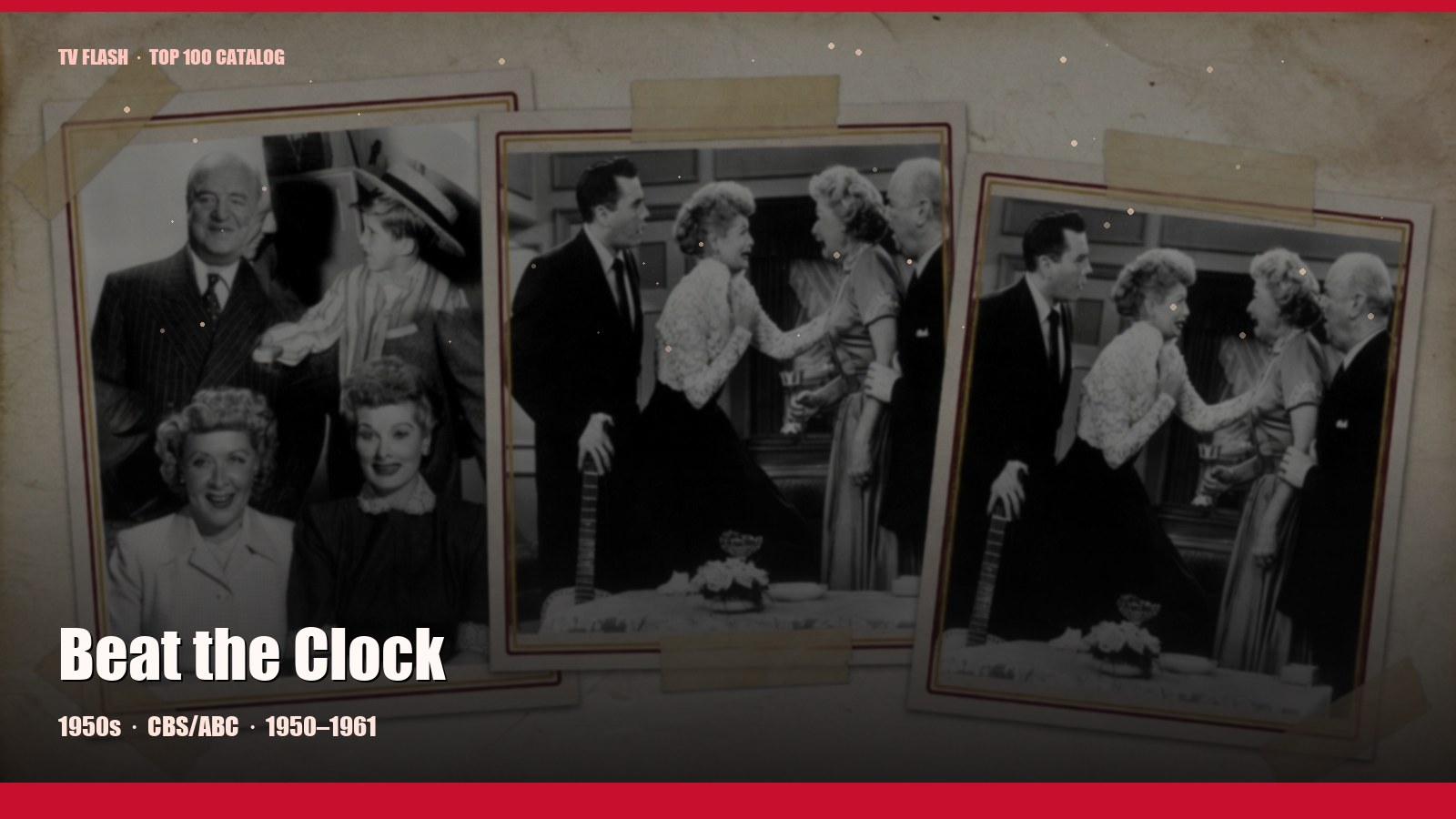
The silhouette is formal wear losing to whipped cream on a timer. Beat the Clock (CBS/ABC, 1950–1961) pitted married couples against messy stunts and a ticking clock — proto-Fear Factor in a gown, Bud Collyer's cheerful chaos, Roxanne as assistant, Goodson-Todman production. Mid-century dignity never stood a chance, on purpose, for prizes and the pleasure of the mess. **This was not a soft launch; this was a hard launch in cream.** Prime stunt-competition of early television. The look is the stain.
A clock bullying a marriage in prime time is image management as slapstick. The form is the stunt plus the tick, not a quiz with a brain. Tessa's tags will live-blog the mess and call the gown ruined. That is the show. Later dare hours turned up the cruelty; this one still looks like a wedding party that went wrong on camera and called it a good time. One vulnerable note: performing composure in soaked formal wear is exhausting. Then back to the silhouette. Collyer's CBS/ABC years put couples in water tanks on a timer. The fittings were the towels.
Look board for a stunt marriage: tuxedo as message dress, cream as sequins, water tank as the lighting plot, clock as jewelry, Roxanne as the calm accessory, Collyer as the velvet rope who is enjoying this. Elevated disaster. Defend the craft of the look against the timeline that says it was only chaos. The chaos is designed. The dignity is the costume the hour is hired to destroy.
The listed first hour is Collyer's cheerful chaos, couples versus messy stunts, mid-century dignity already losing to whipped cream on purpose. The other listed hour, a late-season Episode 1, is the stunt-competition still ticking, formal wear still the costume for water tanks. Two bookmarks for a tiny pack, later revived in other decades with other hosts. You do not binge a timer. You watch the cream hit the cloth.
Last image: a soaked lapel, a clock that won, a prize that cannot fix the suit. See you at the after-party. Bring a towel. The tags can fight about the mess; the silhouette already posed for it — Goodson-Todman stunt-competition, Collyer's cheerful chaos, mid-century dignity hired to lose.
Episode guide
How this series is filed
TV Flash files Beat the Clock (1950–1961) on CBS/ABC as the episode guide: 2 listed hours across 2 seasons, 1950-03-23–1961-01-27 from “Episode 1” (S01E01) to “Episode 1” (S10E01).
Open the episode guide · S01E01 Episode 1 · S10E01 Episode 1
Essential episodes
Married couples, messy stunts, a ticking clock — proto-Fear Factor in formal wear. Filed by Lana Reyes (Red Carpet Reality).
- S01E01 Episode 1
Episode 1: Bud Collyer's cheerful chaos, couples versus messy stunts, mid-century dignity already losing to whipped cream on purpose.
- S10E01 Episode 1
Episode 1 of a late season: the stunt-competition still ticking, formal wear still the costume for water tanks.
At a glance
Couples attempted messy timed stunts for prizes while the clock ticked down. Beat the Clock (CBS/ABC, primarily 1950–1961), a Goodson-Todman production hosted by Bud Collyer with assistant Roxanne, made Saturday-night and daytime messes a family spectator sport. Pure physical comedy as game show: whipped cream, water tanks, mid-century dignity never standing a chance, on purpose. Proto-dare television in formal wear. Later revived in multiple decades with other hosts. The form is the stunt plus the tick, not a quiz with a brain — a clock bullying a marriage for prizes and the pleasure of the mess.
Network & studio
- CBS — broadcast network
- ABC — broadcast network
- Fremantle — production studio
- Mark Goodson Productions — production studio
- Ion Media — production studio
Why watch now
Beat the Clock pitted married couples against messy stunts and a ticking clock — proto-Fear Factor in formal wear, Bud Collyer's cheerful chaos. Prime stunt-competition of early television. Watch it now to see mid-century dignity lose to whipped cream and water tanks, on purpose, for prizes and the pleasure of the mess.
Cultural impact
Beat the Clock was early TV's prime stunt-competition game: Collyer's cheerful chaos, Goodson-Todman messes, a clock as antagonist. It made physical comedy a family spectator sport and taught later dare shows the tick. Formal-wear dignity never stood a chance; that was the pitch. Later revivals kept the stunt-plus-timer bargain while turning up the cruelty. The wedding party that went wrong on camera and called it a good time.
Creators
Mark Goodson · Bill Todman
Key cast
- Bud Collyer as Host
- Roxanne as Assistant
Flash facts
- CBS/ABC game show primarily 1950–1961; hosted by Bud Collyer.
- Goodson-Todman production famous for messy clock-beating stunts.
- Roxanne appeared as assistant.
- Couples attempted timed stunts for prizes while the clock ticked down.
- Later revived in multiple decades with other hosts.
FAQ
Where should I start?
Start with Collyer, a couple, and a messy timed stunt. Formal wear versus whipped cream is the brief.
What can I skip?
Skip every tank-and-cream variation. The clock-and-mess grammar repeats. You have the show after a few dares.
Is it still worth it?
Yes, as early stunt-competition — mid-century dignity losing to a timer, on purpose.
Game show or dare show?
Timed stunt competition — couples versus mess and a clock, not a trivia panel.
Official & further reading
External sites for further reading — TV Flash is not affiliated with these networks or studios.
Back to the decade
Also on the dial
More after Beat the Clock
- Related showLife Is Worth LivingBishop Sheen vs. Milton Berle in the ratings — a chalkboard and a cape beat vaudeville some weeks.
- Related showThe Ernie Kovacs ShowVisual gags, blackouts, and Nairobi Trio — the medium inventing itself for laughs.
- Related showRocky and His FriendsA flying squirrel, a moose, and Cold War satire — Jay Ward's anarchic gift at decade's end.
- Related showKukla, Fran and OllieAd-lib puppets and Fran Allison — gentle absurdity that adults watched without irony.
- Related showSky KingArizona rancher with a Cessna — aviation adventure for kids who wanted wings.
- Related showThe United States Steel HourIndustrial giant, theatrical punch — live drama with a steel-hard production sheen.