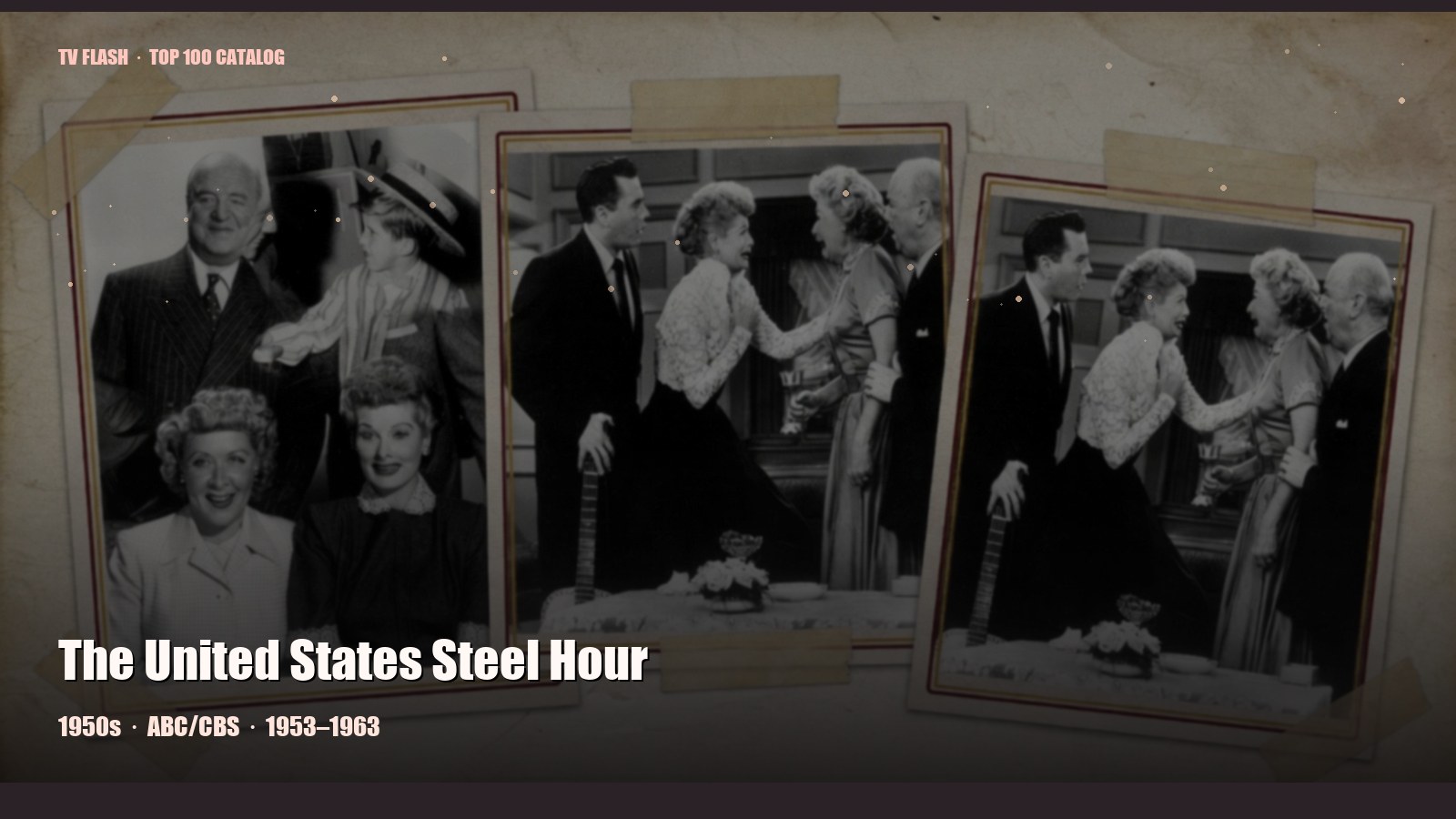
Major live-drama showcase of the Golden Age; launched stars and serious teleplays.
Why it matters
From the desk
Why The United States Steel Hour still plays
The silhouette is industrial sheen on a live play: a steel logo as a curtain, theatrical punch in a living room, hard-hat prestige. The United States Steel Hour (ABC then CBS, 1953–1963) was Golden Age drama with an industrial giant's polish — serious teleplays, launched stars, The Theatre Guild and U.S. Steel, 259 episodes, ten seasons. Andy Griffith's No Time for Sergeants breakout happened on this stage of the air (1955). **This was not a commercial break; this was a hard launch in corporate light.** Proof a steel company once bankrolled the kind of play networks now fear. The look is the sheen.
Sponsor prestige with a hard-hat logo — live drama as a civic flex. The breakouts are the gossip; the sheen is the form. Tessa's tags will stan Griffith and skip the curtain. Let them. The fittings were the teleplays. Image management as industrial dignity: a brand that wanted theater attached, not just a hard sell. One vulnerable note: performing a serious play under a corporate title is exhausting — the logo always in the lobby. Then back to the silhouette. ABC then CBS kept the industrial mark on live serious plays after many anthologies had already folded. When continuing series ate anthology, this hour remained a monument to the idea that an industrial brand might want a play.
Look board for corporate theater: steel as jewelry, live light as the fabric, playbill titles as message dresses, Griffith's breakout as the guest look that left for a bigger carpet, Guild manners as the tailoring. Elevated civic. Defend the craft of the image against the timeline that says a sponsor cannot be a silhouette. The sponsor is the silhouette. That is the 1950s bargain, chrome and all.
The opener, POW, opens Golden Age drama with a steel sheen: serious teleplay, industrial sponsor, living-room theater with a corporate curtain. A mid-early titled comedy-drama, The Meanest Man in the World, is the shop still launching stars between product dignity. A season ignition on a thriller title, We Must Kill Toni, is corporate-sponsored theater still daring a violent playbill. A mid-late named hour, Charlie and the Kid, is proof a steel company could underwrite craft without turning the hour into an ad. The 1963 closer, The Old Lady Shows Her Medals, is the last titled teleplay, the industrial giant packing a decade of air-theater.
Last image: a logo, a play, a living room dressed for company. See you at the after-party. It is a mill with a curtain. The tags can fight about the breakout; the sheen already closed the look.
Episode guide
How this series is filed
TV Flash files The United States Steel Hour (1953–1963) on ABC/CBS as the episode guide: 259 listed hours across 10 seasons, 1953-10-27–1963-06-12 from “POW” (S01E01) to “The Old Lady Shows Her Medals” (S10E21).
Open the episode guide · S01E01 POW · S10E21 The Old Lady Shows Her Medals
Essential episodes
Industrial giant's live sheen — serious teleplays, launched stars, corporate-sponsored theater of the air. Filed by Lana Reyes (Red Carpet Reality).
- S01E01 POW
POW opens Golden Age drama with a steel sheen: serious teleplay, industrial sponsor, living-room theater with a corporate curtain.
- S03E01 The Meanest Man in the World
The Meanest Man in the World — mid-early titled comedy-drama, the shop still launching stars between product dignity.
- S04E01 We Must Kill Toni
We Must Kill Toni: season ignition on a thriller title, corporate-sponsored theater still daring a violent playbill.
- S07E16 Charlie and the Kid
Charlie and the Kid: mid-late named hour, proof a steel company could underwrite craft without turning the hour into an ad.
- S10E21 The Old Lady Shows Her Medals
The Old Lady Shows Her Medals closes 1963: last titled teleplay, the industrial giant packing a decade of air-theater.
From the desk
Flash columns that open this package’s pilots, finales, or fandom heat:
- Golden Age Dispatch: Live from 1955 — Cue Cards, Tungsten, and the Shows That Could Not Be Patched — Golden Age Dispatch
At a glance
A live dramatic anthology sponsored by U.S. Steel and produced with Theatre Guild pedigree. The United States Steel Hour (ABC then CBS, 1953–1963) presented original plays and adaptations to a mass audience through the 1950s. Like its anthology peers, it was both talent factory and cultural status symbol. Andy Griffith's No Time for Sergeants breakout happened here in 1955. Major live-drama showcase of the Golden Age: serious teleplays, launched stars, theatrical punch with an industrial giant's sheen. Corporate-sponsored theater of the air — proof a steel company once bankrolled the kind of play a network might now fear. Hard-hat logo, living-room stage.
Network & studio
Why watch now
The United States Steel Hour was live Golden Age drama with an industrial giant's sheen: serious teleplays, launched stars, theatrical punch. Andy Griffith's No Time for Sergeants breakout happened here. Watch it in 2026 as corporate-sponsored theater of the air — proof a steel company once bankrolled the kind of play networks now fear.
Cultural impact
The United States Steel Hour was a major live-drama showcase of the Golden Age, a talent factory with Theatre Guild pedigree and an industrial logo on the title. Griffith's 1955 No Time for Sergeants breakout is the gossip; the sheen is the form. When continuing series ate anthology, this hour remained a monument to the idea that a steel brand might want a play attached. Later prestige still rents corporate-sponsored theater of the air — serious teleplays, living-room stage.
Creators
The Theatre Guild · U.S. Steel
Flash facts
- ABC then CBS anthology 1953–1963.
- Sponsored by U.S. Steel and produced with Theatre Guild pedigree.
- Presented live original plays and adaptations to a mass audience.
- Included the 1955 TV version of No Time for Sergeants with Andy Griffith.
- Part of the core Golden Age live-television drama ecosystem.
FAQ
Where should I start?
Start with surviving prestige teleplays — Griffith's No Time for Sergeants breakout if you can get it. Live industrial-sponsor drama is the brief.
What can I skip?
Skip a complete-run of every steel-branded night. Anthology is a sample sport. ABC versus CBS is a move, not a new premise.
Is it still worth it?
Yes, as corporate-sponsored theater of the air. Proof a steel company once paid for the kind of play networks now fear.
Industrial film or live drama?
Live dramatic anthology under a steel sponsor — theatrical teleplays, not a factory documentary.
Official & further reading
External sites for further reading — TV Flash is not affiliated with these networks or studios.
Back to the decade
Also on the dial
More after The United States Steel Hour
- Related showThe Ernie Kovacs ShowVisual gags, blackouts, and Nairobi Trio — the medium inventing itself for laughs.
- Related showThe Adventures of Robin HoodRichard Greene's Robin — British export that American kids treated like native folklore.
- Related showOmnibusAloft culture for the masses — Leonard Bernstein, Orson Welles, and Sunday seriousness.
- Related showAmos 'n' AndyHugely popular, deeply fraught — the sitcom that forces the conversation about race and early TV.
- Related showMamaNorwegian immigrant family warmth — live family drama before sitcoms ate the hour.
- Related showMy Little MargieGale Storm's scheming daughter vs. dad's blood pressure — screwball sitcom fizz.