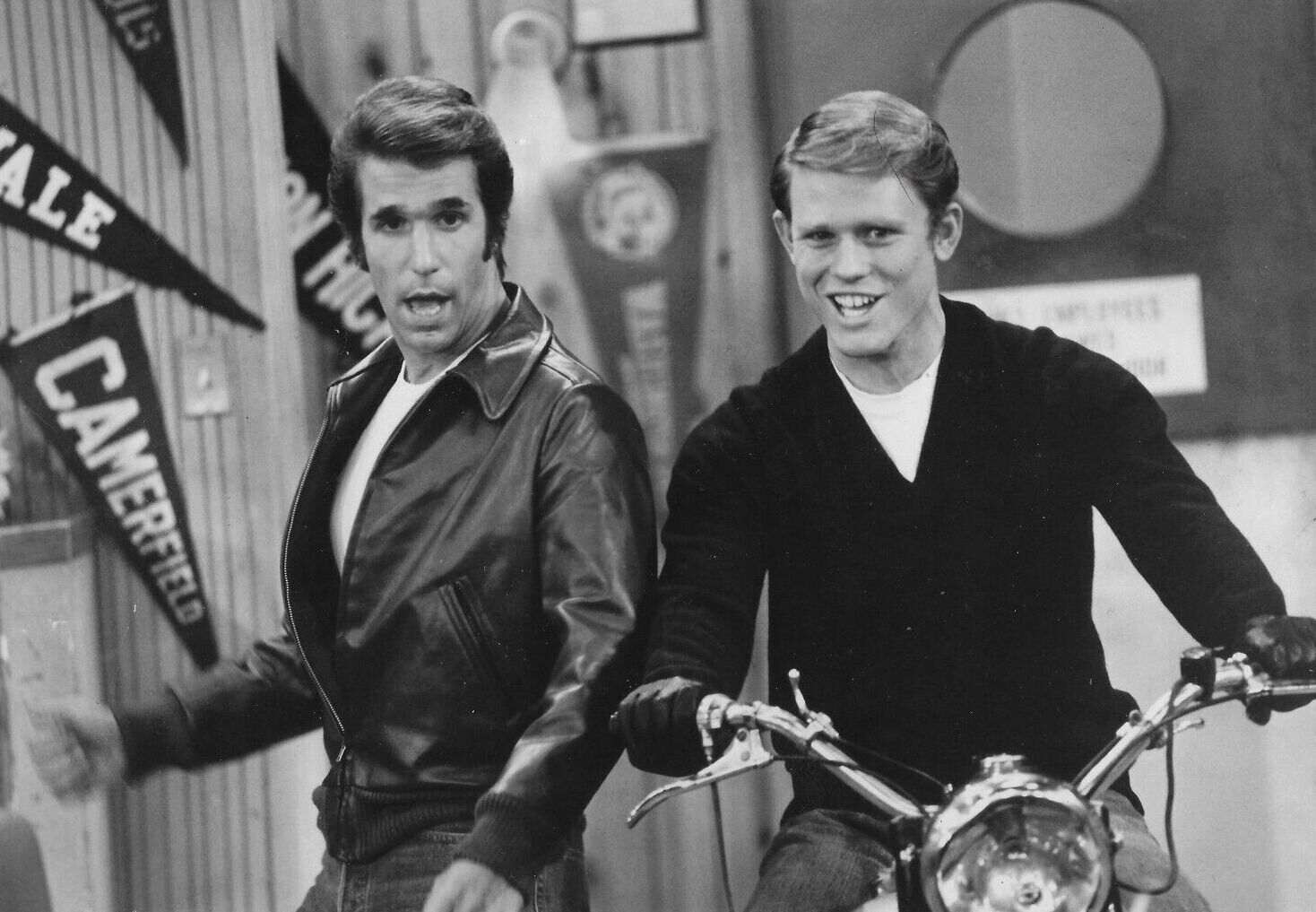
Merchandising, spinoffs, and the phrase that haunts every aging show.
Why it matters
From the desk
The Leather Jacket That Ate the 1950s
Garry Marshall's Milwaukee as a nostalgia factory: malt-shop lighting, a Fonzie the country merchandised into a god, and the water-ski stunt that entered the language.
Picture a 1974 living room trying to remember 1955 and getting the lighting wrong on purpose. Happy Days did not reconstruct the Eisenhower years. It bottled them. ABC wanted warmth after the Lear wars; Garry Marshall delivered a malt shop, a family that still ate together, and a guest greaser in a leather jacket who was not supposed to steal the franchise. Henry Winkler stole it anyway. On the palate: jukebox, catchphrase, and a three-camera hug that America could sell to itself as history.
Ron Howard's Richie is the official protagonist. The ratings had other ideas. Fonzie Drops In is the industrial turning point: the jacket moves from guest chaos to household god. Affiliates knew. Kids knew. The merchandising department knew first. This is not a complaint. It is how three-network nights actually worked — a supporting player becomes the brand, the network pretends it planned that, and the original premise becomes a lead-in to the leather. Must-see was not a slogan yet. It was a jacket hanging on a peg at Arnold's.
The historical claim the room forgets: jumping the shark is not a punchline that happened to a sitcom. It is a 1977 sweeps stunt that worked as spectacle and then became a critic's knife. Hollywood, Part 3, Fonzie on water skis, a shark, Los Angeles pretending to be a vacation from Milwaukee. The phrase outlived the episode, which is the most 1970s thing possible — a gag so successful it turned into a warning label for every aging hit. Linear television already knew how to hype a flop and how to hype a peak until they felt the same. This one named the feeling.
Three scandals that would trend today, and did, analog. Fonzie fever as soft-power event: lunchboxes, a thumbs-up, a nation agreeing on a greaser who said the word wrong on purpose. The spinoff factory — Laverne & Shirley, Mork from Orkan, Joanie Loves Chachi — as proof a hit could clone itself until the clone needed a hit. Ron Howard leaving the nest while the jacket stayed, which is the oldest Hollywood rewrite: keep the icon, wave at the boy. None of this requires cruelty toward the dead. Marshall built a kindness machine. Kindness machines still have contract math.
My Favorite Orkan is the hour the catalog accidentally minted a second mythology. Robin Williams walks in, the studio audience detonates, and ABC smells another series. That is guest-star physics, not a footnote. Fearless Fonzarelli is the leather as public stunt inside the show's own walls — Fonzie as civic event even before the shark. If you only know the water-ski clip, you think the series was a joke that ran long. Watch the early Milwaukee hours. They are smaller, sweeter, and closer to American Graffiti than to a theme park.
The honest finale in this pack is Fonzie's Spots, a September 1984 close after the country had already attended the wedding-and-goodbye of Passages. Event television and catalog television are not always the same night. Passages is the emotional sendoff; the series kept the lights on a little longer, which is very ABC. A toast, then, to the jacket that ate the decade it was impersonating — and to the star who had to live inside a catchphrase while the rest of us used his stunt as a proverb. Glory's deflating detail: Milwaukee never looked like that. The living room did not care.
Episode guide
How this series is filed
TV Flash files Happy Days (1974–1984) on ABC as the episode guide: 255 listed hours across 11 seasons, 1974-01-15–1984-09-24 from “All the Way” (S01E01) to “Fonzie's Spots” (S11E22).
Open the episode guide · S01E01 All the Way · S11E22 Fonzie's Spots
Essential episodes
Five hours from malt-shop contract to jacket-as-god to the stunt that named a fear. Filed by Rex Fontaine (Golden Age Dispatch).
- S01E01 All the Way
The family sitcom ABC ordered: Milwaukee warmth, Richie as official protagonist, the 1950s as lighting.
- S01E07 Fonzie Drops In
The industrial turn. The jacket stops being guest chaos and starts being the brand.
- S03E03 Fearless Fonzarelli (1)
Fonzie as civic event inside the show's own walls — the leather doing public-stunt work before Los Angeles.
- S05E03 Hollywood (3)
The water-ski night. A sweeps spectacle that escaped the episode and became a critic's knife.
- S05E22 My Favorite Orkan
Guest-star physics. An Orkan walks in; a second mythology leaves with him.
At a glance
1950s Milwaukee nostalgia centers on the Cunninghams and leather-jacketed Fonzie as the cool older brother America adopted. Malt shops, catchphrases, and spinoff fuel. The shark jump entered the language forever.
Network & studio
- ABC — broadcast network
Why watch now
To see a network sell the 1950s to the 1970s until a leather jacket became the logo, the merchandising became the plot, and a water-ski stunt entered English as a warning every aging hit still has to beat.
Cultural impact
Happy Days coined “jumping the shark” and proved merchandising-plus-spinoffs could outlive the original joke. Fonzie fever was a soft-power event.
Creators
Garry Marshall
Key cast
- Ron Howard as Richie Cunningham
- Henry Winkler as Arthur 'Fonzie' Fonzarelli
- Tom Bosley as Howard Cunningham
- Marion Ross as Marion Cunningham
- Erin Moran as Joanie Cunningham
Flash facts
- ABC sitcom created by Garry Marshall set in 1950s–early ’60s Milwaukee; aired January 15, 1974–July 19, 1984 (11 seasons, 255 episodes).
- Henry Winkler’s Fonzie became a cultural icon; series spun off Laverne & Shirley, Mork & Mindy, and Joanie Loves Chachi.
- Originated in part from a Love, American Style segment about the Cunninghams.
FAQ
Where should I start?
All the Way, then Fonzie Drops In. The first hour is the family sitcom ABC ordered; the later one is the franchise the country actually bought.
Do I have to watch the shark episode?
Yes, once, as language. Hollywood, Part 3 is how a stunt became a proverb. It is not the best hour. It is the one the culture kept.
When does the show get silly?
The Milwaukee years are warmer and smaller. After the Hollywood trip and the spinoff physics, the jacket is doing more work than the family. Sample both; do not pretend they are the same series.
Is Passages the finale?
It is the emotional goodbye — Richie back, a wedding, the hug the reruns prefer. The catalog then continues to Fonzie's Spots. Honest bookend: the last episode is the last episode.
Is it only nostalgia?
It is nostalgia as industrial product, which is more interesting than nostalgia as feeling. Watch it to see how a network sold the 1950s to the 1970s — and how a supporting player became the logo.
Official & further reading
External sites for further reading — TV Flash is not affiliated with these networks or studios.
Back to the decade
Also on the dial
More after Happy Days
- Related showHart to HartWhen the Harts take a case — champagne detective couple energy.
- Related showBensonSoap's butler takes the statehouse — deadpan competence vs. political chaos.
- Related showThe RookiesYoung cops learning the badge — Spelling-Goldberg earnest street drama.
- Related showWhat's Happening!!Rerun, Raj, and Dwayne — soda-shop hangouts and Mama's basement rules.
- Related showKung FuGrasshopper walks the West — martial arts mysticism in a frontier serial.
- Related showSuper FriendsHall of Justice roll call — Justice League for the cereal-hour crowd.