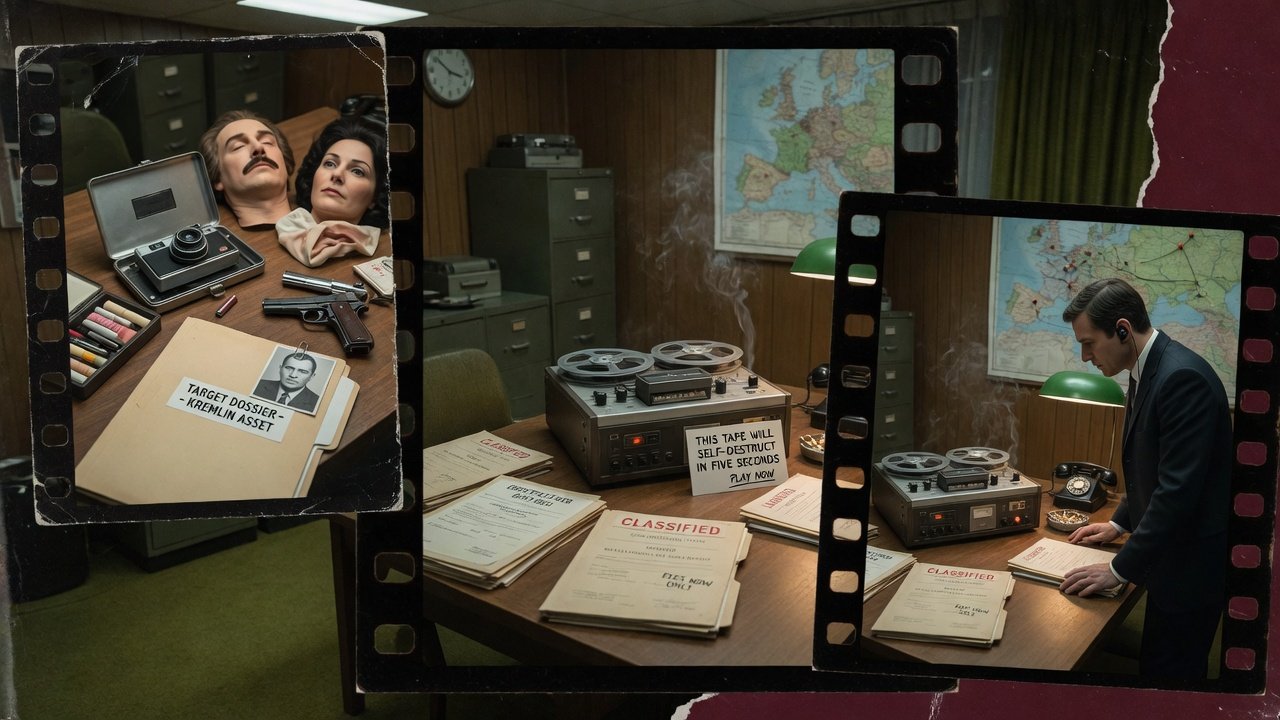
Team procedural template that movies later turned into a global brand.
Why it matters
From the desk
Competence as Spectacle, Before the Movies Bought Explosions
Seven seasons of team craft as drama — self-destructing briefings, disguises as structure, and a Cold War procedural that treated method as the set piece the later films would replace with altitude.
The tape still matters more than the stunt. A briefing, a team, a plan that will not survive contact with a living room's commercials — Mission: Impossible, 1966 on CBS, is the century's heist novel told in weekly chapters. Bruce Geller's series argues that competence is a kind of glamour. The later movies sold faces falling off cliffs. The original sold faces falling off in a workshop. That is not nostalgia. That is a different theory of suspense.
Watch the structure. An IMF assignment arrives; the leader selects specialists; the hour becomes a machine with human parts. Season one belongs to Steven Hill's Dan Briggs, a cooler, stranger center than the brand later advertised. Peter Graves's Jim Phelps takes the table from season two and becomes the face the theme song now implies. Martin Landau's Rollin and Barbara Bain's Cinnamon are disguise as acting theory — masks, voices, the body as a forged document. Greg Morris's Barney is the engineer the plot actually requires. Peter Lupus's Willy is mass as punctuation. Lalo Schifrin's theme is not a souvenir; it is editing. The music tells you the cut is already ahead of the audience.
Gossip arrives as a footnote, which is where it belongs. Landau and Bain left after season three over the usual "creative differences" that are never only creative; the tabloids will say money and marriage; the later seasons say the machine can run with replacement parts and a slightly thinner soul. People who treat television as a crime blotter will start with the contract. The cut starts with The Mind of Stefan Miklos, an hour that plays like a chess problem and still humiliates half of modern "smart" thrillers. The Photographer, The Town, The Exchange, The Mercenaries — these are not clip-show titles. They are arguments about how much information a viewer can hold without a voice-over holding their hand.
What the season is arguing, when it is good:
Team over lone wolf. Method over speechifying. The enemy as a system, not a speech. Failure as a timing error, not a moral collapse. None of that requires pretending every one of 171 hours is a masterpiece. Long-running procedurals sag. Later seasons cycle villains and faces. The form remains: a cold open of instruction, a plan, a nearly-botched middle, a getaway that is really an edit. Streaming prestige would call this a limited series if it were eight episodes and sadder. Network history already knew the assignment.
I will grant the other desk its fireworks: music-rights lore, cast turnover, the movies as a global brand that sometimes remembers this show exists. They sell. They sometimes even illuminate power — who owns a theme, who gets replaced, who becomes a franchise. They are footnotes when the hour is arguing with itself about trust and expertise. They become the whole book only when the masks are empty.
Imitation closes March 1973 as a catalog finale, not a civic event. Honest tail. The series stops. The method does not. Verdict: watch the original for the pleasure of people being good at a job on camera. That sounds dry. It is not. Competence, photographed, is still rarer than an exploding cliff. The scandal of how the movies outran the series is, unfortunately, also part of television history — which is why the critic's job is to keep putting the tape first.
Episode guide
How this series is filed
TV Flash files Mission: Impossible (1966–1973) on CBS as the episode guide: 171 listed hours across 7 seasons, 1966-09-17–1973-03-30 from “Pilot” (S01E01) to “Imitation” (S07E22).
Essential episodes
Five hours of method — the tape, the mask, the plan that still humiliates louder thrillers. Filed by Julian Hart (The Binge Brief).
- S01E01 Pilot
The briefing grammar in one night: tape, team, method. The franchise's true pilot even after the movies rewrote the altitude.
- S02E15 The Photographer
Disguise as acting theory — the camera treating a face like a forged document.
- S02E21 The Town
The machine in a closed community. Procedural dread without a speech about dread.
- S03E12 The Exchange
Trade-craft as emotion: the plan as the only way the show is allowed to feel.
- S03E13 The Mind of Stefan Miklos
A chess-problem hour that still humiliates half of modern 'smart' thrillers. Method at full boil.
At a glance
An elite IMF team accepts self-destructing briefings and pulls off Cold War heists with masks, gadgets, and group craft. Leadership rotates; the mission always comes first. Cool as a martini, tense as a wire cut.
Network & studio
- CBS — broadcast network
Why watch now
Watch the original team as instrument: briefings that self-destruct, disguises as structure, and a weekly procedural that treats competence as drama. The movies later sold spectacle; the series sold method, still the rarer on-screen trick.
Cultural impact
Mission: Impossible made ensemble espionage a TV art and left Lalo Schifrin’s theme as permanent cultural infrastructure. Cast turnover lore is industry textbook.
Creators
Bruce Geller
Key cast
- Peter Graves as Jim Phelps
- Barbara Bain as Cinnamon Carter
- Martin Landau as Rollin Hand
- Greg Morris as Barney Collier
- Peter Lupus as Willy Armitage
Flash facts
- CBS espionage drama created by Bruce Geller; aired September 17, 1966–March 19, 1973 (7 seasons, 171 episodes).
- Famous self-destructing mission briefings and Lalo Schifrin’s theme; IMF team undertakes covert operations.
- Steven Hill played Dan Briggs in season 1; Peter Graves led as Jim Phelps from season 2 onward.
FAQ
Do I need to watch Mission: Impossible in order?
No. It is a procedural. Assignments reset. Cast changes are the serial. Start with the pilot for the briefing grammar, then hop to praised hours such as “The Mind of Stefan Miklos.”
Why does the team leader change after season 1?
Steven Hill's Dan Briggs leads season 1. Peter Graves's Jim Phelps takes over from season 2 and becomes the face most reruns imply. The method stays; the center shifts.
Is it like the Tom Cruise movies?
Same franchise name, different theory of suspense. The series is team craft, masks, and plans. The films are star spectacle and altitude. Watch the show for method, not for cliffs.
Which seasons are strongest?
Many viewers prefer the Landau/Bain years (through season 3) for disguise craft. Later seasons remain watchable procedurals with a rotating bench. Sample before you commit to seven years.
Is the finale a must?
“Imitation” is a catalog close, not a civic event. If you came for the briefing grammar, you already got the point before March 1973.
Cultural eras
Official & further reading
External sites for further reading — TV Flash is not affiliated with these networks or studios.
Back to the decade
Also on the dial
More after Mission: Impossible
- Related showDennis the MenaceGood ol' Mr. Wilson! — comic-strip kid chaos in midcentury suburbia.
- Related showMister EdA horse is a horse, of course — talking-animal sitcom that shouldn't work and did.
- Related showMy Favorite MartianUncle Martin the antennaed alien — sci-fi sitcom before Trek made space serious.
- Related showRoute 66Two guys, a Corvette, and America as open-road anthology.
- Related showScooby-Doo, Where Are You!Meddling kids, a cowardly Great Dane, and monsters who are always Mr. Whoever.
- Related showPetticoat JunctionShady Rest Hotel, three daughters, and the Cannonball train — rural comedy's cozy hub.