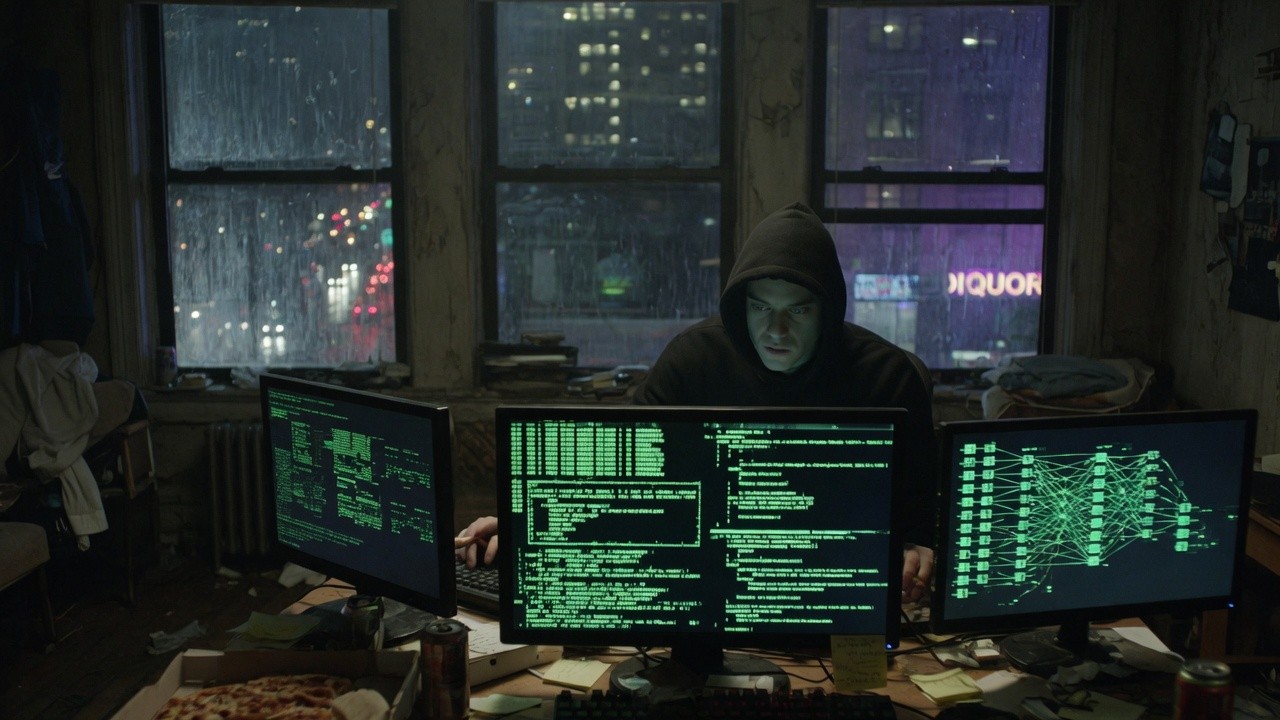
Elevated basic-cable thriller craft; tech-accuracy flex with prestige ambition.
Why it matters
From the desk
The Century’s Novel Came With a Terminal Window
Mr. Robot is a four-season argument about capitalism and unreliability — USA Network craft that actually ends, with a last hour that still talks to the first.
The first cut is a voice you should not trust and a screen you should. Sam Esmail’s series arrived on USA Network looking like a basic-cable thriller and behaving like a novel that had learned to edit. Rami Malek’s Elliot is the instrument: hoodie, stare, narration that is already a lie. The gossip will tell you about an Emmy breakout and twist seasons that trained audiences for unreliability. Fine. The tabloids are a footnote. The cut is the claim. Television as the century’s novel is a line I have used before. This is one of the times it is not a metaphor with better lighting.
What the seasons argue, if you refuse the recap-industrial complex: 1. A man against a company is also a man against a story he is telling himself. 2. Revolution is an aesthetic until it is an accounting problem. 3. Mental illness is not a twist ribbon; it is the form. 4. An ending is a moral, not a sequel deck. People treating the show like a puzzle box are not wrong that it has puzzles. They are wrong that the puzzles are the point. Vivian’s beat is the leak. My beat is whether the hour still works after you know the trick.
The craft flexes are public: terminal-window graphic design as a house style, stagey one-location hours, a Season 4 episode people cite the way they cite a chapter. 407 Proxy Authentication Required is on the essentials list because it is structure, not because it is a jumpscare index. The pilot sells permission to live in Elliot’s head. The first-season closer pays a heist without becoming a trailer. The third-season hold reboots the argument. Hello, Elliot is a finale. The pack ends. The last hour still answers the first file name. That is rarer than prestige branding admits.
You watch it now because tech-thriller television mostly learned the wrong lesson — more jargon, more twists, less conscience. This one kept the conscience and the craft. It is not soothing. It is not a dump-night accessory. USA was not supposed to be the network that did this. The fact that it did is the dirt under the nails: art showing up where the brochure did not promise literature. The scandal of unreliability will outlive some of the sequences. That is, unfortunately, also part of television history. The sequences remain.
Verdict: start at hellofriend. Finish at Hello, Elliot. Do not ask a wiki to watch it for you. The novel only works if you let the narrator fail in real time.
Episode guide
How this series is filed
TV Flash files Mr. Robot (2015–2019) on USA Network as the episode guide: 45 listed hours across 4 seasons, 2015-06-24–2019-12-22 from “eps1.0_hellofriend.mov” (S01E01) to “Hello, Elliot” (S04E13).
Open the episode guide · S01E01 eps1.0_hellofriend.mov · S04E13 Hello, Elliot
Essential episodes
Five hours that teach the contract, the payment, and the ending. Filed by Julian Hart (The Binge Brief).
- S01E01 eps1.0_hellofriend.mov
The narrator as form. Permission to live in a head that is already editing you.
- S01E10 eps1.9_zer0-day.avi
Season 1’s payment. A closer that sells consequence without becoming a pitch deck.
- S03E10 shutdown -r
A hold that reboots the argument. The title is a command; the cut is the ethics.
- S04E07 407 Proxy Authentication Required
Craft peak. Structure as a chapter people still cite when they mean the show was literature.
- S04E13 Hello, Elliot
A finale that answers the first file name instead of shopping a sequel.
At a glance
Unreliable hacker Elliot Alderson targets corporate evil while mental illness and reality glitch together. Terminal windows as aesthetic; capitalism as villain. USA Network prestige island.
Network & studio
- PBS — broadcast network
Why watch now
Watch it for craft that basic cable was not supposed to attempt: unreliable narration, terminal-window aesthetics, and a four-season argument about capitalism that actually ends. The gossip is the twist culture. The text is the cut. Start at the pilot; the last hour still talks back to it.
Cultural impact
Mr. Robot elevated basic-cable thriller ambition and made hacker chic a prestige look. Twist seasons trained audiences for narrative unreliability.
Creators
Sam Esmail
Key cast
- Rami Malek as Elliot Alderson
- Christian Slater as Mr. Robot
- Carly Chaikin as Darlene Alderson
- Portia Doubleday as Angela Moss
- Martin Wallström as Tyrell Wellick
- Grace Gummer as Dominique DiPierro
Flash facts
- Created by Sam Esmail for USA Network — a prestige island on a cable brand known for lighter fare.
- Rami Malek won Outstanding Lead Actor in a Drama Series.
- Notable for ambitious episode forms (including a near-silent heist hour).
FAQ
Where should I start?
The pilot, in order, with your phone face down. The narrator is the form. Skipping ahead breaks the argument.
Do I need to know hacking?
No. You need to know how a story lies. The terminal windows are aesthetic and, occasionally, accurate — neither is the thesis.
Is the finale worth it?
Yes. The last hour talks to the pilot instead of begging another season. That is the job.
What can I skip?
Nothing in Season 1. Later, if you prune, you will still owe yourself the Season 4 craft peak and the closer.
Is it a puzzle box or a drama?
A drama that uses puzzles. If you only watch to be right on a forum, you will miss the novel.
Cultural eras
Official & further reading
External sites for further reading — TV Flash is not affiliated with these networks or studios.
Back to the decade
Also on the dial
More after Mr. Robot
- Related showBlack MirrorTech dread dessert — one episode ruins your relationship with your phone.
- Related showSuccessionBillionaire family knife fight — insults as love language.
- Related showSlow HorsesSpy rejects with better dialogue than the glamorous services.
- Related showSherlockHolmes in texting-era London — coat-tail silhouettes and event episodes.
- Related showDownton AbbeyEdwardian upstairs/downstairs comfort epic — tea, titles, and soft class warfare.
- Related showSesame StreetMuppets, letters, and the street that treated kids' TV like a civil-rights project.