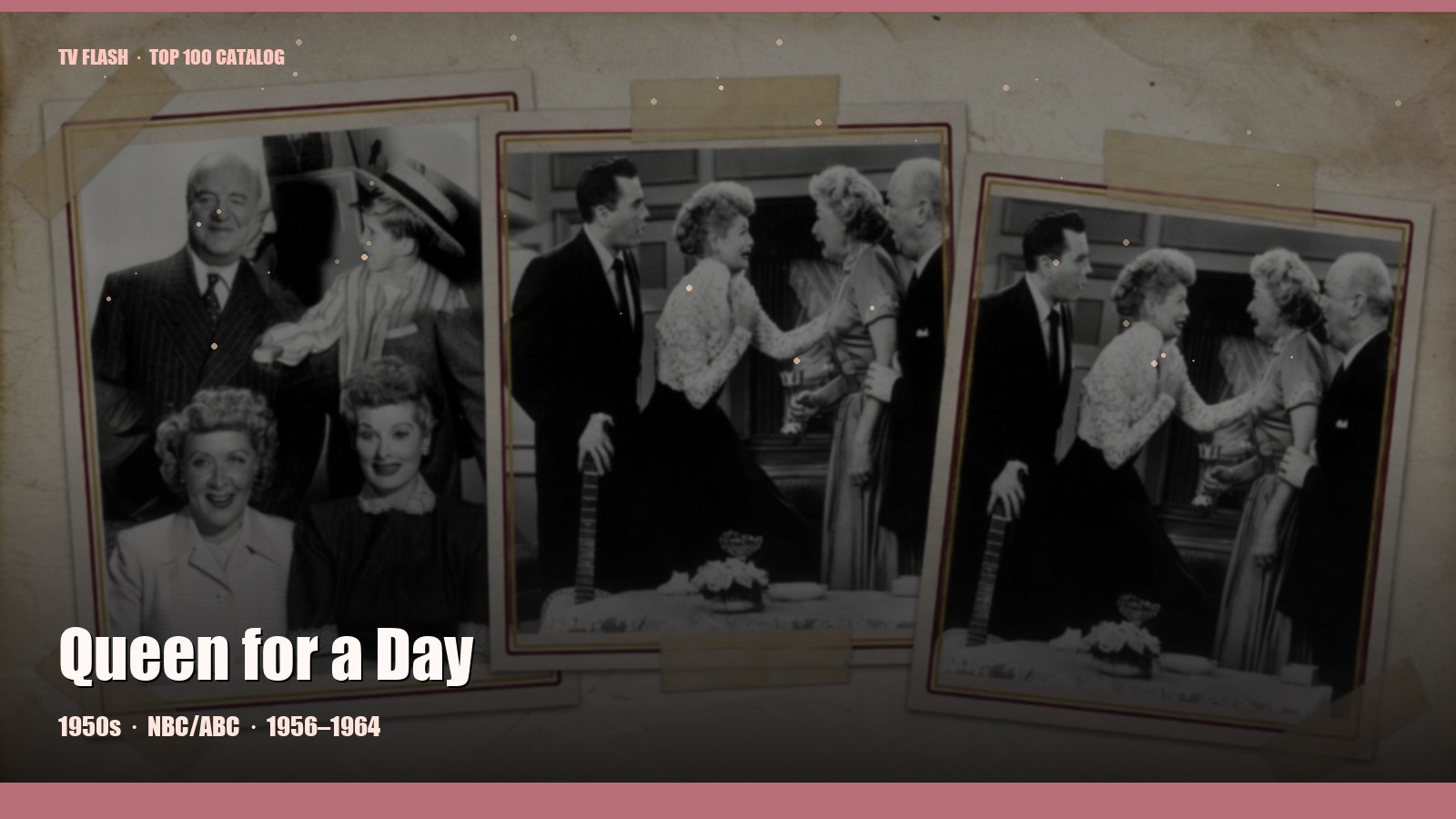
Daytime spectacle of hardship and prizes; controversial ancestor of reality confessional TV.
Why it matters
From the desk
Why Queen for a Day still plays
The silhouette is a crown that is also a verdict: daytime hardship scored on an applause meter, then paid in appliances. Queen for a Day (NBC then ABC, 1956–1964, after earlier radio and local roots) is an applause-meter misery pageant — the most 1950s show that ever 1950s'd. Jack Bailey hosting, John Masterson's form, women's hard-luck stories on a needle, the audience deciding who suffered 'best,' a washing machine as justice. **This was not a fashion crowning; this was a hard launch in tears and chrome.** Controversial ancestor of reality confessional television. The look is the sociology.
The meter deciding pain is still jaw-dropping image craft, if craft is the word. Hardship as competition, washing machines as consolation, applause as a verdict. Tessa's tags will call it a stan war about suffering and they will not be wrong. The fittings were the prizes. Later confessionals sanded the edges; this one lets the needle show. It is not comfort viewing. That is the point. Image management as a moral machine — daytime spectacle with a crown that lasts until the commercial. One vulnerable note: performing need on camera for a washer is exhausting in a way no premiere gown has to be. Then back to the silhouette. The needle is the accessory.
Look board for a misery pageant: crown as costume, meter as jewelry, appliance as the gift bag, Bailey as the velvet rope, audience hands as the critic. Liquid chrome, no irony, message dress if the message is survival. The carpet discourse wants a look. This hour gives you a washer and a ranking of pain. Defend the craft of the image against the timeline that says it was only mid-century kitsch. The image is the ranking. That is worse, and more precise.
The first listed hour is the network daytime era as public milestone: applause-meter misery pageant, hardship scored, prizes waiting, sociology you cannot look away from. The second is format peak and cultural memory — the hour a meter decided who suffered best, then handed her a washer, ancestor of reality confession. Two bookmarks for a tiny pack. You do not binge this. You watch the needle and admit the form invented a kind of fame.
Last image: a crown, a meter, a machine that washes. See you at the after-party. It is a studio with a needle. The tags can fight about taste; the silhouette already told on the decade.
Episode guide
How this series is filed
TV Flash files Queen for a Day (1956–1964) on NBC/ABC as a desk landmark file, not a complete episode guide, 1956-01-03–1960-01-01 from “Network daytime era” (S01E01) to “Format peak / cultural memory” (S01E02).
Open the episode guide · S01E01 Network daytime era · S01E02 Format peak / cultural memory
Essential episodes
Applause-meter misery pageant — daytime hardship, prizes, the 1950s ancestor of confessional reality. Filed by Lana Reyes (Red Carpet Reality).
- S01E01 Network daytime era
Network daytime era: applause-meter misery pageant as public milestone, hardship scored, prizes waiting, sociology you cannot look away from.
- S01E02 Format peak / cultural memory
Format peak / cultural memory — the hour a meter decided who suffered best, then handed her a washer, ancestor of reality confession.
At a glance
Women told tales of hardship; the studio audience's applause chose a queen who won prizes and a crown. Queen for a Day (NBC/ABC, primarily 1956–1964, after radio and local roots), hosted by Jack Bailey and created by John Masterson, made the applause meter a moral machine. Critics called it exploitative; audiences made it a daytime giant. Hardship as competition, appliances as consolation, applause as a verdict. Essential viewing for understanding 1950s gender, class, and TV emotion economies. Controversial ancestor of reality confessional television — a meter deciding who suffered best, then handing over a washing machine as justice.
Network & studio
Why watch now
Queen for a Day is an applause-meter misery pageant: daytime hardship, prizes, and the most 1950s show that ever 1950s'd. Controversial ancestor of reality confessional television. In 2026 it is jaw-dropping sociology — watching a meter decide who suffered best, then handing her a washing machine as justice.
Cultural impact
Queen for a Day was daytime spectacle of hardship and prizes, a controversial ancestor of reality confessional television. Bailey's meter turned women's hard-luck stories into a competition and called the needle a verdict. Historians still cite it as a precursor to talk-show confession culture. Later confessionals sanded the edges; this one lets the needle show. It is not comfort viewing. That is the point.
Creators
John Masterson
Key cast
- Jack Bailey as Host
Flash facts
- Network TV run primarily 1956–1964 on NBC and ABC after radio/local roots.
- Hosted by Jack Bailey with the famous applause-meter crowning.
- Created by John Masterson.
- Women told hardship stories; applause chose a queen who won prizes and a crown.
- Often cited as a precursor to reality and talk-show confessional culture.
FAQ
Where should I start?
Start with the hardship pitches and the applause meter. The prize-as-justice close is the whole moral machine — one episode teaches the form.
What can I skip?
Skip a binge of misery weeks. The pageant repeats, and it is punishing by design. You are sampling a sociology exhibit, not a comfort marathon.
Is it still worth it?
Yes, as jaw-dropping daytime history — the ancestor of reality confessional, not a recommendation as fun.
Game show or reality confessional?
Daytime hardship pageant — applause-meter suffering and prizes, controversial ancestor of reality confession.
Official & further reading
External sites for further reading — TV Flash is not affiliated with these networks or studios.
Back to the decade
Also on the dial
More after Queen for a Day
- Related showLife Is Worth LivingBishop Sheen vs. Milton Berle in the ratings — a chalkboard and a cape beat vaudeville some weeks.
- Related showThe Ernie Kovacs ShowVisual gags, blackouts, and Nairobi Trio — the medium inventing itself for laughs.
- Related showRocky and His FriendsA flying squirrel, a moose, and Cold War satire — Jay Ward's anarchic gift at decade's end.
- Related showKukla, Fran and OllieAd-lib puppets and Fran Allison — gentle absurdity that adults watched without irony.
- Related showSky KingArizona rancher with a Cessna — aviation adventure for kids who wanted wings.
- Related showThe United States Steel HourIndustrial giant, theatrical punch — live drama with a steel-hard production sheen.