Anti-lesson sitcom that rewired joke architecture.
Why it matters
From the desk
A Show About Nothing That Refused the Lesson
Nine seasons of petty social law, bottle-episode architecture, and a 1998 closer that still starts fights — craft first, catchphrase second.
The first useful thing Seinfeld does is decline to improve anyone. Jerry Seinfeld and Larry David built a sitcom whose moral engine is etiquette without ethics: the tiny social rule, enforced with prosecutorial glee, and no hug waiting in the tag. The 1989 opener — Good News, Bad News, the hour still filed in some ledgers as The Seinfeld Chronicles — is already the contract. A comedian cannot read a woman's intentions. A friend will make it worse. The apartment is a courtroom for snacks. If you came for growth, you are in the wrong borough.
Craft, not carpet. The Chinese Restaurant (season 2) is the bottle as architecture: three people waiting, a table that will not come, time as the joke. Prestige television later sold quiet as depth. This hour is loud about nothing and still more structurally honest than half the limited series that name-check it. The Contest (season 4) is the line Standards & Practices could not quite say and the show said anyway — a master class in implication as comic voltage. The Marine Biologist (season 5) is payoff architecture: a lie George cannot live in, a speech the room still quotes because the construction finally detonates. The Opposite is character as engine. George Costanza inverted is still George. That is the joke and the thesis.
Gossip will tell you about Elaine's dance, the Soup Nazi as tourist folklore, and which of the four remained uninjured by the afterlife of fame. Fine. The tabloids will say X; the cut says Y. The cut says observational pettiness can be a national art form if you refuse the lesson hard enough to make it a rule. No hugging, no learning was not a meme. It was a writers'-room constitution. When the room only cares about the leak — who dated whom off camera, which stand-up bit migrated into canon — it is usually because someone stopped watching how the scenes dock. Four plots collide in the last two minutes. That collision is the form.
What the seasons are arguing, in brief: early years teach the social microscope. The middle years (four through seven) are the instrument at concert pitch — Emmy-winning comedy series in 1993, then a long stretch where catchphrases became exports and the plots got crueler without getting sloppy. The late years are the machine aware of itself. The Finale (2), May 14, 1998, puts the four in a Massachusetts courtroom and asks whether a show about nothing owes the audience a moral. Many viewers wanted a hug. The text offered a verdict. I will not pretend the closer is beloved. I will say it is consistent. A series that spent nine years prosecuting manners was never going to hand out clemency as a souvenir.
Rewatch in 2026 as syllabus, not comfort. Start at the pilot if you care about the contract. Jump to the restaurant bottle if you care about form. The Contest still teaches implication. The Marine Biologist still teaches detonation. People who treat television as a crime blotter of famous apartments will miss that this was literature with better lighting and worse people. Comparable titles: Curb Your Enthusiasm as the open-wound sequel; the network sitcoms that tried to steal the attitude and accidentally kept the hugs. Verdict: it is worth the binge if you can live without being improved. The scandal of the finale will outlive the craft. That is, unfortunately, also part of television history — and the show, to its credit, would have found that very funny.
Episode guide
How this series is filed
TV Flash files Seinfeld (1989–1998) on NBC as the episode guide: 180 listed hours across 9 seasons, 1989-07-05–1998-05-14 from “Good News, Bad News” (S01E01) to “The Finale (2)” (S09E24).
Open the episode guide · S01E01 Good News, Bad News · S09E24 The Finale (2)
Essential episodes
A critic's short list — hours that still teach the constitution of nothing. Filed by Julian Hart (The Binge Brief).
- S01E01 Good News, Bad News
The contract: no lesson, no hug, an apartment already behaving like a courtroom.
- S02E11 The Chinese Restaurant
Bottle as architecture. Waiting is the plot; time is the joke; prestige later called this quiet.
- S04E11 The Contest
Implication as voltage. The line Standards could not quite say, and the show said anyway.
- S05E14 The Marine Biologist
Payoff architecture. A lie detonates in a speech the room still quotes because the construction earned it.
- S05E22 The Opposite
Character as engine: invert George and he is still George. The thesis wearing a season-finale suit.
From the desk
Flash columns that open this package’s pilots, finales, or fandom heat:
- Spoiler-Free (Mostly): Finale Discourse Wars — When the Timeline Writes a Better Ending — Spoiler-Free (Mostly)
- Golden Age Dispatch: Finales That Stopped America — Golden Age Dispatch
At a glance
A comedian and three friends obsess over petty social codes in New York with almost no hugs or lessons. Nothing is everything; cruelty is precision comedy. Finale discourse remains a blood sport.
Network & studio
- NBC — broadcast network
Why watch now
For joke architecture that still prosecutes tiny social laws without a hug in the tag — bottle hours, colliding plots, and a finale that chose a verdict over souvenirs. The catchphrases are exports; the construction is the reason to stay.
Cultural impact
Seinfeld made observational pettiness a national art form and catchphrase culture a weekly export. Larry/Jerry mythology is comedy’s founding dual presidency.
Creators
Larry David · Jerry Seinfeld
Key cast
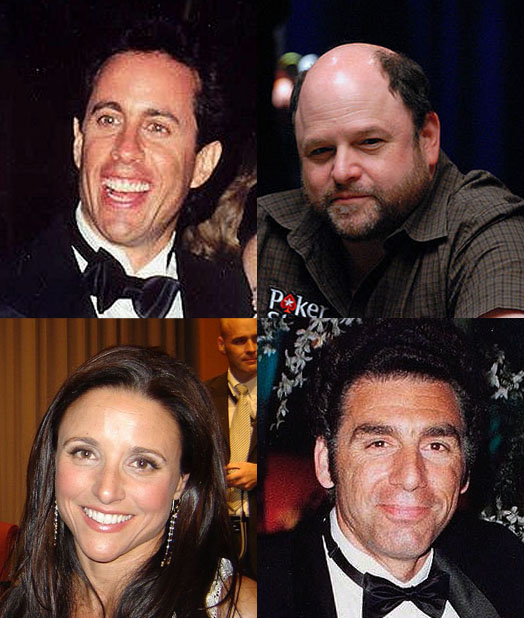
- Jerry Seinfeld as Jerry Seinfeld
- Julia Louis-Dreyfus as Elaine Benes
- Michael Richards as Cosmo Kramer
- Jason Alexander as George Costanza
Flash facts
- NBC “show about nothing” sitcom (1989–1998) co-created by Larry David and Jerry Seinfeld.
- Pilot The Seinfeld Chronicles aired in 1989 before the series fully took hold.
- Won the Emmy for Outstanding Comedy Series in 1993 among many other honors.
- Observational comedy about petty social rules became a 1990s comedy template.
- Finale was a major media event; the cast remained strongly associated with their roles.
FAQ
Where should I start — the 1989 pilot or later?
The pilot (Good News, Bad News) is the contract, not the peak. If the early seasons feel stiff, skip to season 3 or 4 and return. The Chinese Restaurant is the first hour that still teaches form on a first watch.
Is it serialized? What can I skip?
Mostly episodic, with running social grudges. You can graze. You will miss some callbacks and the slow crueling of the four. There is no mythology homework. Skip holiday filler if you must; do not skip the bottle hours.
Is the finale worth the argument?
The Finale (2) (May 14, 1998) is consistent with the show's constitution and widely disliked for that reason. Watch it as a verdict, not as a hug. The fight is the afterlife. The hour is the evidence.
Is Seinfeld mean, or precise?
Precise, which reads as mean if you wanted a lesson. Cruelty is the comic instrument. The four are not role models. That was the point, filed in public, for nine seasons on NBC.
Do I need Curb Your Enthusiasm first — or after?
After, if at all. Curb is the open-wound sequel energy, not a prequel. Seinfeld is the closed sitcom object: 1989 to 1998, 180 episodes, then a door.
Cultural eras
Official & further reading
- Netflix — Seinfeld
- Sony Pictures Television
- NBC network
- Wikipedia
- IMDb
- TMDB search
- YouTube — trailers & clips
External sites for further reading — TV Flash is not affiliated with these networks or studios.
Back to the decade
Also on the dial
More after Seinfeld
- Related showBlossomHats, fourth-wall bits, and Very Special Episodes — Mayim Bialik’s first era.
- Related showJAGNavy lawyers with jet fuel — procedural that quietly built a franchise navy.
- Related showUnsolved MysteriesRobert Stack’s trench coat and that theme — true crime as living-room séance.
- Related showWingsNantucket airline brothers — Cheers-adjacent comfort with a one-plane airline.
- Related showNewsRadioWNYX workplace farce — Phil Hartman perfection in a radio station madhouse.
- Related show3rd Rock from the SunAliens in human suits discover emotions, bureaucracy, and Jane Curtin.