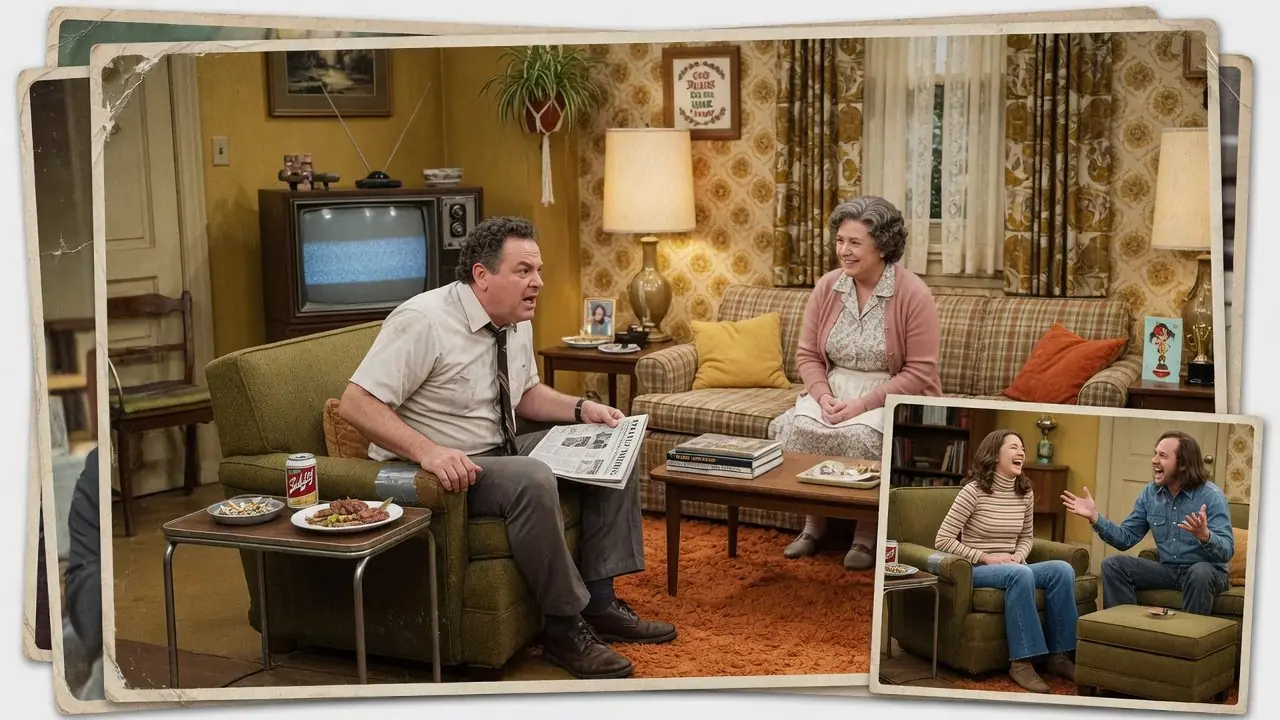
Picture a living room that already knew the guest star was auditioning for a series of their own. No multiverse slide deck — just a laugh track, a doorway entrance, and a network executive smelling spinoff the way a shark smells blood in the Nielsen book. The 1970s were not gentle about success. They industrialized it. One hit sitcom could feed a second household, a third workplace, a fourth cousin in another city, until the schedule looked like a family tree drawn by someone with stock options. That pattern should feel familiar to anyone living through franchise television now. The gadgets changed. The appetite did not.
What did a spinoff factory actually look like?
Scarcity with a production line. All in the Family did not merely top the charts; it exported characters into Maude, The Jeffersons, Good Times (by way of that extended universe’s own branching), and more doorway mythology than a modern pitch bible. The Mary Tyler Moore Show spun Rhoda and Lou Grant — romance and newsroom, same DNA, different hour. Happy Days minted Laverne & Shirley, Mork & Mindy, and the kind of Fonzie-adjacent heat that made leather jackets a scheduling strategy. On the palate: multi-camera certainty, theme songs America could hum in the grocery line, and a guest arc that was really a pilot in costume.
Three spinoff moves that would trend today (and did, in their analog way):
- The backdoor pilot episode — a “special guest” week that is a series proposal with a laugh track.
- The workplace transplant — keep the tone, change the set, pray the chemistry refills.
- The relative in another zip code — franchise as family reunion, whether or not the original cast visits.
None of this requires ancestor worship. It requires memory. When a streamer announces a “from the world of” limited series with a new cast and a familiar logo, it is not inventing original sin. It is running a 1970s playbook with better fonts and worse theme songs.
Were spinoffs art, commerce, or both?
Both, often in the same half hour. Some spinoffs became canonical in their own right — sharper, freer, or simply better cast for the new premise. Others were beige porridge with a familiar surname. The historical claim the room forgets: networks treated hit characters as infrastructure, not only as individuals. That is not uniquely cynical. Theater has always known the value of a returning face. Television just put it on a fall schedule and sold soap around it.
The gossip traveled by columnist and commissary: which star refused to guest on the child series, which producer wanted credit on every branch of the tree, which cast member learned their supporting role was the real merchandise. Old-Hollywood dirt is fair game; cruelty toward the dead is not. Prefer the anecdote that survives three barstools and still checks out when you open a biography — the star who hated being the “spinoff engine,” the executive who ordered another cousin because Thursday needed a lead-in.
Streaming’s defenders (pencils sharpening at the charts desk) will say modern franchises are richer, longer, more novelistic. Sometimes. Amnesia is still not a business model. Infinite inventory did not invent the spinoff factory; it removed the schedule’s natural limit on how many factories could run at once. Linear television had to choose a night. That constraint made each launch feel like weather. Abundance makes each launch feel like a software update. The pattern — milk the hit, mint the adjacent, bury the dud without a parade — is older than the For You page.
What should franchise TV steal from the 1970s map?
Not the oligopoly. The clarity. A spinoff that could be pitched in one sentence after a single guest episode. Characters who arrived already funny, not after six hours of lore PowerPoint. And a little humility: America once learned a new address — a New York apartment, a Milwaukee brewery, a newsroom — because a living-room hit opened a door and trusted the audience to walk through weekly. Imagine those executives with a group chat. Actually — better not. Some writers’ rooms barely survived the memo.
A toast, then, to the factory that smelled like videotape and ambition — and to the supporting player who stole a backdoor pilot so completely the original series had to pretend it planned that all along. Glory always had a human, slightly deflating detail. That, my dears, is continuity.
FAQ
What were the major 1970s TV spinoff factories?
Hit sitcoms such as All in the Family, The Mary Tyler Moore Show, and Happy Days generated multiple successful spinoffs, using guest appearances and character transplants to launch new series across network schedules.
What is a backdoor pilot?
A backdoor pilot is an episode of an existing show designed to introduce characters and a setting for a potential spinoff series, functioning as a de facto pilot without a separate pilot presentation.
How do 1970s spinoffs relate to modern franchise TV?
Both treat successful worlds as expandable assets. The 1970s used schedule placement and character migration; modern TV uses streaming universes and “from the world of” branding. The commercial instinct is continuous even when the technology is not.