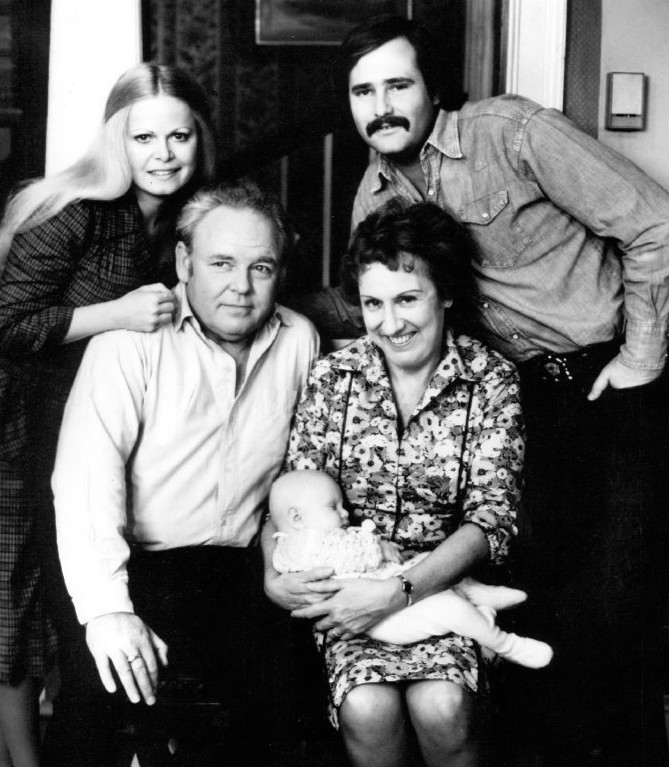
Rewired what a sitcom was allowed to say on American TV.
Why it matters
From the desk
The Chair Was the Argument
Norman Lear's Queens living room as American theater: a bigot, a saint, a meathead, and a laugh track that refused to pretend the country was finished arguing.
The opening is a chair. Not a thesis about the 1970s — a wing chair, a man, and a camera that already knows where the fight will sit. Carroll O'Connor's Archie is not a cartoon of prejudice; he is a cadence. Jean Stapleton's Edith is not a punching bag; she is timing. Rob Reiner and Sally Struthers arrive as the future walking through the door and sitting on the wrong furniture. If you came for a clip of slurs as period flavor, you have already missed the cut. The cut is how long the room is allowed to stay ugly before someone loves somebody anyway.
Norman Lear and Bud Yorkin adapted Till Death Us Do Part and did the unfashionable thing: they kept the argument American instead of sanding it into a catchphrase factory. CBS put it on in 1971, when a sitcom was still supposed to be a truce. All in the Family is not a truce. It is a weekly ethics exam with a piano sting. The tabloids will tell you about sponsor panic and viewers who wrote in to defend Archie as if he were a neighbor. Fine. The text is sharper than the mail. It keeps letting Edith be smarter than the room, then punishing her for it, then asking whether the laugh is on her or on you.
Craft first. The living room is a proscenium that never pretends to be cinema. Multi-cam blocking as civic architecture: who stands, who sits, who gets the close-up when the slur lands. O'Connor's pauses are the show. Stapleton's voice cracks are the show. Reiner's Meathead is not a position paper; he is a man who cannot stop explaining a country that is sitting three feet away. When the series is great, the joke and the bruise occupy the same sentence. When it is lesser, it is because someone chose the bruise as a button.
People treating television like a crime blotter will remember the Sammy Davis Jr. hour as a stunt. It is a stunt. It is also a formal dare: put the most famous guest in the most radioactive chair and see whether the series still knows how to be a sitcom. Edith's Christmas Story does the opposite dare — illness, fear, a laugh track that has to wait. Two's a Crowd locks Archie and Mike in a space too small for their speeches and accidentally writes the show's best two-hander. None of these hours require a prestige ribbon. They require you to notice who the camera loves when the argument runs out of air.
The spinoff factory is the footnote, not the lede. Maude, The Jeffersons, Good Times via Maude: Lear proved a living room could be a studio system. That is industrial history. The aesthetic history is narrower. For nine seasons the series kept asking whether a bigot could be a protagonist without becoming a mascot. O'Connor fought the character in public; the character won the ratings. That tension is the work. It is also why the show still photographs as dangerous in reruns and as cosplay in bad imitations. Copy the slurs and you get a clip account. Copy the chair, the pause, the Edith look, and you get a play.
Is it dated? Of course it is dated. It is a 1970s CBS sitcom that used words the current broadcast standards department would treat as a fire drill. Dated is not the same as solved. The structure still teaches: let the worst person in the house talk long enough to hang himself, then refuse the victory lap. Later half-hours that want credit for being brave usually skip the hanging and keep the lap.
Verdict: start at Meet the Bunkers, then Sammy's Visit if you need the cultural object, then Two's a Crowd if you need the art. The scandal will outlive the craft — viewers still arguing whether Archie was the joke or the hero. That is, unfortunately, also part of television history. The chair remains. The country still sits in it.
Episode guide
How this series is filed
TV Flash files All in the Family (1971–1979) on CBS as the episode guide: 210 listed hours across 9 seasons, 1971-01-12–1979-04-08 from “Meet the Bunkers” (S01E01) to “Too Good Edith” (S09E27).
Open the episode guide · S01E01 Meet the Bunkers · S09E27 Too Good Edith
Essential episodes
Five half-hours that still teach the chair, the pause, and the bruise. Filed by Julian Hart (The Binge Brief).
- S01E01 Meet the Bunkers
The proscenium in one night: furniture as politics, marriage as timing, the future sitting on the wrong sofa.
- S01E08 Lionel Moves Into the Neighborhood
The neighborhood as thesis. Integration is not a special; it is a doorbell the series will keep answering.
- S02E21 Sammy's Visit
Guest-star voltage that still works as form: fame in the radioactive chair, the sitcom daring itself to remain a sitcom.
- S04E15 Edith's Christmas Story
The laugh track made to wait. Illness as a half-hour problem the recovery joke cannot solve.
- S08E19 Two's a Crowd
Archie and Mike without an audience of furniture. The two-hander the speeches were always avoiding.
From the desk
Flash columns that open this package’s pilots, finales, or fandom heat:
- Golden Age Dispatch: Finales That Stopped America — Golden Age Dispatch
- Golden Age Dispatch: The 1970s Spinoff Factories (When One Hit Fed a Universe) — Golden Age Dispatch
At a glance
Archie Bunker’s Queens living room becomes a national argument about race, gender, politics, and the generation gap. Edith, Gloria, and Meathead push back while love complicates the bigotry. The sitcom stopped being safe.
Network & studio
- CBS — broadcast network
Why watch now
Watch it for the blocking, not the clip account: a multi-cam living room that treats a slur as a pause, Edith as the cut, and a weekly argument as the only plot a country that will not shut up actually needs.
Cultural impact
All in the Family turned the living-room argument into national sport and rewired sponsor panic forever. Norman Lear’s revolution starts with that chair.
Creators
Norman Lear
Key cast
- Carroll O'Connor as Archie Bunker
- Jean Stapleton as Edith Bunker
- Rob Reiner as Michael Stivic
- Sally Struthers as Gloria Stivic
Flash facts
- CBS sitcom developed by Norman Lear from the British series Till Death Us Do Part; aired January 12, 1971–April 8, 1979 (9 seasons, 205 episodes).
- Centered on working-class Archie Bunker in Queens and topical social debates; produced by Tandem Productions.
- Theme 'Those Were the Days' performed by O’Connor and Stapleton; spawned multiple spin-offs.
FAQ
Where should I start?
Meet the Bunkers. The chair, the marriage, and the Meathead argument are already the series. If that hour feels like a museum, skip ahead to Sammy's Visit and come back; the pilot is still the contract.
What can I skip?
The season-nine clip retrospectives are optional. Late-run Stephanie-era hours are warmer and smaller; watch them if you want the hangover, not if you want the argument at full volume.
Is the finale worth it?
Too Good Edith is a series bookend, not a detonation. Come for Edith, not for a last political speech. The famous hours already spent the dynamite.
Is it still watchable, or is it only a history lesson?
Watchable as craft; bruising as language. It is a sitcom, not a documentary, and the laugh track is part of the argument. If you need the 1970s explained, read a book. If you need to see how a half-hour held a fight, watch the chair.
Do I need the British original first?
No. Till Death Us Do Part is useful context, not homework. Lear's version is a different machine: American class, American race, American piano sting.
Cultural eras
Official & further reading
External sites for further reading — TV Flash is not affiliated with these networks or studios.
Back to the decade
Also on the dial
More after All in the Family
- Related showThe Paper ChaseLaw school as blood sport — Professor Kingsfield terrifies a generation of pre-law kids.
- Related showThe Sonny & Cher Comedy HourI got you babe — marital sparring as variety gold before the divorce plot twist.
- Related showThe Young and the RestlessGenoa City boardrooms and bedrooms — youth, wealth, and that theme song.
- Related showHee HawCornfield vaudeville — country music, cornball sketches, and rural syndication power.
- Related showMatch GameBlank the blank — celebrity panel innuendo as daytime sport.
- Related showThe White ShadowWhite coach, mostly Black high-school team — gym class as social drama.