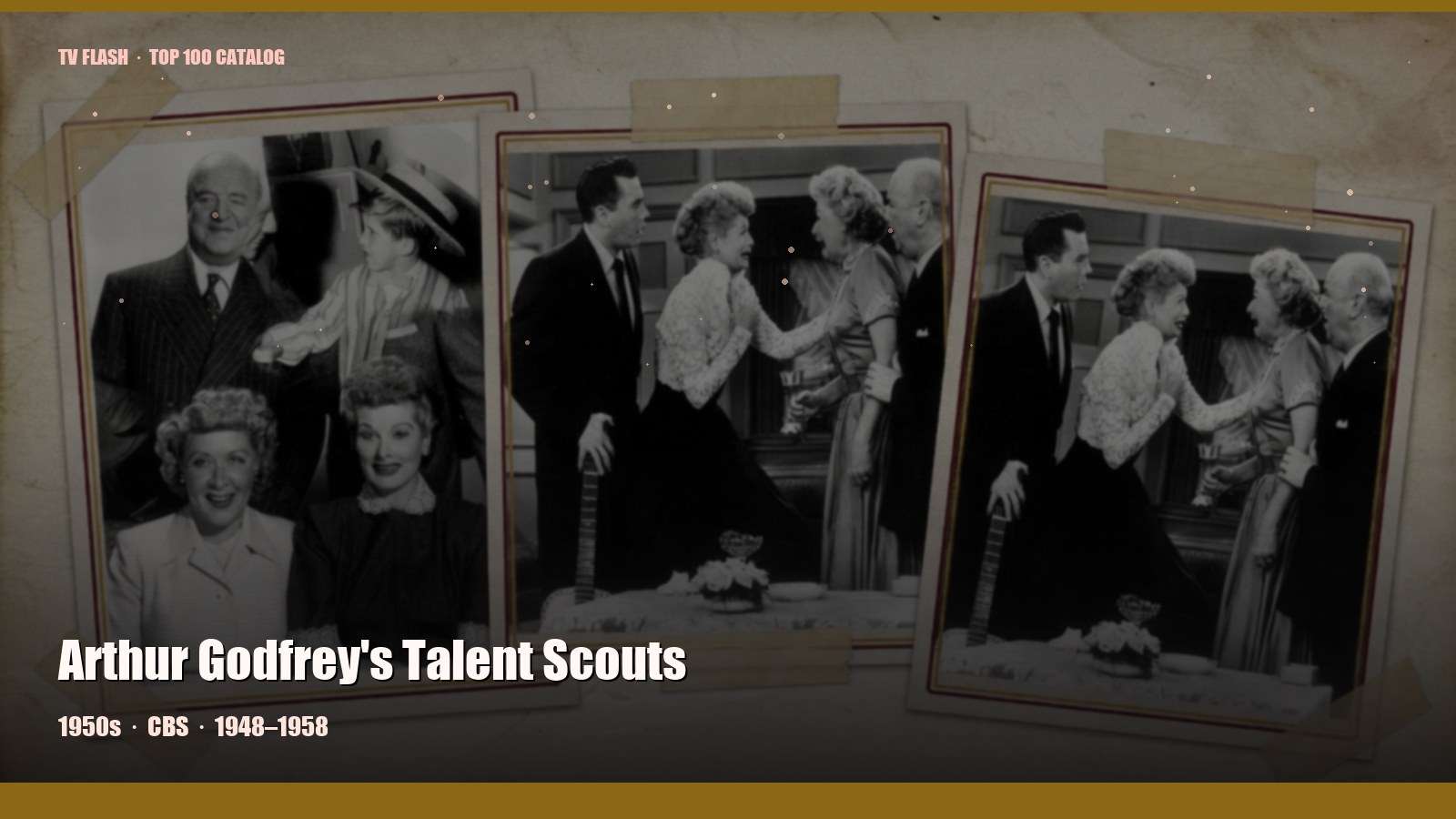
Talent-show prototype and one of early TV's highest-rated franchises.
Why it matters
From the desk
Why Arthur Godfrey's Talent Scouts still plays
The look is a ukulele that can make or unmake a career — folksy tyranny as a silhouette, an applause meter as the verdict, a host instead of a judges' table. CBS's *Arthur Godfrey's Talent Scouts* (1948–1958) was among the top-rated shows of early television; combined with *Arthur Godfrey and His Friends*, he was a one-man primetime block. Amateur and rising performers auditioned; the meter could mint careers. On-air firings. Beloved and feared in the same breath. America's first real TV star-maker. The timeline can fight about later singing competitions. The gown was a ukulele and a night he owned.
Godfrey headlined both franchises on the same network. Helped launch or boost performers who later became major stars. Talent-show prototype and one of early TV's highest-rated franchises. Folksiness as a weapon; on-air firings as the cautionary silhouette; a ukulele host who could make or unmake a career on a network night. Two episodes in this catalog pack, one season of file, a decade of discovery nights in the ratings. Beloved and feared in the same breath — America's first real TV star-maker, the host (not a judges' table) owning the power. The talent-scout format echoes in every singing competition since. Tessa can keep the stan wars about who deserved the meter. This was image management as host power: the look that decided the career. CBS kept the ukulele empire in the top ranks. The prehistory of the competition franchise, when folksiness was a weapon and the applause meter was the verdict.
Look board: ukulele as scepter; applause meter as jewelry; folksy warmth as the message dress; a second Godfrey hour as the matching set. The series premiere is ukulele host as America's first TV star-maker, folksy tyranny already able to make a career in one night. The series end of network run is 1958 closer as public milestone, the talent-show prototype packing away on-air firings and a ukulele.
Skip hunting a judges' table. There isn't one. The host owned the power. CBS kept the ukulele empire in the top ranks for a decade of discovery nights. Every later singing competition still echoes the scout format, usually with more chairs and less fear.
See you at the after-party, which was a firing or a career, depending on the meter. The second look is always the host without a panel. That is the real dress: folksy tyranny that taught America how a man with a ukulele could own a network night.
Episode guide
How this series is filed
TV Flash files Arthur Godfrey's Talent Scouts (1948–1958) on CBS as a desk landmark file, not a complete episode guide, 1948-12-06–1958-01-01 from “Series premiere (Talent Scouts)” (S01E01) to “Series end of network run” (S01E02).
Open the episode guide · S01E01 Series premiere (Talent Scouts) · S01E02 Series end of network run
Essential episodes
Ukulele star-maker — folksy tyranny, on-air firings, the prehistory of every singing competition. Filed by Lana Reyes (Red Carpet Reality).
- S01E01 Series premiere (Talent Scouts)
Series premiere (Talent Scouts): ukulele host as America's first TV star-maker, folksy tyranny already able to make a career in one night.
- S01E02 Series end of network run
Series end of network run — 1958 closer as public milestone, the talent-show prototype packing away on-air firings and a ukulele.
At a glance
Amateur and rising performers auditioned for Arthur Godfrey and a studio applause meter that could mint careers. CBS's Talent Scouts (1948–1958) was among the top-rated shows of early television; combined with Arthur Godfrey and His Friends on the same network, he was a one-man primetime block. Folksy tyranny and a ukulele host who could make or unmake a career on a network night: America's first real TV star-maker, the host — not a judges' table — owning the power. The talent-scout format echoes in every TV competition since.
Network & studio
- CBS — broadcast network
Why watch now
Arthur Godfrey's Talent Scouts is the talent-show prototype: a ukulele host who could make or unmake a career on a network night. Folksy tyranny, on-air firings, and America's first real TV star-maker. Watch it now as the prehistory of every singing competition — when the host, not a judges' table, owned the power.
Cultural impact
Arthur Godfrey's Talent Scouts was a talent-show prototype and one of early TV's highest-rated franchises. Combined with his other CBS hours, Godfrey was a one-man primetime block: beloved and feared in the same breath, a star-maker whose folksiness was a weapon. The applause meter as verdict still echoes in every singing competition. Later judges' tables merely divided a power the host once held alone.
Creators
Arthur Godfrey
Key cast
- Arthur Godfrey as Host
Flash facts
- CBS talent/variety series 1948–1958; among the top-rated shows of early TV.
- Arthur Godfrey also headlined Arthur Godfrey and His Friends on the same network.
- Helped launch or boost performers who later became major stars.
- Amateur and rising performers faced a studio applause meter that could mint careers.
- Godfrey hosted and created the franchise as a one-man primetime block.
FAQ
Where should I start?
Start with Godfrey, the ukulele, and the applause-meter auditions. The host's power is the show; the acts are the evidence.
What can I skip?
Skip collapsing it with Arthur Godfrey and His Friends as one series. Scout nights are the discovery machine. You need not hear every amateur.
Is it still worth it?
Yes, as the talent-show prototype — a host who could make or unmake a career before judges' tables existed.
Variety or competition?
Talent-scout variety — live discovery with an applause meter, host as star-maker.
Official & further reading
External sites for further reading — TV Flash is not affiliated with these networks or studios.
Back to the decade
Also on the dial
More after Arthur Godfrey's Talent Scouts
- Related showThe Ernie Kovacs ShowVisual gags, blackouts, and Nairobi Trio — the medium inventing itself for laughs.
- Related showThe Adventures of Robin HoodRichard Greene's Robin — British export that American kids treated like native folklore.
- Related showThe United States Steel HourIndustrial giant, theatrical punch — live drama with a steel-hard production sheen.
- Related showOmnibusAloft culture for the masses — Leonard Bernstein, Orson Welles, and Sunday seriousness.
- Related showAmos 'n' AndyHugely popular, deeply fraught — the sitcom that forces the conversation about race and early TV.
- Related showMamaNorwegian immigrant family warmth — live family drama before sitcoms ate the hour.