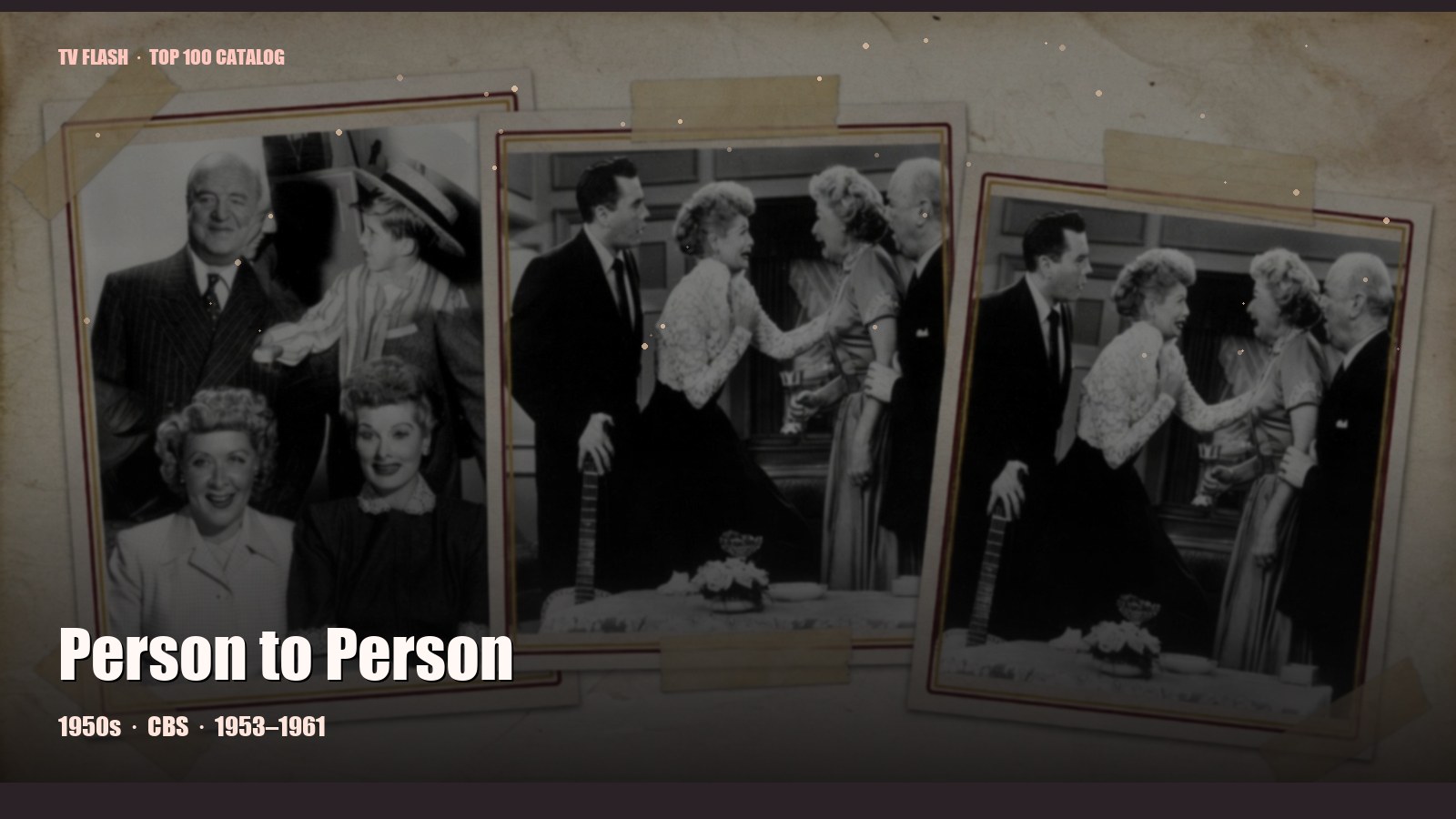
Invented the modern at-home celebrity interview on network television.
Why it matters
From the desk
Why Person to Person still plays
So about last night, except last night is 1954 and Edward R. Murrow is in a den that is not his. *Person to Person* (CBS, 1953–1961) interviewed public figures live via remote cameras in their homes — politicians to movie stars, intimacy as spectacle, remote cameras as manners. Murrow hosted until 1959; Charles Collingwood followed. It sat beside *See It Now* as the other half of Murrow's TV persona. Stars smoking on their own sofas felt like sci-fi etiquette. (I said spoiler-free. The den is the spoiler. Influencers made the tour a content vertical later; this was the original come-inside.)
John Aaron and Jesse Zousmer helped build the remote; the den was the set. The series invented the modern at-home celebrity interview and pioneered the home-tour aesthetic television still uses. Stars in their own living rooms felt like sci-fi etiquette — privileged access from politicians to movie stars, a technical and cultural novelty that made intimacy the spectacle. Lana can keep the gown and the pap angle. This look is a sofa, a cigarette, and a camera that pretended it had been invited. Two episodes in this catalog pack, two seasons of file, eight years of privileged access in the culture. Murrow until 1959, then Collingwood: the come-inside special as a franchise that later sit-downs and house tours still copy without admitting they are copying a CBS remote.
What the timeline decided: the 4/9/54 listed hour is Murrow beamed into a den, stars smoking on their own sofas — at-home celebrity interview as remote-camera manners. The 1961 closer in this pack is the come-inside-my-house special packing away after eight seasons of intimacy as spectacle. Skip hunting a 'gotcha.' The form is manners as access. The group chat would have live-blogged the ashtray.
Harder news lived on *See It Now*; this was the other Murrow, the one who treated a living room as a set without calling it a leak. Technical novelty. Cultural novelty. The home-tour still pays rent on that remote.
See you in the tags: #comeinsidemyhouse and the argument about whether intimacy on camera is a sacrament or a bit. I need sleep and a rewatch of a den that was already content. The replies can fight the influencers. Murrow had the sofa first.
Episode guide
How this series is filed
TV Flash files Person to Person (1953–1961) on CBS as the episode guide: 2 listed hours across 2 seasons, 1953-10-02–1961-09-08 from “4/9/54” (S01E01) to “Episode 1” (S09E01).
Essential episodes
Murrow in the den — at-home celebrity as remote-camera manners, intimacy as a 1950s spectacle. Filed by Tessa Quinn (Spoiler-Free (Mostly)).
- S01E01 4/9/54
4/9/54: Murrow beamed into a den, stars smoking on their own sofas — at-home celebrity interview as remote-camera manners.
- S09E01 Episode 1
1961 closer in this pack: the come-inside-my-house special packing away after eight seasons of intimacy as spectacle.
At a glance
Edward R. Murrow interviewed public figures live via remote cameras in their homes, creating a sense of privileged access from politicians to movie stars. CBS's Person to Person (1953–1961), built with John Aaron and Jesse Zousmer, was hosted by Murrow until 1959 and then by Charles Collingwood. Remote dens were a technical and cultural novelty. It sat beside Murrow's harder news work on See It Now as the other half of his TV persona: intimacy as spectacle. Stars smoking on their own sofas pioneered the home-tour aesthetic television still uses.
Network & studio
- CBS — broadcast network
Why watch now
Person to Person invented the at-home celebrity interview: Edward R. Murrow beamed into dens while stars smoked on their own sofas. Intimacy as spectacle, remote cameras as manners. Watch it now to see every living-room sit-down and come-inside-my-house special before influencers made the tour a content vertical.
Cultural impact
Person to Person invented the modern at-home celebrity interview on network television. Remote cameras in guests' homes turned privileged access into weekly spectacle and pioneered the home-tour aesthetic the medium still uses. Paired with See It Now, it showed both sides of Murrow's TV persona: hard news and living-room manners. Stars in their own dens felt like sci-fi etiquette. Later sit-downs still rent this furniture.
Creators
Edward R. Murrow · John Aaron · Jesse Zousmer
Key cast
- Edward R. Murrow as Host
- Charles Collingwood as Host (later)
Flash facts
- CBS interview series 1953–1961; Murrow hosted until 1959, then Charles Collingwood.
- Remote interviews from guests' homes were a technical and cultural novelty.
- Paired with Murrow's harder news work on See It Now as two sides of his TV persona.
- Guests ranged from politicians to movie stars.
- John Aaron and Jesse Zousmer helped build the remote-home format.
FAQ
Where should I start?
Start with Murrow on the remote, a famous guest in their own house. The sofa-and-cigarette access is the invention.
What can I skip?
Skip the Collingwood years until you have Murrow's at-home manner, and skip treating it as See It Now. This is the soft-power twin, not the McCarthy reports.
Is it still worth it?
Yes, as the ancestor of every at-home celebrity sit-down. Intimacy as a broadcast trick starts here.
News interview or celebrity tour?
Remote at-home interview show — public-affairs gloss on a house tour, not a hard newsmagazine.
Official & further reading
External sites for further reading — TV Flash is not affiliated with these networks or studios.
Back to the decade
Also on the dial
More after Person to Person
- Related showThe Ernie Kovacs ShowVisual gags, blackouts, and Nairobi Trio — the medium inventing itself for laughs.
- Related showThe Adventures of Robin HoodRichard Greene's Robin — British export that American kids treated like native folklore.
- Related showThe United States Steel HourIndustrial giant, theatrical punch — live drama with a steel-hard production sheen.
- Related showOmnibusAloft culture for the masses — Leonard Bernstein, Orson Welles, and Sunday seriousness.
- Related showAmos 'n' AndyHugely popular, deeply fraught — the sitcom that forces the conversation about race and early TV.
- Related showMamaNorwegian immigrant family warmth — live family drama before sitcoms ate the hour.