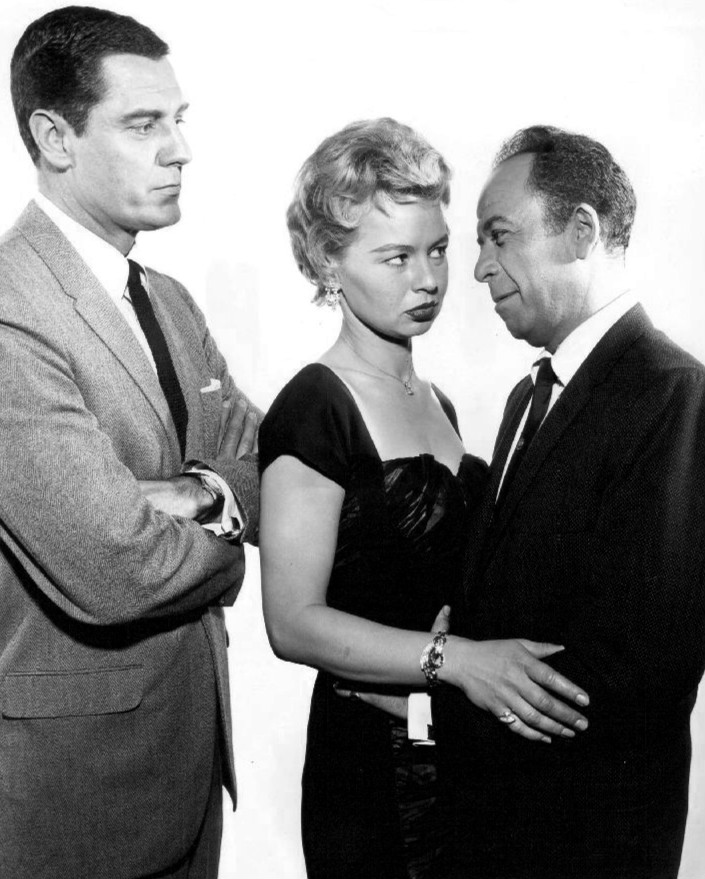
Style-forward detective TV; Mancini's music made crime sound modern.
Why it matters
From the desk
Why Peter Gunn still plays
The bass line enters before the detective does. Peter Gunn (NBC then ABC, 1958–1961), created by Blake Edwards, is a sleek private eye on a jazz-soaked city beat: Craig Stevens in the title, Lola Albright as girlfriend-singer Edie Hart, Herschel Bernardi as police contact Lt. Jacoby, and a Henry Mancini theme that became a major instrumental hit. Style-forward detective television. The walking bass invented a whole aesthetic. One hundred fourteen half-hours in which vibe is not decoration. Vibe is structure. Edwards making the camera modern while the cases stay sleek and short.
What the series is arguing: crime can be about texture as much as clues. Mancini's score outlived the plots — the footnote the blotter desks will treat as gossip is simply the industrial fact. Nightclub blonde, cocktail-napkin noir, a PI who looks designed. Edwards moved the series from NBC to ABC; the bass line did not notice. That is craft continuity, not a scandal. People treating television like a crime blotter will linger on the network hop. The cut says the aesthetic did not require a logo.
Permission to watch for the album cover and still call it criticism: the half-hour is cinematic cool applied to television's cheap clock. Guest menace, a song, a close-up that behaves like a lighting plot. Albright's Edie is not a prize at the end of the case; she is the nightclub the show cannot live without. Jacoby is the civic hinge. Stevens underplays so the music can overplay. Three seasons. The later, louder detective hours would forget that silence is a rhythm instrument.
The opener, The Kill, is the cool-jazz private eye walking in, Mancini already outliving the plots, Edwards making crime sound like a nightclub. A mid-first-season titled hour, The Leaper, is the walking bass still the real starring credit on a sleek PI aesthetic. Season two ignites on a racket title, Protection — style-forward detective television that still looks like an album cover. Late second season, Baby Shoes, the blonde nightclub still the set, the score still the franchise. The 1961 closer, Murder on the Line, is the last titled case, Mancini packed into the afterlife, Gunn's bass line still walking.
Verdict: watch it for the score and the silhouette, and for the proof a detective half-hour could be a design object. The scandal will outlive some of the cases — that is television — but the bass line is the literature with better lighting. Closed. The plots were never the point. Edwards knew. Mancini made sure you could hum the knowing.
Episode guide
How this series is filed
TV Flash files Peter Gunn (1958–1961) on NBC/ABC as the episode guide: 114 listed hours across 3 seasons, 1958-09-22–1961-09-18 from “The Kill” (S01E01) to “Murder on the Line” (S03E38).
Open the episode guide · S01E01 The Kill · S03E38 Murder on the Line
Essential episodes
Cool-jazz PI — Mancini bass line, blonde nightclub, Blake Edwards making crime sound modern. Filed by Julian Hart (The Binge Brief).
- S01E01 The Kill
The Kill: cool-jazz private eye opens, Mancini already outliving the plots, Blake Edwards making crime sound like a nightclub.
- S01E15 The Leaper
The Leaper — mid-first-season titled hour, walking bass line still the real starring credit on a sleek PI aesthetic.
- S02E01 Protection
Protection: season-two ignition on a racket title, style-forward detective television that still looks like an album cover.
- S02E38 Baby Shoes
Baby Shoes: late second-season named hour, the blonde nightclub still the set, the score still the franchise.
- S03E38 Murder on the Line
Murder on the Line closes 1961: last titled case, Mancini packed into the afterlife, Gunn's bass line still walking.
At a glance
Sleek private eye Peter Gunn works a jazz-soaked city beat with girlfriend-singer Edie Hart and police contact Lt. Jacoby. Peter Gunn (NBC then ABC, 1958–1961), created by Blake Edwards, brought cinematic cool to the half-hour: Craig Stevens, Lola Albright, Herschel Bernardi, and a Henry Mancini theme that became a major instrumental hit. Style-forward detective TV; the walking bass line invented a whole aesthetic. Mancini's score outlived the plots. Crime could be about vibe as much as clues — a nightclub blonde, a bass line, and a PI who looks like a cocktail-napkin sketch of noir. Edwards making the camera modern while the cases stay sleek and short.
Network & studio
Why watch now
Peter Gunn is a cool-jazz private eye, a blonde nightclub, and a Henry Mancini score that outlived the plots. Blake Edwards made crime sound modern. Watch it in 2026 for the walking bass line and the sleek PI aesthetic — style-forward detective television that still looks like a cocktail-napkin sketch of noir.
Cultural impact
Peter Gunn proved TV crime could be about vibe as much as clues. Edwards's cinematic cool and Mancini's walking bass line made detective television sound modern; the theme became a major instrumental hit. Style-forward PI craft — nightclub, bass, short sleek cases — still looks like a cocktail-napkin sketch of noir. Later crime hours still rent this jazz furniture even when they drop the blonde and keep the chill.
Creators
Blake Edwards
Key cast
- Craig Stevens as Peter Gunn
- Lola Albright as Edie Hart
- Herschel Bernardi as Lt. Jacoby
Flash facts
- NBC then ABC crime series 1958–1961; created by Blake Edwards.
- Henry Mancini's theme became a major instrumental hit.
- Craig Stevens starred; Lola Albright as nightclub singer Edie Hart.
- Herschel Bernardi played police contact Lt. Jacoby.
- Style-forward detective TV: jazz-soaked city beat, cinematic cool, vibe as much as clues.
FAQ
Where should I start?
Start with Stevens, Albright's nightclub, and Mancini's theme. The cool is the premise; a couple of cases teach the beat.
What can I skip?
Skip needing every clue. Plots are secondary to vibe. NBC versus ABC is a network hop, not a reboot you must study.
Is it still worth it?
Yes, for the jazz-noir PI aesthetic. The score still walks; the sleekness still photographs.
Procedural or style piece?
Cool-jazz private-eye drama — half-hour noir with a hit theme, vibe as much as clues.
Official & further reading
External sites for further reading — TV Flash is not affiliated with these networks or studios.
Back to the decade
Also on the dial
More after Peter Gunn
- Related showLife Is Worth LivingBishop Sheen vs. Milton Berle in the ratings — a chalkboard and a cape beat vaudeville some weeks.
- Related showThe Ernie Kovacs ShowVisual gags, blackouts, and Nairobi Trio — the medium inventing itself for laughs.
- Related showRocky and His FriendsA flying squirrel, a moose, and Cold War satire — Jay Ward's anarchic gift at decade's end.
- Related showKukla, Fran and OllieAd-lib puppets and Fran Allison — gentle absurdity that adults watched without irony.
- Related showSky KingArizona rancher with a Cessna — aviation adventure for kids who wanted wings.
- Related showThe United States Steel HourIndustrial giant, theatrical punch — live drama with a steel-hard production sheen.