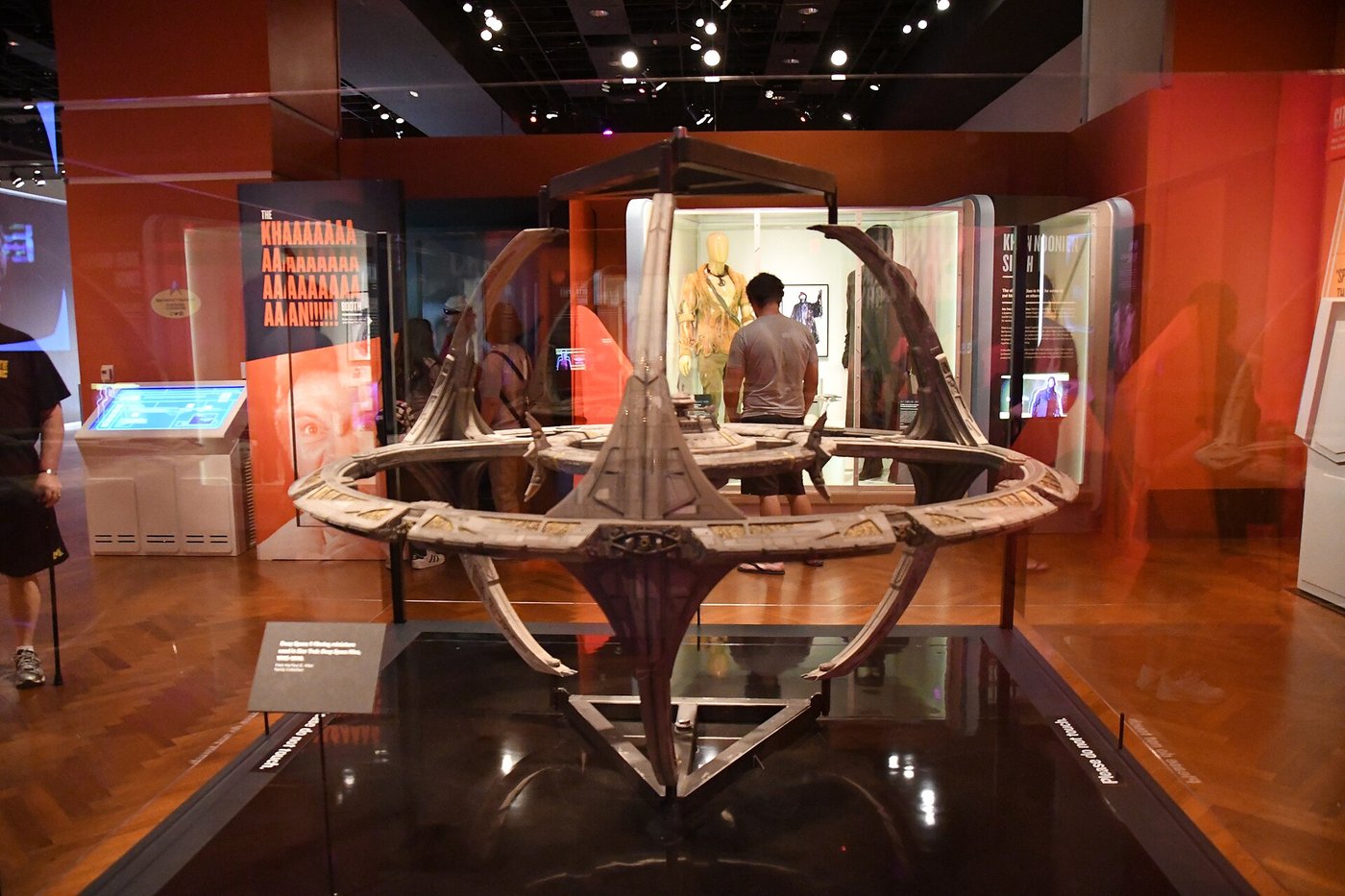
Star Trek: Deep Space Nine
Trek stays put — serialized war, religion, and politics on a space station.
Trek stays put — serialized war, religion, and politics on a space station.
Boldest 1990s Trek: serialization, moral gray, and Sisko’s commanding presence.
Why it matters
From the desk
Flash: January 3, 1993, syndication, a politically charged station near a wormhole, and the franchise finally staying put. Rick Berman and Michael Piller's Deep Space Nine leaned into serialization, war arcs, religion, and moral gray that 1990s Trek had often dodged. Avery Brooks's Sisko anchored diplomacy, prophecy, and combat with commanding gravity. Nana Visitor, Colm Meaney, René Auberjonois, Terry Farrell, Armin Shimerman made station politics into longform novel television. Someone already filed the TNG-versus-DS9 civil war. **They are not amicable.** Seven seasons through 1999. The station is the set. Utopia is the argument.
The museum guard will tell you to watch the text, not the fan war. Cute. The fan war is how the text became a peak. Serialized, spiritually tangled, ethically unresolved. The Dominion War redefined franchise stakes. Ferengi redemption arcs and Sisko as a landmark of representation and command are the lasting heat. Concurrent with other 1990s Trek series, and still the one that argues hardest with the brand's smile.
Who was where — beat sheet: Brooks as Sisko, the gravity. Visitor as Kira. Meaney as O'Brien. Auberjonois as Odo. A publicist *unavailable for comment* on whether the wormhole was religion or plot. s01e01 Emissary, Part I puts Sisko on the station. s03e01 The Search, Part I makes serialization house style. s04e01 The Way of the Warrior files Klingon heat as a novel chapter. s06e01 A Time to Stand is Dominion War as the gray TNG often dodged. s07e26 What You Leave Behind, Part II closes the seven-season novel with a messy goodbye. One hundred seventy-six episodes.
One almost-empathy beat, and it is for whoever had to keep a weekly franchise smiling while this one let occupancy, faith, and command be the actual plot. Critical reappraisal elevated it among Trek peaks even as the civil war never quite ended. Later prestige franchise TV that treats seasons as novels still owes the station rent.
Last flash: ask me how I know the deleted Story was the one where utopia loses the argument and the show still wears the uniform. The museum can keep Next Generation as canon. The lobby was Deep Space Nine, and it was already a war desk.
Episode guide
TV Flash files Star Trek: Deep Space Nine (1993–1999) on Syndication as the episode guide: 176 listed hours across 7 seasons, 1993-01-03–1999-06-02 from “Emissary, Part I” (S01E01) to “What You Leave Behind, Part II” (S07E26).
Open the episode guide · S01E01 Emissary, Part I · S07E26 What You Leave Behind, Part II
The station that stayed put — five hours where Trek finally let war and faith get messy. Filed by Vivian Cross (The Carpet Report).
Emissary, Part I: Sisko on a politically charged station, the franchise already arguing with utopia from a wormhole.
The Search, Part I: serialization as house style, Bajor and the Gamma Quadrant no longer reset-button weather.
The Way of the Warrior: Klingon heat as a novel chapter, Berman and Piller letting the station become a war desk.
A Time to Stand: Dominion War as the gray TNG often dodged — occupancy, faith, and command as the actual plot.
What You Leave Behind, Part II: seven-season novel closed, the station finally allowed a messy goodbye.
Starfleet commander Benjamin Sisko takes charge of a politically charged space station near a stable wormhole — and the show, unusually for Trek, mostly stays put. Rick Berman and Michael Piller's DS9 leaned into serialization, war arcs, religion, and moral gray that 1990s Trek had often dodged. Avery Brooks's Sisko anchored diplomacy, prophecy, and combat with commanding gravity. Bajor, the Dominion War, and station politics turned ensemble sci-fi into longform novel television. It is the Trek that argues hardest with utopia.
Trek stays put: Avery Brooks's Sisko commands a politically charged station near a wormhole, and the franchise finally lets serialization, war, and religion get messy. Berman and Piller's seven-season novel argues with utopia — Bajor, the Dominion War, moral gray TNG often dodged. The boldest 1990s Star Trek, still fighting the fan civil war.
Deep Space Nine expanded what Star Trek could be — serialized, spiritually tangled, and ethically unresolved. It influenced later prestige franchise TV that treats seasons as novels. Sisko remains a landmark of representation and command on genre television.
Rick Berman · Michael Piller
Fixed station instead of a constantly traveling starship; heavier serialization, politics, religion, and the Dominion War as a long novel.
From the beginning if you want the political setup; the war arcs are the reputation, but they pay off a station you have to live on first.
Seven seasons, 1993–1999, concurrent with other 1990s Trek — a full novel, not a sampler.
Serialized sci-fi drama: diplomacy, faith, and war on a station that refuses to warp away from the mess.
External sites for further reading — TV Flash is not affiliated with these networks or studios.
Also on the dial