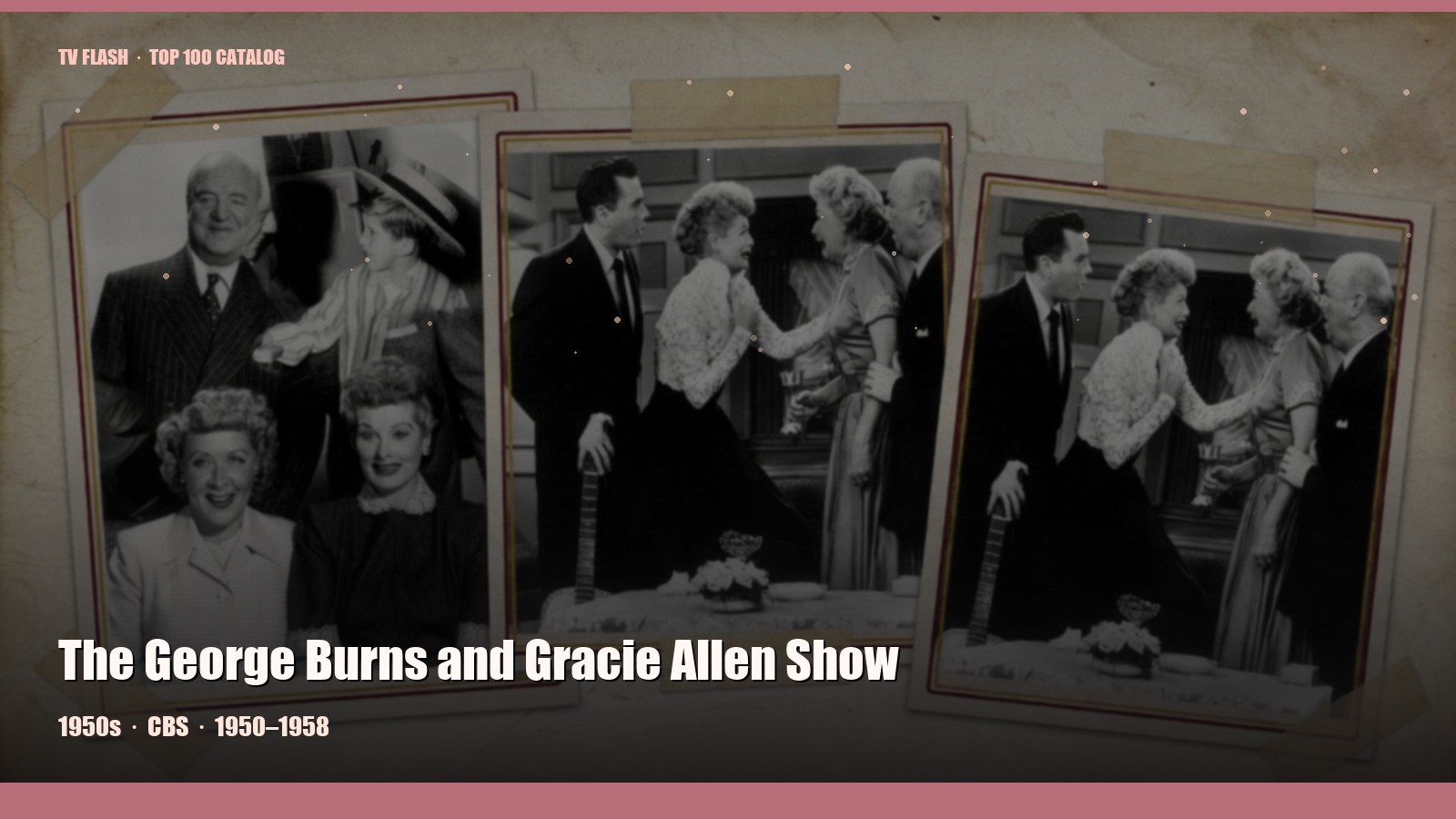
Early meta-sitcom: the star steps outside the scene and talks to us.
Why it matters
From the desk
Why The George Burns and Gracie Allen Show still plays
The look is a man in the aisle and a woman who derails reality — fourth-wall George, dizzy-logic Gracie, marriage as perfected vaudeville. Their CBS sitcom (1950–1958), 291 episodes across eight seasons, migrated a legendary vaudeville and radio marriage into television's living room without sanding off the surreal. George narrated; Gracie derailed; neighbors, Bea Benaderet's Blanche, announcer Harry Von Zell, Fred Clark's Harry Morton played along. Direct address as a silhouette. Meta before sitcoms had a word for meta. The timeline can call it a bit. The gown is a hinge on the fourth wall.
The act ended when Gracie retired from performing; Burns producing afterward and his later solo career only underlined how perfect the pair had been. George Burns and Ralph Levy on the creation card. Direct address became a sitcom tool. Gracie's comic persona influenced generations of absurdist character work. *Burns and Allen* proved vaudeville marriage acts could become sophisticated TV form. Lightning bottled in black-and-white half-hours: blended domestic sitcom plots with vaudeville-honed routines, famous for Burns's direct-to-camera commentary and Allen's illogical comic logic. Tessa can keep the reply-guy discourse. This was image management as a marriage act: he steps outside, she stays in the logic, the audience is the third party. Fred Clark's Harry Morton joined the neighbor circuit; the marriage still ended only when Gracie walked away.
Look board: cigar-and-aside lighting; Gracie's illogical music as the dress; neighbor circuit as chorus; vaudeville refusing to pretend the living room invented them. *The Kleebob Card Game* is George stepping outside the scene to talk to us, Gracie's logic already the radio partnership un-sanded for television. *Gracie Goes to a Psychiatrist* is season-two title as dizzy-logic clinic. *The Good Old Days of Vaudeville* is the meta-sitcom naming its source code.
*George Invites Critics to Watch First Show of Season* is titled as press-night swagger, the star still narrating the sitcom from the aisle. *The Exchange Student* closes 1958: last named hour of the surreal marriage, bottled when Gracie's logic still outran the plot. Skip hunting a domestic 'problem.' The problem is reality. Gracie wins.
See you at the after-party, which was a retirement and a solo career that proved the pair had been the look. The second look is always George without Gracie. That is the real image: a hinge that only worked with both of them on it.
Episode guide
How this series is filed
TV Flash files The George Burns and Gracie Allen Show (1950–1958) on CBS as the episode guide: 291 listed hours across 8 seasons, 1950-10-12–1958-09-15 from “The Kleebob Card Game” (S01E01) to “The Exchange Student” (S08E39).
Open the episode guide · S01E01 The Kleebob Card Game · S08E39 The Exchange Student
Essential episodes
Fourth-wall George, dizzy-logic Gracie — marriage as vaudeville, early meta-sitcom in pearls. Filed by Lana Reyes (Red Carpet Reality).
- S01E01 The Kleebob Card Game
The Kleebob Card Game: George steps outside the scene to talk to us, Gracie's logic already the radio partnership un-sanded for television.
- S02E01 Gracie Goes to a Psychiatrist
Gracie Goes to a Psychiatrist — season-two title as dizzy-logic clinic, marriage still perfected vaudeville with a fourth wall on a hinge.
- S02E15 The Good Old Days of Vaudeville
The Good Old Days of Vaudeville: the meta-sitcom naming its source code, Burns and Allen refusing to pretend the living room invented them.
- S05E01 George Invites Critics to Watch First Show of Season
George Invites Critics to Watch First Show of Season — titled as press-night swagger, the star still narrating the sitcom from the aisle.
- S08E39 The Exchange Student
The Exchange Student closes 1958: last named hour of the surreal marriage, bottled when Gracie's logic still outran the plot.
At a glance
George Burns broke the fourth wall to confide in the audience while Gracie Allen weaponized illogic into pure comic music. Their CBS sitcom (1950–1958) migrated a legendary vaudeville/radio marriage into television's living room without sanding off the surreal. George narrated; Gracie derailed reality; neighbors and announcers played along. It was meta before sitcoms had a word for meta. When Gracie retired, the act's lightning was bottled forever in those black-and-white half-hours.
Network & studio
- CBS — broadcast network
Why watch now
The George Burns and Gracie Allen Show is fourth-wall George and dizzy-logic Gracie: marriage as perfected vaudeville, the star stepping outside the scene to talk to us. Watch it now as early meta-sitcom — a radio partnership migrated without sanding off the surreal, bottled when Gracie retired.
Cultural impact
Burns and Allen proved vaudeville marriage acts could become sophisticated TV form and made direct address a sitcom tool. Gracie Allen's comic persona influenced generations of absurdist character work. George's later solo career only underlined how perfect the pair had been.
Creators
George Burns · Ralph Levy
Key cast
- George Burns as George Burns
- Gracie Allen as Gracie Allen
- Harry Von Zell as Harry Von Zell
- Bea Benaderet as Blanche Morton
- Fred Clark as Harry Morton
Flash facts
- CBS sitcom starring George Burns and Gracie Allen, 1950–1958.
- Continued their long-running radio and stage partnership on television.
- Famous for Burns's direct-to-camera commentary and Allen's illogical comic logic.
- Blended domestic sitcom plots with vaudeville-honed routines.
- Ended when Gracie Allen retired from performing.
FAQ
Where should I start?
Start anywhere George talks to the camera and Gracie derails the room. The fourth-wall marriage is the show from the jump.
What can I skip?
Skip hunting a serialized plot. Domestic excuses exist to launch vaudeville logic. Post-Gracie Burns is a different career.
Is it still worth it?
Yes. Template for fourth-wall sitcom magic and one of comedy's great partnerships on film.
Sitcom or vaudeville?
Meta-sitcom: domestic half-hours with direct address and a vaudeville marriage intact.
Official & further reading
- Paramount+ — The George Burns and Gracie Allen Show
- CBS home
- Wikipedia
- IMDb
- TMDB search
- YouTube — trailers & clips
External sites for further reading — TV Flash is not affiliated with these networks or studios.
Back to the decade
Also on the dial
More after The George Burns and Gracie Allen Show
- Related showThe Ernie Kovacs ShowVisual gags, blackouts, and Nairobi Trio — the medium inventing itself for laughs.
- Related showThe Adventures of Robin HoodRichard Greene's Robin — British export that American kids treated like native folklore.
- Related showThe United States Steel HourIndustrial giant, theatrical punch — live drama with a steel-hard production sheen.
- Related showOmnibusAloft culture for the masses — Leonard Bernstein, Orson Welles, and Sunday seriousness.
- Related showAmos 'n' AndyHugely popular, deeply fraught — the sitcom that forces the conversation about race and early TV.
- Related showMamaNorwegian immigrant family warmth — live family drama before sitcoms ate the hour.