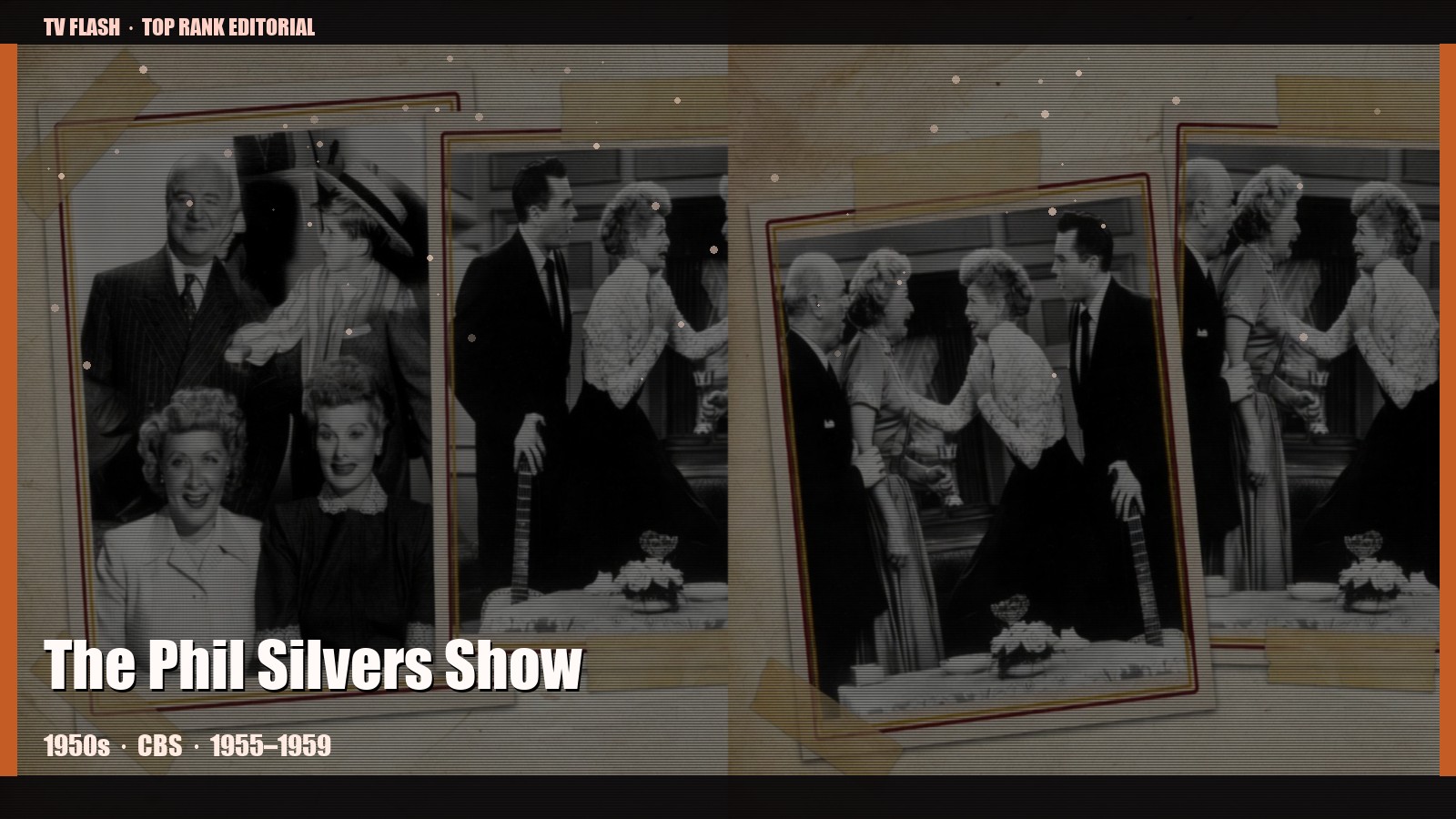
Fast-talk ensemble sitcom that won a shelf of Emmys and influenced every schemer comedy after.
Why it matters
From the desk
Why The Phil Silvers Show still plays
CBS window: 1955–1959. Originally titled *You'll Never Get Rich*. **142 episodes, four seasons**, a shelf of Emmys, Nat Hiken's breakneck rewrites, Phil Silvers as Sgt. Ernie Bilko in the fictional Fort Baxter motor pool. That is not a cozy service half-hour. That is a hustler sitcom with military branding, fast-talk ensemble as the engine, the con as a weekly workplace. Rex can hymn the barracks. The metric is the rewrite speed and the Emmy shelf.
Silvers's gambling-debt legend and the show's rewrite culture are showbiz lore around a series that already moves like a con. Paul Ford's Col. John Hall, Harvey Lembeck's Cpl. Rocco Barbella, Herbie Faye's Cpl. Sam Fender: marks and accomplices in a barracks that is really a casino. It taught every later workplace comedy how a hustler talks when the army is the office. Bilko became the template for the charming military con man and a high-water mark for Nat Hiken's comedy craft. The show's Emmy success validated ensemble service comedy as prestige funny. Later barracks sitcoms borrowed the hustle without always matching the wit. Four seasons of motor-pool cons were enough to stock a generation of schemer comedies. Counts vary slightly by pilot and special inclusion; the chart still reads as a complete con. Originally *You'll Never Get Rich* — even the first title was a hustle.
How the drop worked: *New Recruits* opens the motor pool, Silvers as licensed con man, Hiken already treating the platoon as a sitcom engine. *Sergeant Bilko Presents Ed Sullivan* is variety-king crossover as hustle, the con meeting the Sunday brand it was built to parody. *Bilko's Merry Widow* is season-three ignition on a titled scheme. *Gold Fever* starts the last season as another get-rich plot — the schemer comedy template already fully assembled.
*Weekend Colonel* closes 1959: final-rank hustle as sign-off, the motor pool packing away a con that later sitcoms never quite repaid. Counts vary slightly by pilot and special inclusion; the chart still reads as a complete four-season con. **Emmys validated ensemble service comedy as prestige funny.** Nostalgia without the rewrite culture is just a uniform.
Projection: every later schemer workplace is still paying rent on that motor pool. If a streamer buries the fast-talk half-hour behind a prestige limited, you'll know who lost the room. Watch Bilko as the licensed con, not the hymn to the '50s.
Episode guide
How this series is filed
TV Flash files The Phil Silvers Show (1955–1959) on CBS as the episode guide: 142 listed hours across 4 seasons, 1955-09-20–1959-06-17 from “New Recruits” (S01E01) to “Weekend Colonel” (S04E35).
Open the episode guide · S01E01 New Recruits · S04E35 Weekend Colonel
Essential episodes
Bilko's motor-pool hustle — Nat Hiken speed, con-man ensemble, every later schemer comedy in debt. Filed by Max Sterling (Streaming Confidential).
- S01E01 New Recruits
New Recruits opens the motor pool: Silvers as licensed con man, Hiken's breakneck rewrites already treating the platoon as a sitcom engine.
- S02E14 Sergeant Bilko Presents Ed Sullivan
Sergeant Bilko Presents Ed Sullivan — variety-king crossover as hustle, the con meeting the Sunday brand it was built to parody.
- S03E01 Bilko's Merry Widow
Bilko's Merry Widow: season-three ignition on a titled scheme, fast-talk ensemble still the funniest uniform television licensed.
- S04E01 Gold Fever
Gold Fever starts the last season as another get-rich plot — the schemer comedy template already fully assembled.
- S04E35 Weekend Colonel
Weekend Colonel closes 1959: final-rank hustle as sign-off, the motor pool packing away a con that later sitcoms never quite repaid.
At a glance
Master Sergeant Ernie Bilko ran the motor pool at Fort Baxter like a casino with a salute. Phil Silvers's machine-gun delivery powered CBS's The Phil Silvers Show (originally You'll Never Get Rich, 1955–1959), a service comedy where every private was a mark and every scheme almost worked. Nat Hiken's writing room built ensemble precision around Silvers's hustle. The series cleaned up Emmy recognition and proved military sitcoms could be sharp rather than soft. Bilko remains the patron saint of lovable larceny in uniform.
Network & studio
- CBS — broadcast network
Why watch now
The Phil Silvers Show is Sgt. Bilko's motor-pool hustle: the funniest con man in uniform television ever licensed, Nat Hiken's breakneck rewrites, a shelf of Emmys. Watch it now as fast-talk ensemble sitcom that influenced every later schemer comedy — gambling-debt legend included, the con as a weekly military workplace.
Cultural impact
Bilko became the template for the charming military con man and a high-water mark for Nat Hiken's comedy craft. The show's Emmy success validated ensemble service comedy as prestige funny. Later barracks sitcoms borrowed the hustle without always matching the wit.
Creators
Nat Hiken
Key cast
- Phil Silvers as MSgt. Ernie Bilko
- Paul Ford as Col. John Hall
- Harvey Lembeck as Cpl. Rocco Barbella
- Herbie Faye as Cpl. Sam Fender
- Maurice Gosfield as Pvt. Duane Doberman
Flash facts
- CBS sitcom starring Phil Silvers as Sgt. Ernie Bilko, 1955–1959 (originally titled You'll Never Get Rich).
- Created/run under comedy architect Nat Hiken.
- Roughly 140-ish episodes across four seasons (counts vary slightly by pilot/special inclusion).
- Won multiple Emmy Awards and critical praise for ensemble writing and Silvers's lead performance.
- Set largely at the fictional Fort Baxter motor pool, a playground for Bilko's schemes.
FAQ
Where should I start?
Start with Bilko in the motor pool at full hustle — Silvers talking faster than the army can regulate. Ensemble chaos is the form from week one.
What can I skip?
Skip treating it as a war drama and skip a solemn complete-run project. Four seasons of con variations are a sampler, not a serialized caper.
Is it still worth it?
Yes. Fast-talk ensemble sitcom that still influences every schemer comedy after it.
Military sitcom or con show?
Workplace sitcom in uniform — a barracks con man, not a combat hour.
Official & further reading
External sites for further reading — TV Flash is not affiliated with these networks or studios.
Back to the decade
Also on the dial
More after The Phil Silvers Show
- Related showThe Ernie Kovacs ShowVisual gags, blackouts, and Nairobi Trio — the medium inventing itself for laughs.
- Related showThe Adventures of Robin HoodRichard Greene's Robin — British export that American kids treated like native folklore.
- Related showThe United States Steel HourIndustrial giant, theatrical punch — live drama with a steel-hard production sheen.
- Related showOmnibusAloft culture for the masses — Leonard Bernstein, Orson Welles, and Sunday seriousness.
- Related showAmos 'n' AndyHugely popular, deeply fraught — the sitcom that forces the conversation about race and early TV.
- Related showMamaNorwegian immigrant family warmth — live family drama before sitcoms ate the hour.