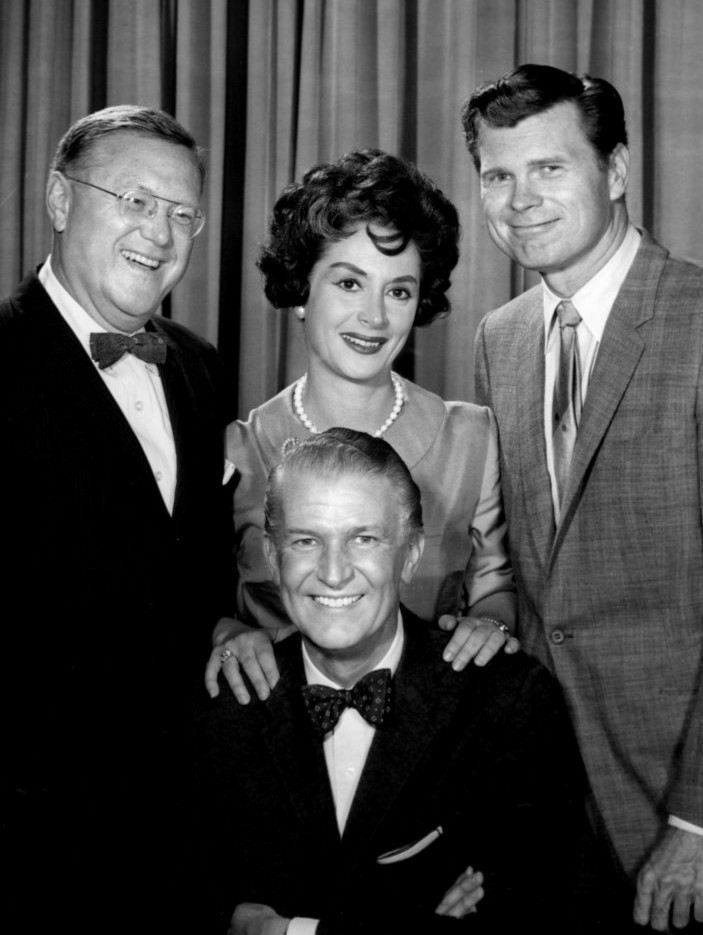
Perfected the impostor-panel format still revived every few years.
Why it matters
From the desk
Why To Tell the Truth still plays
The look is three people claiming one identity — a lie detector with manners, celebrities sweating, a reveal line that escaped the show into the language. *To Tell the Truth*, CBS prime time 1956–1968, 251 episodes across six seasons in this catalog file: Bob Stewart's impostor format for Goodson-Todman, hosted by Bud Collyer, panel heat from Kitty Carlisle, Orson Bean, Tom Poston. 'Will the real ___ please stand up?' still works because the bluff is the entertainment. The timeline can meme the line. The silhouette was a cocktail of who-is-real.
The format is still revived every few years because identity as a guessing sport does not need a reboot to stay famous. Goodson-Todman panel craft at peak cleverness. The stand-up line never needed a rewrite. Three people claim to be the same noteworthy person; a celebrity panel questions them, then votes for the real one. *To Tell the Truth* perfected the impostor-panel format still revived every few years; 'Will the real ___ please stand up?' escaped the show into the language. Tessa can keep the tags fighting about who was fake. This was image management as the game: three claims, one truth, a panel that had to look like it knew. Bud Collyer hosted the original network run. Kitty Carlisle, Orson Bean, and Tom Poston supplied the heat. Goodson-Todman ran it in prime time through 1968. The bluff is the entertainment.
Look board: three matching claims; panel sweat as the jewelry; Collyer's reveal as the gown drop; biographies as the prize. The Pilot is three people claiming one identity, celebrities sweating, and the lie detector with manners born on CBS. *Ruth Nichols, Bill Jordan, Audrey Ericson* is named-identity season open, the format already a weekly who-is-real cocktail. *Murray Rose, Bill Thompson, Yung Oh Kim* is 1959 ignition on a stacked identity card, panel still sweating the stand-up.
*Elmer Wheeler, Victor Kugler, Mary Hearn* is mid-run named night, the impostor game treating real biographies as the prize. *Dr. Robert P. Vose, Myrtle Shriner, Edmund G. Love* closes this pack: last triple-name hour, will-the-real still the language. Skip hunting a 'winner's journey.' The form is the bluff. The stand-up is the look.
See you at the after-party, which was a phrase that left the studio and never came back. The second look is always the one who stands. That is the real dress: a format that made truth a silhouette, and a lie a matching outfit.
Episode guide
How this series is filed
TV Flash files To Tell the Truth (1956–1968) on CBS as the episode guide: 251 listed hours across 6 seasons, 1956-12-18–1962-05-14 from “Pilot” (S01E01) to “Dr. Robert P. Vose, Myrtle Shriner, Edmund G. Love” (S06E19).
Open the episode guide · S01E01 Pilot · S06E19 Dr. Robert P. Vose, Myrtle Shriner, Edmund G. Love
Essential episodes
Three claim one identity — impostor panel with manners, the stand-up phrase that never left the language. Filed by Lana Reyes (Red Carpet Reality).
- S01E01 Pilot
Pilot: three people claim one identity, celebrities sweat, and the lie detector with manners is born on CBS.
- S02E01 Ruth Nichols, Bill Jordan, Audrey Ericson
Ruth Nichols, Bill Jordan, Audrey Ericson — named-identity season open, the format already a weekly who-is-real cocktail.
- S03E01 Murray Rose, Bill Thompson, Yung Oh Kim
Murray Rose, Bill Thompson, Yung Oh Kim: 1959 ignition on a stacked identity card, panel still sweating the stand-up.
- S02E32 Elmer Wheeler, Victor Kugler, Mary Hearn
Elmer Wheeler, Victor Kugler, Mary Hearn — mid-run named night, the impostor game treating real biographies as the prize.
- S06E19 Dr. Robert P. Vose, Myrtle Shriner, Edmund G. Love
Dr. Robert P. Vose, Myrtle Shriner, Edmund G. Love closes this pack: last triple-name hour, will-the-real still the language.
At a glance
Three people claim to be the same noteworthy person; a celebrity panel questions them, then votes for the real one. Bob Stewart's impostor format for Goodson-Todman ran in CBS prime time from 1956 to 1968, hosted by Bud Collyer, with panel heat from Kitty Carlisle, Orson Bean, and Tom Poston. The reveal — "Will the real [name] please stand up?" — escaped into the language. A lie detector with manners, still revived every few years because the bluff is the entertainment.
Network & studio
- CBS — broadcast network
- Fremantle — production studio
- Mark Goodson Productions — production studio
Why watch now
To Tell the Truth perfected the impostor panel: three people claim one identity, the celebrities sweat, and one phrase escaped into the language. Will the real blank please stand up still works because the format is a lie detector with manners. A 2026 viewer watches the original bluff-as-entertainment machine.
Cultural impact
To Tell the Truth perfected the impostor-panel format still revived every few years. The stand-up reveal escaped the show into the language, which is how you know a game has become folklore. Goodson-Todman panel craft at peak cleverness treated identity as sport and celebrities as the ones who sweat. Later versions keep rearranging the furniture; the bluff itself never needed a reboot to stay famous.
Creators
Bob Stewart · Mark Goodson · Bill Todman
Key cast
- Bud Collyer as Host
- Kitty Carlisle as Panelist
- Orson Bean as Panelist
- Tom Poston as Panelist
Flash facts
- CBS prime-time series 1956–1968; created by Bob Stewart for Goodson-Todman.
- Hosted by Bud Collyer in the original network run.
- Famous reveal: "Will the real [name] please stand up?"
- Panel regulars included Kitty Carlisle, Orson Bean, and Tom Poston.
- The impostor-panel format has been revived repeatedly.
FAQ
Where should I start?
Start with Collyer's original CBS run and wait for the stand-up reveal. Three claimants, one identity, a sweating panel — that is the whole machine.
What can I skip?
Skip later revivals until you have the 1950s–60s manners. You do not need every occupation; the impostor grammar repeats on purpose.
Is it still worth it?
Yes. The original bluff-as-entertainment machine still works because the format is cleaner than the copies.
Quiz, panel, or reality?
Impostor panel game — identity as a polite interrogation, not a trivia quiz.
Official & further reading
External sites for further reading — TV Flash is not affiliated with these networks or studios.
Back to the decade
Also on the dial
More after To Tell the Truth
- Related showThe Ernie Kovacs ShowVisual gags, blackouts, and Nairobi Trio — the medium inventing itself for laughs.
- Related showThe Adventures of Robin HoodRichard Greene's Robin — British export that American kids treated like native folklore.
- Related showThe United States Steel HourIndustrial giant, theatrical punch — live drama with a steel-hard production sheen.
- Related showOmnibusAloft culture for the masses — Leonard Bernstein, Orson Welles, and Sunday seriousness.
- Related showAmos 'n' AndyHugely popular, deeply fraught — the sitcom that forces the conversation about race and early TV.
- Related showMamaNorwegian immigrant family warmth — live family drama before sitcoms ate the hour.