Proved unscripted sparkle could be appointment TV without a single car chase.
Why it matters
From the desk
The Blindfold Was the Velvet Rope
Seventeen years of Sunday-night guessing: occupations as social theater, mystery guests as proto-paparazzi, and a panel that treated celebrity like a cocktail it could interrogate.
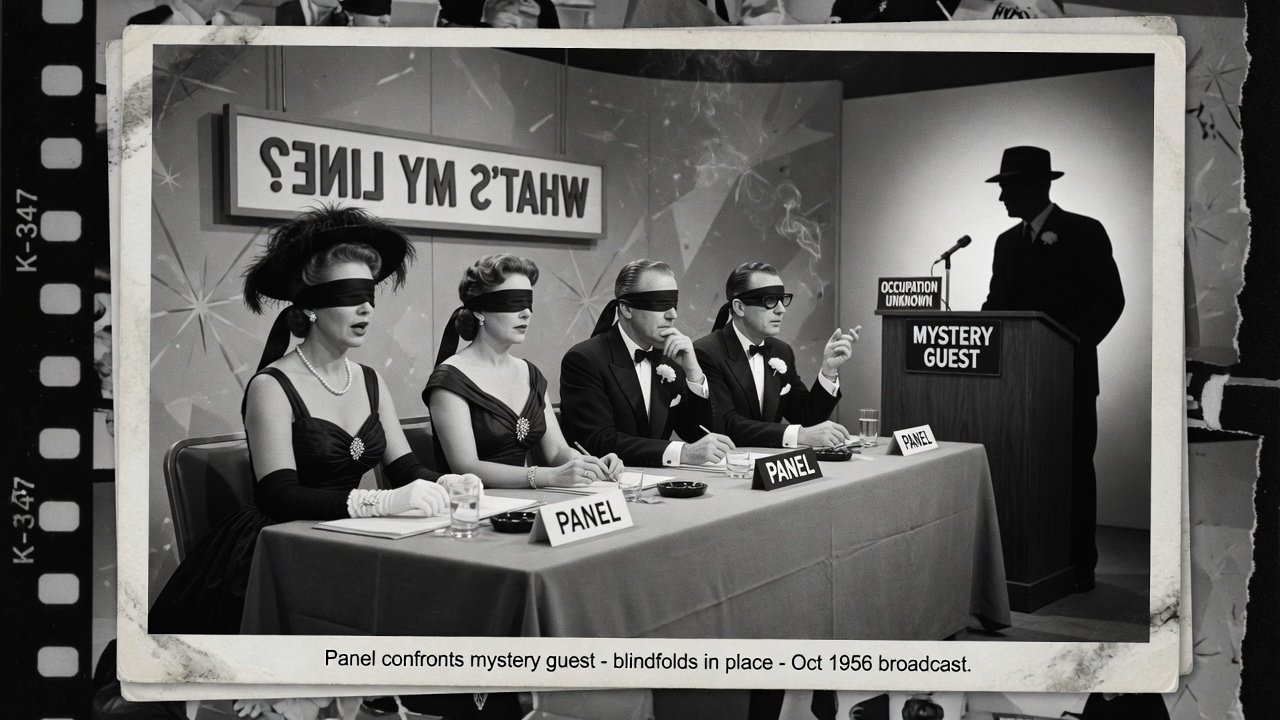
Flash: the blindfolds go on, the mystery guest sits down, and a living room that still owned pearls tries to guess who just walked in without looking. What’s My Line? is not a game show in the screaming-LED sense. It is a rope line with manners. Occupations first — the plumber, the inventor, the woman whose job the panel cannot imagine a lady having — then the celebrity round, which is the afterparty. John Daly keeps the gavel. Arlene Francis sparkles like she has already heard the better story in the green room. Dorothy Kilgallen plays the room like a column. Bennett Cerf makes a joke that would still get a publicist involved. The museum wants unscripted sparkle. I want who was sitting next to whom.
February 1950: Phil Rizzuto, and the country learns that a baseball name is enough to open a format. Then the guest book becomes a crime scene of proximity. Salvador Dalí. Eleanor Roosevelt. Lucille Ball, twice if you count the Desi two-shot. Elizabeth Taylor, which is still a headline even if you only have the kinescope and a caption. Mystery guests were the original who are they dating discourse, except the dating was a handshake and a gag about lipstick on a blindfold. They are not amicable, not always — panel feuds were the group chat. Kilgallen’s heat was the point. Cerf’s chuckle was the cover.
Who was where (beat sheet, not a TOC):
1. Mystery guest in a look engineered to be famous even with a sign over the name.
2. Panel doing gratitude theater while hunting a tell.
3. Daly as fire marshal of the joke, which is very museum-guard energy if you ask the wrong critic.
4. A PA named Connie with the occupation cards, because somebody had to know the real job.
The people who want just the text will tell you it is a charming artifact. Cute. Charm was the cover charge. This was appointment glamour without a car chase: Goodson-Todman polish, CBS Sunday real estate, a format that proved unscripted television could be a cocktail party the nation was invited to crash. Preempted weeks in the log are part of the gossip — even a velvet rope gets a sports overrun. Later seasons hide names behind EPISODE numbers in this catalog, which is a gift to anyone who likes a little archival fog with their pearls. Hunt the named nights. That is where the carpet still photographs.
How to watch nine hundred hours without lying to yourself: you will not. Sample the first Rizzuto, a surrealist, a First Lady, a sitcom empress, a movie queen. You are tracing heat, not completing a spreadsheet. The September 1967 closer is the door — Daly’s original CBS run ending, blindfolds packed, the panel’s Sunday manners about to be rerun as nostalgia instead of news. Variety and panel both died the same cultural death: the kids stopped asking the host for permission, and the afterparty moved.
Last flash: the blindfold was never about fairness. It was about making celebrity walk into a room and sit still while four people with microphones decided how famous was famous enough to guess in ten questions. Ask me how I know. The deleted caption was always the occupation they could not say politely, and the handshake at the end was the official amicable. The unofficial version is why you are still reading. Door close. The pearls stay on.
Episode guide
How this series is filed
TV Flash files What's My Line? (1950–1967) on CBS as a season-first catalog of 901 listed hours across 18 seasons, 1950-02-02–1967-09-03 from “Phil Rizzuto” (S01E01) to “EPISODE #876” (S18E53).
Open the episode guide · S01E01 Phil Rizzuto · S18E53 EPISODE #876
Essential episodes
Named heat in a 900-hour fog — the nights the living room knew exactly who sat down. Filed by Vivian Cross (The Carpet Report).
- S01E01 Phil Rizzuto
Rizzuto opens the format: a baseball name as enough fame to invent a Sunday.
- S03E21 Salvador Dali
Dalí as mystery-guest surrealism — the panel meeting an occupation it cannot categorize.
- S05E07 Eleanor Roosevelt
Eleanor Roosevelt: civic fame walking into a parlor game and still making it appointment TV.
- S05E25 Lucille Ball
Lucille Ball, solo heat — sitcom empress as the guest the living room already thought it owned.
- S06E11 Elizabeth Taylor
Elizabeth Taylor: movie-queen proximity, still a headline through kinescope grain.
At a glance
Blindfolded panelists guess occupations and celebrity mystery guests with urbane banter and good manners. Occupations range from humble to glamorous; the fun is the guessing game as social theater. Unscripted sparkle without a car chase in sight.
Network & studio
- CBS — broadcast network
- Mark Goodson Productions — production studio
- CBS Productions — production studio
Why watch now
Sunday manners with teeth: occupations as class theater, mystery guests as a rope line the panel was allowed to interrogate. Watch the named nights — ballplayers, First Ladies, sitcom empresses — and the feuds that prove unscripted sparkle was never just polite.
Cultural impact
What’s My Line? proved unscripted television could be appointment viewing on pure charm. Mystery-guest culture prefigured every “who are they dating” discourse cycle.
Creators
Mark Goodson · Bill Todman
Key cast
- John Charles Daly as Host
- Dorothy Kilgallen as Panelist
- Arlene Francis as Panelist
- Bennett Cerf as Panelist
Flash facts
- Goodson-Todman panel game show; CBS network run February 2, 1950–September 3, 1967 (876 episodes), plus syndicated 1968–1975.
- Panelists guessed contestants’ occupations; celebrity mystery guests often appeared blindfolded.
- Hundreds of episodes survive as kinescopes from the live-TV era.
FAQ
Where should I start?
Start with Phil Rizzuto in 1950 to see the format born, then jump to named mystery-guest nights — Dalí, Roosevelt, Ball, Taylor — rather than marching the episode numbers.
What can I skip?
Skip the idea of nine hundred Sundays. Mid-run occupation weeks are the machine humming. Preempted-week listings are calendar scars, not shows. Hunt names.
Is the last episode worth it?
As a door close, yes. September 1967 ends Daly’s original CBS run. It is manners being packed away, not a twist. The afterparty had already started leaving.
Do I watch in order?
No. It is a panel log. Order helps if you are tracing a regular panelist’s heat or a guest’s return. Otherwise, jump by the name on the title card.
Is it a game show or a gossip show?
Both, if you are honest. Occupations are social theater; mystery guests are proto-paparazzi. The blindfold is the velvet rope.
Cultural eras
Official & further reading
External sites for further reading — TV Flash is not affiliated with these networks or studios.
Back to the decade
Also on the dial
More after What's My Line?
- Related showThe Ernie Kovacs ShowVisual gags, blackouts, and Nairobi Trio — the medium inventing itself for laughs.
- Related showThe Adventures of Robin HoodRichard Greene's Robin — British export that American kids treated like native folklore.
- Related showThe United States Steel HourIndustrial giant, theatrical punch — live drama with a steel-hard production sheen.
- Related showOmnibusAloft culture for the masses — Leonard Bernstein, Orson Welles, and Sunday seriousness.
- Related showAmos 'n' AndyHugely popular, deeply fraught — the sitcom that forces the conversation about race and early TV.
- Related showMamaNorwegian immigrant family warmth — live family drama before sitcoms ate the hour.