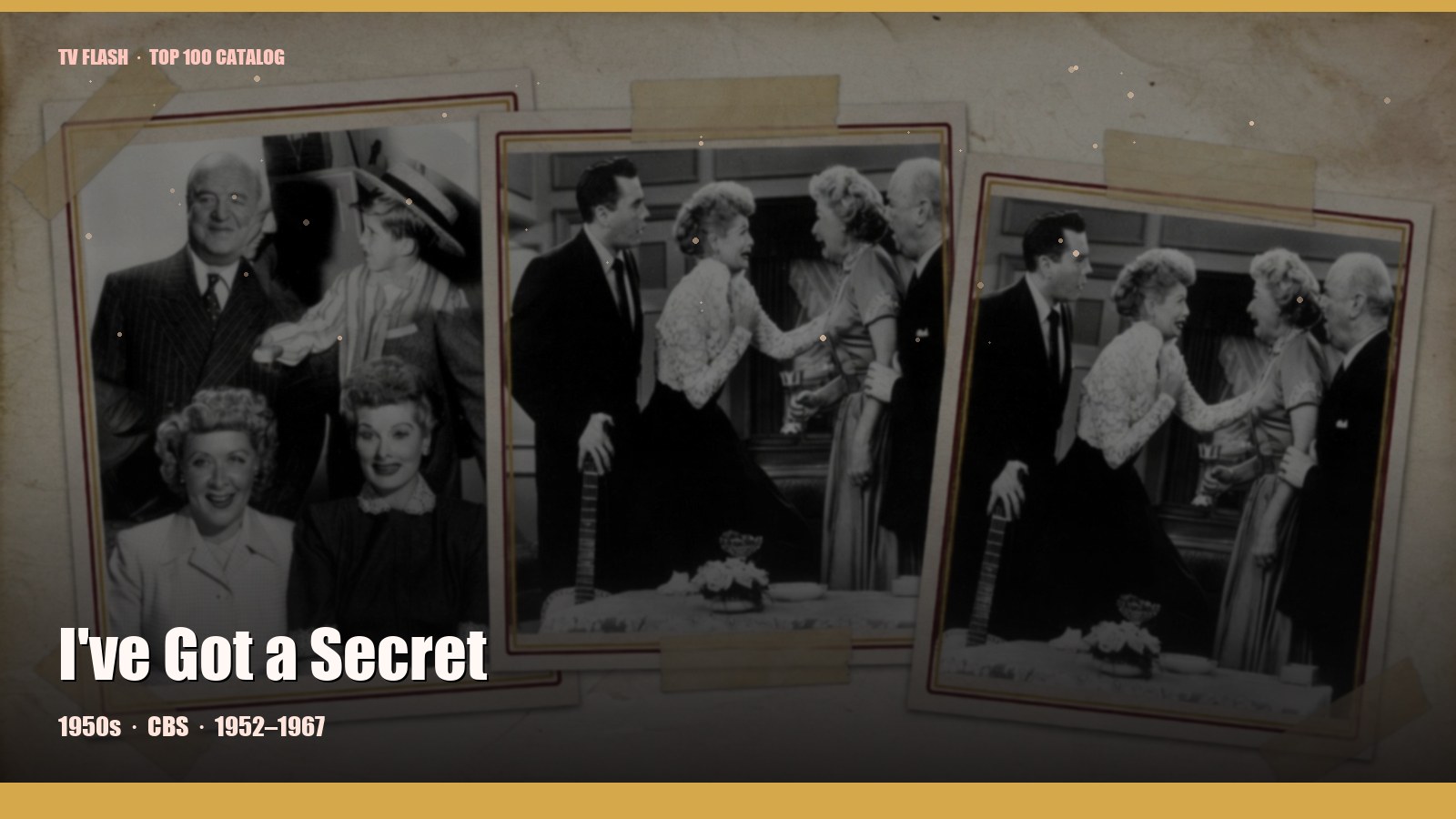
Long-running panel hit that made ordinary secrets into prime-time theater.
Why it matters
From the desk
Why I've Got a Secret still plays
Garry Moore's sweater-set warmth was not a drop. It was a CBS night, 1952–1967, *I've Got a Secret* as Goodson-Todman charm with a wink: contestants whisper a secret to the host, a celebrity panel tries to guess it with yes/no questions, 592 episodes across 16 seasons. Regulars included Bill Cullen, Henry Morgan, Betsy Palmer. Secrets ranging from silly to historically delightful. Quieter than the big-money quizzes, it outlasted many of them. Patterns: parlor game as prime-time theater, from an era when secrets still felt like cards in an envelope instead of leaks in a vending machine.
Ordinary confessions became appointment television; celebrity secret-holders kept it endlessly clip-able. It is the ancestor of every talk-show I-never-told-anyone segment, from an era when secrets still felt like parlor games instead of leaks. Revivals came later; the Moore-era original is the cultural touchstone. Mark Goodson and Bill Todman built panel manners with a punchline in the envelope. Long-running panel hit that made ordinary secrets into prime-time theater — quieter than the big-money quizzes, it outlasted many of them, which is a pattern if you are paying attention. Max can keep the authenticity crisis and the manufactured booth. This was a secret you were invited to guess, not a feed you were invited to doomscroll. Garry Moore hosted like a cardigan civic ritual. Bill Cullen and Henry Morgan guessed. Betsy Palmer sat on the panel. The sweater was the brand.
What the network night looked like: a card, a sweater, a panel that treated fame like a parlor game. *Boris Karloff* is premiere secret as horror-star confession theater, Moore's warmth already the Goodson-Todman wink. *Zsa Zsa Gabor* is glamour as secret-holder. *Howard Duff, Ida Lupino* is dual-star night as mid-run landmark, ordinary confessions still the ancestor of every I-never-told-anyone segment. *Jimmy Dean* is 1962 named guest, country fame walking into the secret chair while Moore still hosts like a cardigan civic ritual.
*Lynn Redgrave* closes 1967: last titled secret in this mega-pack, the confession format packing away sixteen seasons of polite shock. Skip hunting the big-money booth. The form is manners. The envelope is the prize.
A toast to the sweater, and a raised eyebrow for anyone who thinks a leak is more elegant than a parlor game. *I've Got a Secret* made ordinary confessions into prime-time theater. The martini goes with the card. The panel already knew how to wink.
Episode guide
How this series is filed
TV Flash files I've Got a Secret (1952–1967) on CBS as a season-first catalog of 592 listed hours across 16 seasons, 1952-06-19–1967-04-03 from “Boris Karloff” (S01E01) to “Lynn Redgrave” (S16E11).
Open the episode guide · S01E01 Boris Karloff · S16E11 Lynn Redgrave
Essential episodes
Celebrity secret-holders, sweater-set warmth — Goodson-Todman confession theater in five named nights. Filed by Rex Fontaine (Golden Age Dispatch).
- S01E01 Boris Karloff
Boris Karloff: premiere secret as horror-star confession theater, Garry Moore's sweater-set warmth already the Goodson-Todman wink.
- S02E02 Zsa Zsa Gabor
Zsa Zsa Gabor — glamour as secret-holder, the guessing panel treating fame like a parlor game with a card.
- S06E01 Howard Duff, Ida Lupino
Howard Duff, Ida Lupino: dual-star night as mid-run landmark, ordinary confessions still the ancestor of every I-never-told-anyone segment.
- S11E22 Jimmy Dean
Jimmy Dean: 1962 named guest, country fame walking into the secret chair while Moore still hosts like a cardigan civic ritual.
- S16E11 Lynn Redgrave
Lynn Redgrave closes 1967: last titled secret in this mega-pack, the confession format packing away sixteen seasons of polite shock.
At a glance
Contestants whisper a secret to the host; a celebrity panel tries to guess it with yes/no questions. Mark Goodson and Bill Todman's CBS panel show (1952–1967) was quieter than the big-money quizzes and outlasted many of them — Garry Moore's sweater-set warmth, regulars including Bill Cullen, Henry Morgan, and Betsy Palmer, secrets ranging from silly to historically delightful. Ordinary confessions became prime-time theater. Revived multiple times, the Moore-era original remains the cultural touchstone: parlor-game manners with a punchline waiting in the envelope.
Network & studio
Why watch now
I've Got a Secret turned ordinary confessions into prime-time theater: celebrity secret-holders, a guessing panel, and Garry Moore's sweater-set warmth. Goodson-Todman charm with a wink. Watch it in 2026 as the ancestor of every talk-show I-never-told-anyone segment, when secrets still felt like parlor games instead of leaks.
Cultural impact
I've Got a Secret made ordinary secrets into long-running prime-time theater and outlasted many louder quiz shows. Goodson-Todman charm with a wink taught television that a whispered confession could hold a night without a fortune at stake. Celebrity secret-holders kept it clip-able; later revivals never displaced the Moore-era original as the cultural touchstone. Panel manners with a punchline in the envelope still haunt every I-never-told-anyone segment.
Creators
Mark Goodson · Bill Todman
Key cast
- Garry Moore as Host
- Bill Cullen as Panelist
- Henry Morgan as Panelist
- Betsy Palmer as Panelist
Flash facts
- CBS panel show 1952–1967; hosted primarily by Garry Moore.
- Goodson-Todman production; regulars included Bill Cullen and Henry Morgan.
- Revived multiple times; the Moore-era original is the cultural touchstone.
- Betsy Palmer sat on the celebrity panel.
- Secrets ranged from silly to historically delightful; quieter than big-money quizzes.
FAQ
Where should I start?
Start with Moore, the whispered secret, and a panel that includes Cullen or Morgan. The parlor-game contract is immediate.
What can I skip?
Skip the big-money quiz comparison as a viewing plan, and skip later revivals if you want the sweater-set original. You need not hear every secret.
Is it still worth it?
Yes, as the long-running panel hit that made ordinary secrets into prime-time theater.
Quiz or panel game?
Celebrity panel guessing game — secrets as parlor theater, not isolation-booth stakes.
Official & further reading
External sites for further reading — TV Flash is not affiliated with these networks or studios.
Back to the decade
Also on the dial
More after I've Got a Secret
- Related showThe Ernie Kovacs ShowVisual gags, blackouts, and Nairobi Trio — the medium inventing itself for laughs.
- Related showThe Adventures of Robin HoodRichard Greene's Robin — British export that American kids treated like native folklore.
- Related showThe United States Steel HourIndustrial giant, theatrical punch — live drama with a steel-hard production sheen.
- Related showOmnibusAloft culture for the masses — Leonard Bernstein, Orson Welles, and Sunday seriousness.
- Related showAmos 'n' AndyHugely popular, deeply fraught — the sitcom that forces the conversation about race and early TV.
- Related showMamaNorwegian immigrant family warmth — live family drama before sitcoms ate the hour.