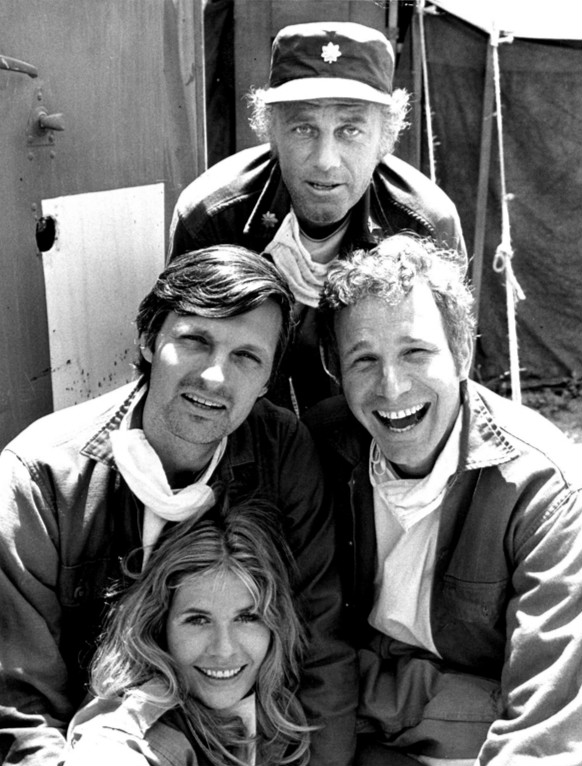
Showed comedy could be serious art without losing laughs.
Why it matters
From the desk
The Night CBS Let a War Comedy Own the Living Room
From a Korean War tent on Monday night to a two-and-a-half-hour goodbye still quoted like scripture — how M*A*S*H made gallows humor appointment TV.
February 28, 1983, CBS did not program a sitcom. It programmed weather. Goodbye, Farewell and Amen ate the night, the morning papers, and a ratings myth executives still quote like scripture — a two-and-a-half-hour close on a Korean War tent America had been visiting since September 1972. The helicopters were already folklore. The laugh track, by then, had learned when to shut up. On the palate: canvas, cigarette haze, and a three-act clock that could turn a punchline into a casualty without changing the lighting.
Larry Gelbart and Gene Reynolds took Robert Altman's 1970 film and Richard Hooker's novel and did something the three-network map almost never allowed: they let a comedy grow a conscience in public. Set in Korea. Received as Vietnam. Standards & Practices hovered; affiliates still ran the spots. Alan Alda's Hawkeye became the franchise's gravity, which is both the craft story and the commissary story. Power on a hit is never only creative differences. It is who owns Monday.
The historical claim the room forgets: M*A*S*H did not become serious by abandoning jokes. It became serious by refusing to treat jokes as a safety net. Early seasons still snap like service comedy — black-market scams, a chief surgeon the Army did not order, letters home that read like stand-up with a postage stamp. Then the catalog starts keeping receipts. You can feel the shift without a dashboard. The unit simply stops pretending the war is a setup.
Three nights that would trend today — and did, analog. Henry Blake's sendoff: a laugh-track show that mailed a character home and then told the truth in the last beat, leaving living rooms without a recovery joke. The interview hour: documentary drag on a sitcom stage, as if CBS had misplaced the laugh machine and decided not to look for it. Radar's goodbye: a supporting player leaving like a lead because the audience had already promoted him. None of these are clip-show nostalgia. They are the catalog teaching itself new manners.
The drop-culture boys will file this under catalog that still converts. Cute. Conversion is not why a reported hundred million people sat still. Scarcity plus nerve is why. You could not skip to the next title. You lived with the 4077th until the credits, then you argued at work. Linear television already knew how to bury a show — bad timeslot, no promos, a shrug dressed as the audience spoke. This one refused burial by becoming civic furniture. The gadgets changed. The soap opera of a hit — who left, who stayed, who got the close-up — did not.
Wayne Rogers left. McLean Stevenson left. Gary Burghoff left. Harry Morgan's Potter restabilized command without pretending the first colonel had been a temp. Loretta Swit's Margaret was allowed to become a person instead of a punchline, which is the kind of recast-of-the-soul the vending-machine era still fumbles. Jamie Farr's Klinger stopped being a one-joke uniform and became the unofficial mayor of the camp. None of that is simpler times. It is a writers' room negotiating a war that would not stay offstage, while CBS still needed the hour to pay for the tents.
Watch the form, not the merchandising. Later bottle hours — a point of view through a wounded G.I.'s eyes, a night of dreams, Hawkeye talking to a silent tent — are prestige television wearing 1970s lighting. If your limited series needs a ribbon to feel adult, this catalog already sat in the same living room as All in the Family and stole none of its chair. A toast, then, to the night that ended whether the algorithm liked it or not, and to the theme song a generation hummed without knowing the lyrics were a wound. Glory had a deflating detail: it was still a CBS comedy with a laugh track in the can. The helicopters did not care.
Episode guide
How this series is filed
TV Flash files M*A*S*H (1972–1983) on CBS as the episode guide: 251 listed hours across 11 seasons, 1972-09-17–1983-02-28 from “M*A*S*H - The Pilot” (S01E01) to “Goodbye, Farewell and Amen” (S11E16).
Open the episode guide · S01E01 M*A*S*H - The Pilot · S11E16 Goodbye, Farewell and Amen
Essential episodes
Five hours that show the tent learning, then refusing, the recovery joke. Filed by Rex Fontaine (Golden Age Dispatch).
- S01E01 M*A*S*H - The Pilot
The service-comedy contract in one night: chaos, rank, and a laugh track that still thinks it is in charge.
- S01E17 Sometimes You Hear the Bullet
The first clear receipt. A comedy that lets friendship arrive with a cost the sitcom hour is not built to refund.
- S03E24 Abyssinia, Henry
The sendoff that taught living-room America a laugh-track show could withhold the button. Still the series' most stolen dare.
- S04E24 The Interview
Documentary drag on a sitcom stage — form as argument, not a gimmick week.
- S08E04 Good-Bye Radar (1)
A supporting player leaving like a lead. The catalog promoting the audience's favorite without a farewell tour.
From the desk
Flash columns that open this package’s pilots, finales, or fandom heat:
- Golden Age Dispatch: Finales That Stopped America — Golden Age Dispatch
- Streaming Confidential: Pilot Sell, Finale Hold — How Openers and Endings Still Move the Chart — Streaming Confidential
At a glance
Surgeons and staff at a Korean War MASH unit fight bureaucracy, boredom, and blood with jokes that sometimes break into tears. Hawkeye’s irreverence meets the cost of endless war. Comedy earns its pathos without a laugh track safety net in later years.
Network & studio
- CBS — broadcast network
- 20th Century Fox Television — production studio
Why watch now
Eleven seasons of a network comedy that kept rewriting its own permission slip — Korea as the set, Vietnam as the aftertaste, and a goodbye still quoted whenever someone needs proof a sitcom can stop the country.
Cultural impact
M*A*S*H showed network comedy could be serious art and still dominate living rooms. “Goodbye, Farewell and Amen” remains the event finale every network envies.
Creators
Larry Gelbart
Key cast
- Alan Alda as Capt. Hawkeye Pierce
- Loretta Swit as Maj. Margaret Houlihan
- Jamie Farr as Cpl. Maxwell Klinger
- Harry Morgan as Col. Sherman Potter
- Gary Burghoff as Cpl. Radar O'Reilly
Flash facts
- CBS comedy-drama about a Korean War mobile army surgical hospital; aired September 17, 1972–February 28, 1983 (11 seasons, 256 episodes).
- Developed by Larry Gelbart from the 1970 film and Richard Hooker’s novel; mixed humor with antiwar themes.
- Series finale 'Goodbye, Farewell and Amen' set long-standing U.S. viewership records for a scripted episode.
FAQ
Where should I start if I cannot watch all eleven seasons?
Start with the 1972 pilot to learn the tent's manners, then jump to Sometimes You Hear the Bullet and Abyssinia, Henry. Those three hours teach the joke-to-wound contract better than a clip reel.
Is M*A*S*H a comedy or a war drama?
Both, on purpose. Early seasons play as service comedy; later seasons let the operating room win the argument. The laugh track recedes as the catalog grows up.
Can I skip the later seasons after the original ensemble thins out?
You can, but you will miss the show's actual thesis. Potter, the bottle hours, and Radar's exit are not leftovers. They are the series learning how to end in public.
Is the finale worth a two-and-a-half-hour sit?
Yes, as event television even if you already know the lore. It is the closer networks still cite when they want a goodbye to feel like weather, not a credit cookie.
Do I need the 1970 movie first?
No. The series borrows the camp and the irreverence; it does not require Altman's film as homework. Watch the movie later as a cousin, not a prerequisite.
Cultural eras
Official & further reading
- 20th Century Studios TV
- Hulu — M*A*S*H
- CBS network
- Wikipedia
- IMDb
- TMDB search
- YouTube — trailers & clips
External sites for further reading — TV Flash is not affiliated with these networks or studios.
Back to the decade
Also on the dial
More after M*A*S*H
- Related showThe Paper ChaseLaw school as blood sport — Professor Kingsfield terrifies a generation of pre-law kids.
- Related showThe Sonny & Cher Comedy HourI got you babe — marital sparring as variety gold before the divorce plot twist.
- Related showThe Young and the RestlessGenoa City boardrooms and bedrooms — youth, wealth, and that theme song.
- Related showHee HawCornfield vaudeville — country music, cornball sketches, and rural syndication power.
- Related showMatch GameBlank the blank — celebrity panel innuendo as daytime sport.
- Related showThe White ShadowWhite coach, mostly Black high-school team — gym class as social drama.