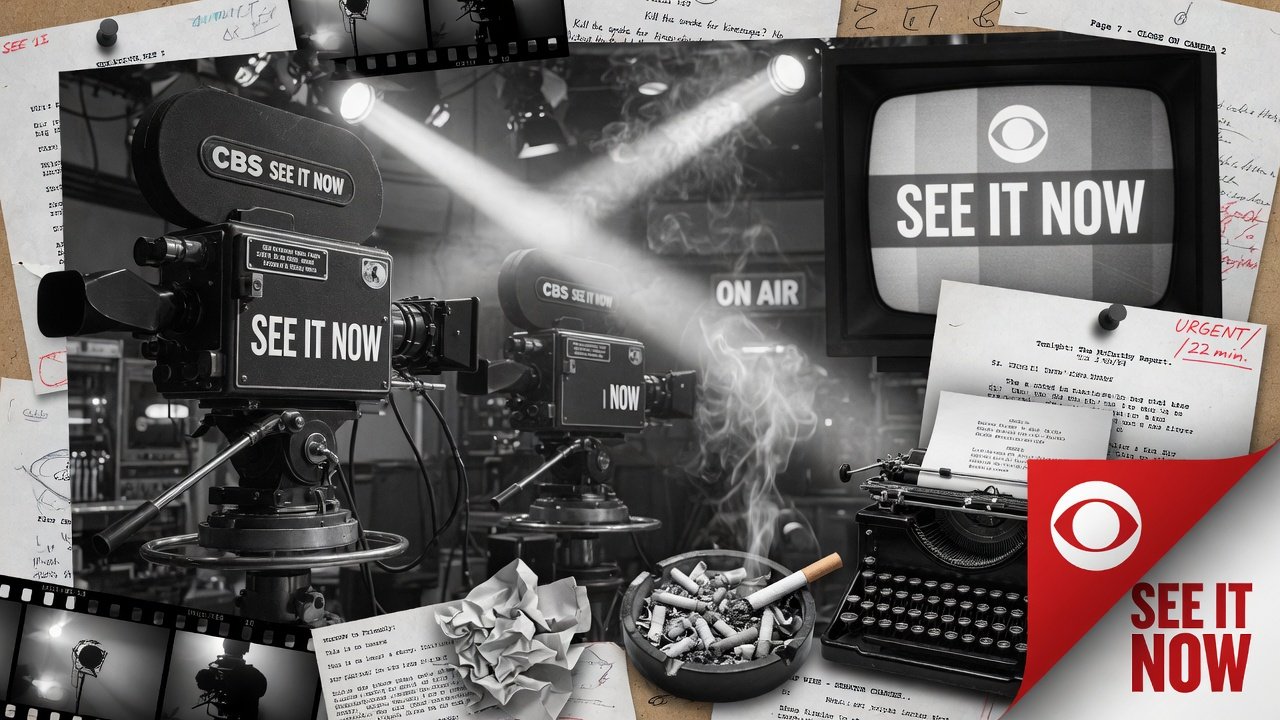
Defined serious TV journalism and the medium's power to confront McCarthyism.
Why it matters
From the desk
Why See It Now still plays
Edward R. Murrow did not drop a clip. He lit a cigarette and treated the camera like a witness. *See It Now*, CBS, 1951–1958, evolved from radio's *Hear It Now*: film reports, live remote links, editorial spine on subjects from Korea to domestic politics. Fred W. Friendly produced. The March 1954 broadcasts critically examining Senator Joseph McCarthy became the medium's defining journalist-versus-demagogue showdown — civic sacrament, not a vending-machine explainer queued behind a recap thumbnail.
Sponsor tensions and network caution eventually boxed the program in, but the bar it set for broadcast courage never lowered. Murrow's cigarette haze and moral clarity remain the house style of serious TV news mythology. Later newsmagazines inherited the ambition, if not always the nerve. *See It Now* defined what network news could dare and stamped Murrow into the American conscience; it remains the template for journalist-takes-on-demagogue media lore. Patterns: a public-affairs hour can check power until the sponsor decides the night is for selling sets. Max's world will call that a window, a quiet Friday, a buried row in the app. We called it a conscience with a time slot, film in the can, and a living room asked to sit still for civic sacrament instead of a recap thumbnail.
The series premiere is film reports and live links as civic sacrament, Friendly's spine already under the sponsor pressure. The listed hour that still owns the desk is *A Report on Senator Joseph R. McCarthy* — the 1954 title that became journalism's demagogue template. Two episodes in this catalog pack, and they are enough to argue the point: television could confront power instead of merely moving product.
What the network night looked like: Murrow on camera, film in the can, live links that made distance feel like evidence. No three-act prestige sheen. No binge. A cigarette and a civic dare. The Murrow–McCarthy clash is still the template because the medium keeps needing one.
A toast to the haze, and a raised eyebrow for anyone who thinks courage is a brand refresh. *See It Now* taught the living room to watch power. The martini is for after the film rolls. The remote is not a toy.
Episode guide
How this series is filed
TV Flash files See It Now (1951–1958) on CBS as a desk landmark file, not a complete episode guide, 1951-11-18–1954-03-09 from “Series premiere” (S01E01) to “A Report on Senator Joseph R. McCarthy” (S01E02).
Open the episode guide · S01E01 Series premiere · S01E02 A Report on Senator Joseph R. McCarthy
Essential episodes
Murrow, cigarette, conscience — two civic hours that proved television could confront a demagogue. Filed by Rex Fontaine (Golden Age Dispatch).
- S01E01 Series premiere
Series premiere: film reports and live links as civic sacrament, Fred Friendly's spine already under the sponsor pressure.
- S01E02 A Report on Senator Joseph R. McCarthy
A Report on Senator Joseph R. McCarthy — the 1954 title that became journalism's demagogue template, still the desk's required hour.
At a glance
Edward R. Murrow and Fred W. Friendly built See It Now as civic sacrament: film, live links, and editorial spine on subjects from Korea to domestic politics. Evolving from radio's Hear It Now, the CBS public-affairs series (1951–1958) treated the camera like a witness, not a circus. The March 1954 broadcasts critically examining Senator Joseph McCarthy became the medium's defining journalist-versus-demagogue showdown. Sponsor tensions and network caution eventually boxed the program in, but the bar it set for broadcast courage never lowered. Murrow's cigarette haze and moral clarity remain the house style of serious TV news mythology.
Network & studio
- CBS — broadcast network
Why watch now
See It Now is Murrow with a cigarette and a conscience: film reports, live links, and the 1954 McCarthy broadcasts that became journalism's demagogue template. Watch it in 2026 as civic sacrament — Fred Friendly's producing spine, sponsor pressure, and proof television could confront power instead of merely selling sets.
Cultural impact
See It Now defined what network news could dare and stamped Murrow into the American conscience. It remains the template for 'journalist takes on demagogue' media lore. Later newsmagazines inherited its ambition, if not always its nerve.
Creators
Edward R. Murrow · Fred W. Friendly
Key cast
- Edward R. Murrow as Host / reporter
- Fred W. Friendly as Producer
Flash facts
- CBS public-affairs series that ran 1951–1958, evolved from radio's Hear It Now.
- Created and led by Edward R. Murrow with producer Fred W. Friendly.
- Landmark March 1954 broadcasts critically examined Senator Joseph McCarthy.
- Used film reports, live remote links, and Murrow's on-camera editorial presence.
- Sponsor and network pressures eventually limited the show's freest form.
FAQ
Where should I start?
Start with the March 1954 McCarthy reports, the nights the series is most remembered for, then sample the film-and-remote public-affairs form around them.
What can I skip?
Skip treating it as a bingeable drama. It is a newsmagazine; you are sampling civic nerve, not completing a season arc.
Is it still worth it?
Yes — as the origin story of television as a check on power, not just a delivery system for ads.
News, documentary, or entertainment?
Serious public-affairs / newsmagazine — documentary confrontation, not variety or scripted drama.
Official & further reading
External sites for further reading — TV Flash is not affiliated with these networks or studios.
Back to the decade
Also on the dial
More after See It Now
- Related showThe Ernie Kovacs ShowVisual gags, blackouts, and Nairobi Trio — the medium inventing itself for laughs.
- Related showThe Adventures of Robin HoodRichard Greene's Robin — British export that American kids treated like native folklore.
- Related showThe United States Steel HourIndustrial giant, theatrical punch — live drama with a steel-hard production sheen.
- Related showOmnibusAloft culture for the masses — Leonard Bernstein, Orson Welles, and Sunday seriousness.
- Related showAmos 'n' AndyHugely popular, deeply fraught — the sitcom that forces the conversation about race and early TV.
- Related showMamaNorwegian immigrant family warmth — live family drama before sitcoms ate the hour.