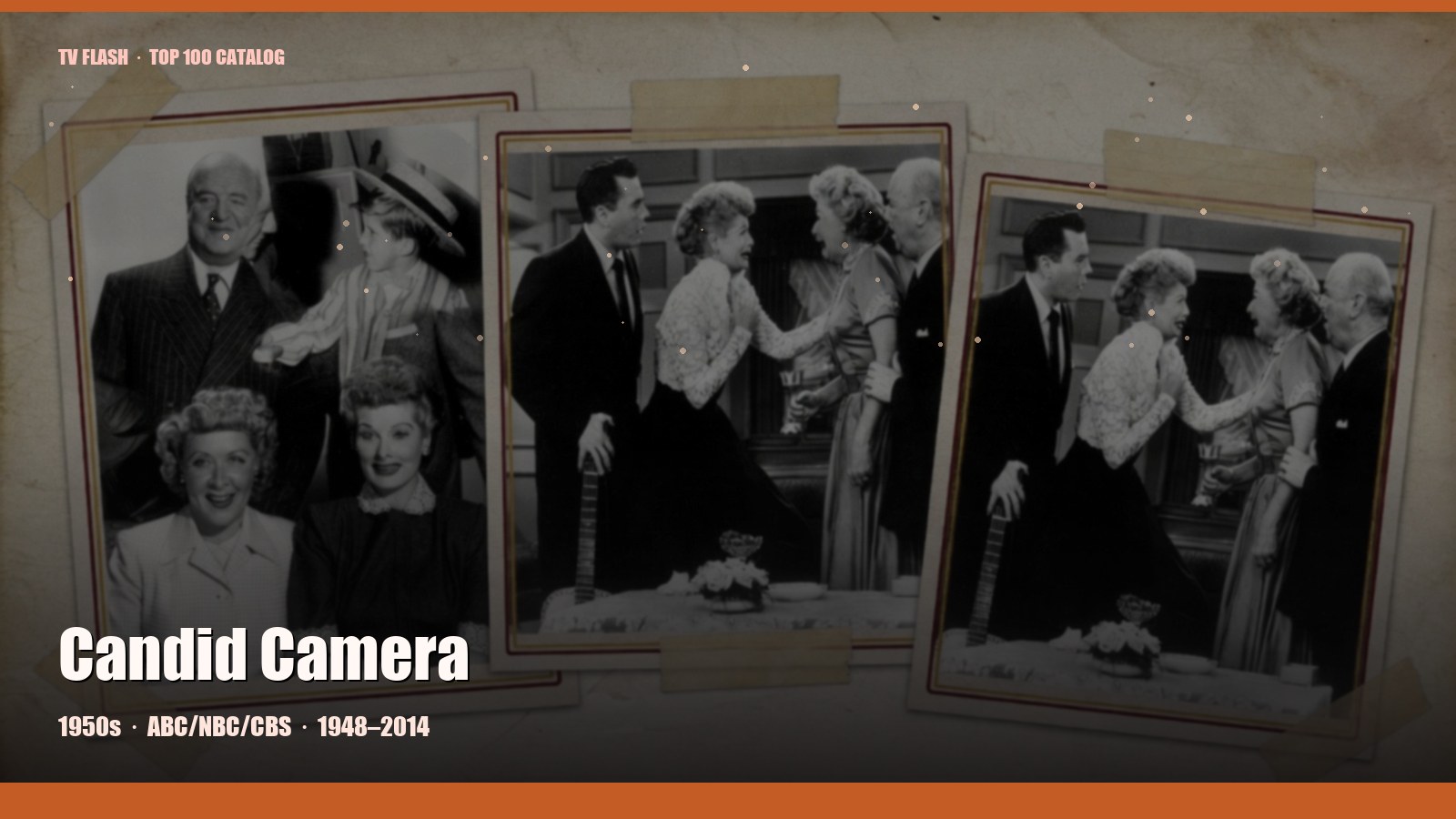
Prototype of reality/prank television; ordinary people as the show.
Why it matters
From the desk
Why Candid Camera still plays
The punchline is a civilian. Candid Camera is Allen Funt's prank sociology: hidden cameras, unsuspecting people, and the smile that made ordinary faces the first reality stars. Television versions from 1948 onward, major 1950s presence on ABC, NBC, and CBS after radio's Candid Microphone; Durward Kirby as co-host in the network years. Prototype of prank and reality television. A gotcha contract from an era when being filmed without consent was still sold as a joke instead of a crisis. The work is the reveal as structure — setup, ordinary person, the moment they become the show.
What the series is arguing, whether it meant to or not: civilians as content. The blotter will call Funt mischievous and stop there. The cut is colder. Later prank franchises and reality producers still work the same vein, usually with less gentleness and more lawyers. Gossip as footnote: Funt's empire made unsuspecting civilians the first reality stars. Fine. The form is the bargain — the smile, the setup, the sociology as gag, the gag as industry. Permission to watch the 1950s hours as craft and as a document of consent sold as entertainment. Both can be true. The fire marshal stays for the show.
Craft notes: radio-to-TV translation of the hidden mike; the host as the only person in on the architecture; Kirby's presence as network manners around a trap. Tiny catalog pack in this file — two listed hours as public milestones rather than a complete log of a franchise that kept returning through 2014. You cannot binge a practical joke. You can see the contract get invented.
The first listed hour is the TV premiere era with Funt: hidden cameras, unsuspecting civilians, the smile that made ordinary people the first reality stars. The second is a long-run franchise marker — public milestone of the original gotcha contract, being filmed without consent sold as a national grin. Two bookmarks for a form that became an industry. Sample the smile. Notice the trap. That is the assignment.
Verdict: watch it as the original hidden-camera bargain, not as harmless nostalgia. The scandal will outlive the gentleness — that is, unfortunately, also part of television history. Closed. The sociology was the gag. The gag hired the country.
Episode guide
How this series is filed
TV Flash files Candid Camera (1948–2014) on ABC/NBC/CBS as a desk landmark file, not a complete episode guide, 1948-08-10–1960-10-02 from “TV premiere era (Allen Funt)” (S01E01) to “Long-run franchise marker” (S01E02).
Open the episode guide · S01E01 TV premiere era (Allen Funt) · S01E02 Long-run franchise marker
Essential episodes
Funt's hidden-camera smile — civilians as first reality stars, gotcha as a long-run franchise. Filed by Julian Hart (The Binge Brief).
- S01E01 TV premiere era (Allen Funt)
TV premiere era (Allen Funt): hidden cameras, unsuspecting civilians, the smile that made ordinary people the first reality stars.
- S01E02 Long-run franchise marker
Long-run franchise marker — public milestone of the original gotcha contract, being filmed without consent sold as a national grin.
At a glance
Hidden cameras catch ordinary people reacting to absurd setups, then reveal the gag. Candid Camera (ABC/NBC/CBS, TV versions from 1948 onward, a major 1950s network presence) is Allen Funt's prank sociology, born on radio as Candid Microphone, with Durward Kirby as co-host. Unsuspecting civilians become the show; the smile is the contract. It became a TV perennial. Every modern prank and reality ambush show owes Funt a royalty in spirit. Prototype of reality television: ordinary people as content, the reveal as the punchline, being filmed without consent still sold as a joke. Funt's mischievous empire made civilians the first reality stars.
Network & studio
Why watch now
Candid Camera is Allen Funt's prank sociology: hidden cameras, unsuspecting civilians, and the smile that made ordinary people the first reality stars. Prototype of prank and reality television. A 2026 viewer watches the original gotcha contract — when being filmed without consent was still sold as a joke instead of a crisis.
Cultural impact
Candid Camera was the prototype of reality and prank television: ordinary people as the show, the reveal as the punchline. Funt's radio Candid Microphone crossed to a network perennial and taught later ambush franchises the civilian-as-content bargain. The sociology is the gag; the gag became an industry. Later prank hours still work the same vein, usually with less gentleness and more lawyers.
Creators
Allen Funt
Key cast
- Allen Funt as Host
- Durward Kirby as Co-host
Flash facts
- TV versions from 1948 onward; major 1950s presence on network schedules.
- Created by Allen Funt; originated as radio's Candid Microphone.
- Durward Kirby served as co-host.
- Hidden cameras catch ordinary people, then reveal the gag.
- Foundational influence on reality and practical-joke television.
FAQ
Where should I start?
Start with Funt's hidden-camera setups and the reveal smile. Civilians walking into the gag are the series; you have the form in a handful of bits.
What can I skip?
Skip a complete-run of every prank. The sociology repeats. Later revival versions are other decades' ethics wearing the same title.
Is it still worth it?
Yes, as the prototype of prank and reality TV — the original gotcha contract, now watched as history as much as fun.
Game show or reality?
Hidden-camera prank show — civilians as the stars, comedy as sociology, not a quiz.
Official & further reading
- Official — Candid Camera
- ABC home
- CBS home
- NBC home
- Wikipedia
- IMDb
- TMDB search
- YouTube — trailers & clips
External sites for further reading — TV Flash is not affiliated with these networks or studios.
Back to the decade
Also on the dial
More after Candid Camera
- Related showThe Ernie Kovacs ShowVisual gags, blackouts, and Nairobi Trio — the medium inventing itself for laughs.
- Related showThe Adventures of Robin HoodRichard Greene's Robin — British export that American kids treated like native folklore.
- Related showThe United States Steel HourIndustrial giant, theatrical punch — live drama with a steel-hard production sheen.
- Related showOmnibusAloft culture for the masses — Leonard Bernstein, Orson Welles, and Sunday seriousness.
- Related showAmos 'n' AndyHugely popular, deeply fraught — the sitcom that forces the conversation about race and early TV.
- Related showMamaNorwegian immigrant family warmth — live family drama before sitcoms ate the hour.