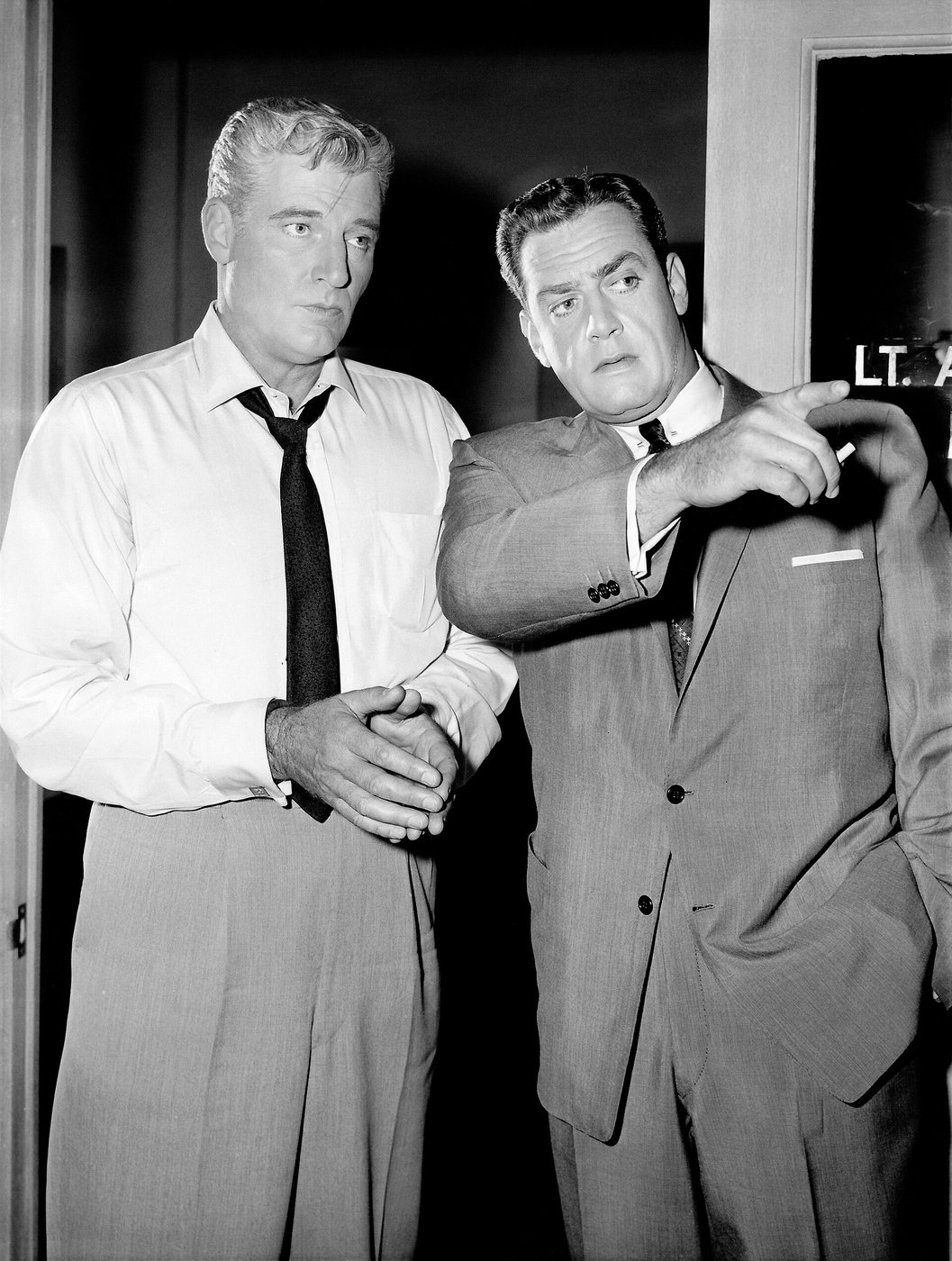
Invented the modern legal procedural's comfort contract with the audience.
Why it matters
From the desk
The Last Witness Stands Up — Comfort as a Formal Contract
Nine seasons of courtroom architecture: Raymond Burr’s stillness, a killer who almost always rises, and a procedural that taught America to wait for the second confession.
Watch the stillness first. Raymond Burr does not play brilliance as sweat. He plays it as furniture that has already been placed. Perry Mason, from the 1957 opener onward, is a legal procedural that understands delay as pleasure: investigation as a corridor, the courtroom as a stage, the last witness as a structural promise. The tabloids will say Burr’s public image was a managed cathedral — and they are not wrong, as gossip. The cut says something dryer. The camera trusts a man who barely moves, then lets the plot orbit him until someone in the gallery breaks.
The work is formula, which is not an insult. Formula is how a weekly hour argues with itself without becoming a mood board. Della Street and Paul Drake are not sidekicks in the modern quip sense; they are departments. Hamilton Burger is the necessary loss function — a prosecutor who must be competent enough that Mason’s win still costs something, even when the verdict is never really in doubt. People who treat television like a crime blotter will tell you the pleasure is the gasp when the real killer stands. Fine. The craft pleasure is how often the hour earns that gasp with plant-and-payoff instead of a last-minute prop.
What the season is arguing, when it is arguing well:
1. That justice can be appointment theater without becoming cynicism.
2. That a defense attorney might be the moral center of a mass audience in the late fifties — a more interesting civic claim than the later cop-show default.
3. That repetition is a contract: you came for the standing-up, so the standing-up had better be staged.
The hours that still teach are not always the most ornate titles. The restless-redhead opener sells the grammar: Burr, the office, the courtroom as destination. Later first-season cases tighten the machine until the typist hour and the lame-canary hour feel like the show discovering how much style a closed system can hold. Then comes the exception that proves the contract was always a contract. The deadly-verdict hour is famous because Mason loses — which is to say the series briefly tells the truth about formula: you only notice the rails when the train misses the station. Gossip will call it a stunt. The cut calls it a stress test.
Is it literature with better lighting? Not always. Plenty of weeks are efficient carpentry, and carpentry is how nine seasons exist. What it is not is empty comfort. Comfort here is ethical design: the innocent get a champion who looks like a cathedral and cross-examines like a clock. Later legal dramas either keep that promise (the system can still be made to work, this week) or spend their prestige budget explaining why it cannot. Both descend from this camera setup. Rex will toast living-room America. Vivian will want the Burr mythology. I will stay with the staging of the last question.
The 1966 closer has the good manners to be a fadeout instead of a franchise card. Burr had already become the role; the role had already become a public trust. You do not need two hundred-plus hours. You need enough to feel the rails, one hour that bends them, and the exit. Verdict: start at the redhead, jump to the loss, end at the fadeout. The scandal of a star’s private architecture will outlive the carpentry. That is, unfortunately, also part of television history — and it still is not why the courtroom works.
Episode guide
How this series is filed
TV Flash files Perry Mason (1957–1966) on CBS as the episode guide: 271 listed hours across 9 seasons, 1957-09-21–1966-05-22 from “Erle Stanley Gardner's The Case of the Restless Redhead” (S01E01) to “The Case of the Final Fadeout” (S09E30).
Open the episode guide · S01E01 Erle Stanley Gardner's The Case of the Restless Redhead · S09E30 The Case of the Final Fadeout
Essential episodes
Grammar, style, the hour the rails fail, and a fadeout with manners. Filed by Julian Hart (The Binge Brief).
- S01E01 Erle Stanley Gardner's The Case of the Restless Redhead
The grammar lesson: stillness, corridor, courtroom as destination.
- S01E38 Erle Stanley Gardner's The Case of the Terrified Typist
First-season style at full tightness — the closed system discovering elegance.
- S02E30 Erle Stanley Gardner's The Case of the Lame Canary
Plant-and-payoff as comfort, not gasp-chasing; the title still photographs as classic Mason.
- S07E04 The Case of the Deadly Verdict
The stress test: the win-loss pattern blinks, and you finally see the rails.
- S09E30 The Case of the Final Fadeout
A closer that fades instead of pitching. The role had already become a public trust.
At a glance
Defense attorney Perry Mason, secretary Della Street, and investigator Paul Drake turn each case into a courtroom thriller with a last-minute reveal. The real killer almost always stands up under Mason’s cross-examination. It’s justice as weekly theater with Raymond Burr’s unflappable center.
Network & studio
- CBS — broadcast network
Why watch now
Burr’s stillness is the camera’s argument: delay as pleasure, court as stage, the last witness as a kept promise. Watch a weekly legal machine that made justice appointment theater — then the rare hour the rails fail, which is how you learn the contract was always a contract.
Cultural impact
Perry Mason invented the modern legal procedural’s audience contract: truth will out before the credits. Every network lawyer drama still borrows its courtroom-as-stage energy.
Creators
Erle Stanley Gardner
Key cast
- Raymond Burr as Perry Mason
- Barbara Hale as Della Street
- William Hopper as Paul Drake
- William Talman as Hamilton Burger
- Ray Collins as Lt. Arthur Tragg
Flash facts
- CBS legal drama based on Erle Stanley Gardner’s characters, airing September 21, 1957–May 22, 1966 (9 seasons, 271 episodes).
- Executive produced by Gail Patrick Jackson for Paisano Productions with CBS Television.
- Theme 'Park Avenue Beat' by Fred Steiner became closely associated with the series.
FAQ
Where should I start?
Start with the 1957 restless-redhead opener to learn the grammar, then one tight first-season case. The pleasure is structure, not a serialized mystery box.
What can I skip?
Skip completionism. Nine seasons of weekly cases repeat on purpose. Once you can predict the corridor to court, sample rather than march.
Is the finale worth it?
Yes, as a fadeout with manners. It closes a nine-season contract instead of pitching a universe. Watch it after you know the rails, not as a standalone thriller.
Do I need to watch in order?
No. Continuity is office warmth, not plot. The exception is the rare hour that breaks the win-loss pattern — watch that after you have the formula in your bones.
Is it comfort junk or craft?
Both, if you are honest. The comfort is a formal promise: investigation, courtroom, the standing-up. The craft is whether this week’s plants deserve that promise.
Cultural eras
Official & further reading
External sites for further reading — TV Flash is not affiliated with these networks or studios.
Back to the decade
Also on the dial
More after Perry Mason
- Related showThe Ernie Kovacs ShowVisual gags, blackouts, and Nairobi Trio — the medium inventing itself for laughs.
- Related showThe Adventures of Robin HoodRichard Greene's Robin — British export that American kids treated like native folklore.
- Related showThe United States Steel HourIndustrial giant, theatrical punch — live drama with a steel-hard production sheen.
- Related showOmnibusAloft culture for the masses — Leonard Bernstein, Orson Welles, and Sunday seriousness.
- Related showAmos 'n' AndyHugely popular, deeply fraught — the sitcom that forces the conversation about race and early TV.
- Related showMamaNorwegian immigrant family warmth — live family drama before sitcoms ate the hour.