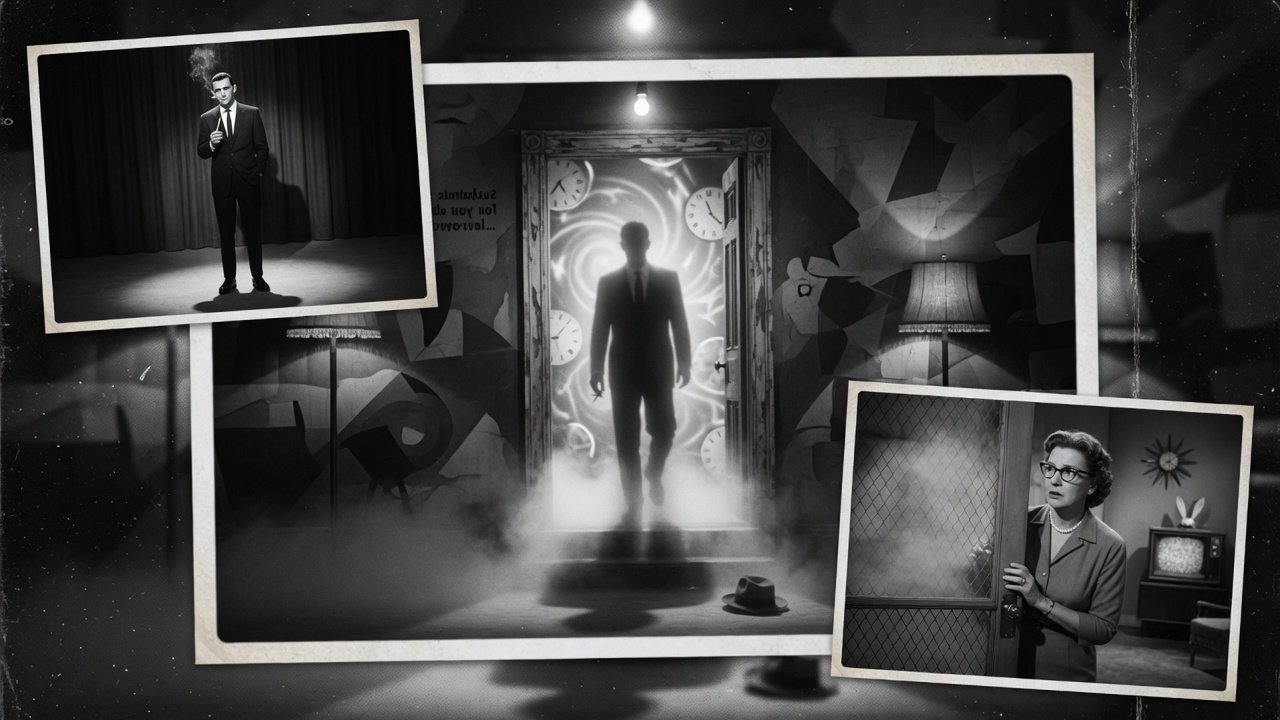
Created the prestige anthology vocabulary every limited series still steals.
Why it matters
From the desk
A Black Suit, a Sponsor Note, and a Country That Flinched
Five seasons of moral fable in a tuxedo: isolation as the first instrument, the twist as ethics, and Rod Serling’s war with the men who paid for the commercials.
October 1959, CBS: a man walks into an empty town and the country learns a new address. The Twilight Zone did not invent the anthology. It invented the anthology as a national flinch — half-hour moral weather, a host in a dark suit, and a closing turn that was supposed to sting after the sponsor smile. Rod Serling had already fought live-drama censors and lost enough rounds to change weapons. Fantasy was the loophole. Aliens, bargains, small towns that eat themselves: the vocabulary of a writer who wanted to talk about fear without asking a cigarette company for permission first.
On the palate: cigarette haze and perfect three-act dread, Bernard Herrmann’s nerves, and a narrator who treated the living room like a jury. Isolation is the first instrument. A bank teller, a neighborhood, a face under bandages, a child who must be told it is a good life. The twist is not a party trick. It is the bill. Later prestige limited series still rent that structure and call it elevated. Max will chart the drop. Fine. Serling was doing appointment ethics when the remote had three bullets and a snowy fourth if the rabbit ears lied.
The historical claim the room forgets: Standards & Practices and the sponsor were co-authors whether they got a credit. Serling’s battles with both are as legendary as the episodes, and they are the reason the show still feels like a smuggled sermon. You could not say certain American things in a straight drama. You could say them if a Martian held the mirror. That is craft under oligopoly, not nostalgia. Three scandals that would trend today and did, in analog:
1. A writer boxed into allegory because the cigarette men hated a straight racial plot.
2. Guest-star mythology as disposable souls — one and done, no franchise safety net.
3. An hour-long fourth season that proved more time is not the same as more nerve.
Watch it as a museum of instruments, not as a twist contest. The empty-town opener teaches loneliness as science fiction. The broken-glasses hour is still the most stolen moral in the catalog: be careful what solitude you pray for. The face-as-contract hour is television’s cruelest beauty lesson, shot so the audience becomes the freak. The child who runs a town is a Standards nightmare in a child’s cardigan. The gremlin on the wing is fear that still photographs, which is why every airplane panic since has been a photocopy.
How not to watch: as binge candy. These hours were built to sit in the blood overnight. A dump calendar turns the flinch into a snack. Serling wrote for a public that had to face the watercooler with the ending still hot. That is linear event television, even when the event is a fable. The fifth-season closer is a swimming-pool departure that never needed to exist; anthologies do not owe you a last chapter. The series ended because the form had been used hard, not because the host ran out of sermons.
A toast to the man in the black suit who made America afraid of its own living room — and to the sponsor who thought a twist ending was safer than a straight sentence about the country. Glory, slightly deflated, as usual. Start with isolation. Stay for the ethics. Leave the algorithm’s greatest-twists list in the lobby.
Episode guide
How this series is filed
TV Flash files The Twilight Zone (1959–1964) on CBS as the episode guide: 156 listed hours across 5 seasons, 1959-10-02–1964-06-19 from “Where is Everybody?” (S01E01) to “The Bewitchin' Pool” (S05E36).
Open the episode guide · S01E01 Where is Everybody? · S05E36 The Bewitchin' Pool
Essential episodes
Anthology hours that still teach the twist as ethics, not only surprise. Filed by Rex Fontaine (Golden Age Dispatch).
- S01E01 Where is Everybody?
Isolation as the first instrument.
- S01E08 Time Enough at Last
The broken glasses hour — still the anthology’s most stolen moral.
- S02E06 The Eye of the Beholder
The face as a social contract. Television’s cruelest beauty lesson.
- S03E08 It's a Good Life
A child as Standards & Practices nightmare.
- S05E03 Nightmare at 20,000 Feet
The gremlin on the wing — fear that still photographs.
From the desk
Flash columns that open this package’s pilots, finales, or fandom heat:
- Golden Age Dispatch: Best Episodes of I Love Lucy — The Operating System Still Running — Golden Age Dispatch
- The Binge Brief: Best TV Pilots That Still Teach the Craft — The Binge Brief
At a glance
Each week drops ordinary people into extraordinary traps — aliens, bargains, small-town secrets — with Rod Serling guiding you in and out like a tuxedoed conscience. The twists land as moral punches more than mere shock. Black-and-white allegory never looked this sharp.
Network & studio
- CBS — broadcast network
Why watch now
Serling used fantasy as a smuggled sermon when sponsors would not let a straight drama talk. Watch for isolation as craft, the twist as a bill coming due, and half-hours built to sit in the blood overnight — not to snack in a dump.
Cultural impact
The Twilight Zone gave America a shared language for paranoia, irony, and sponsor-proof social critique. Every limited series that promises a twist still rents space in Serling’s shadow.
Creators
Rod Serling
Key cast
- Rod Serling as Host / Narrator
Flash facts
- CBS anthology series created and hosted by Rod Serling, airing October 2, 1959–June 19, 1964 (5 seasons, 156 episodes).
- Serling wrote or co-wrote 92 of 156 episodes and served as executive producer.
- Season 4 used hour-long episodes; seasons 1–3 and 5 were half-hour format.
FAQ
Where should I start?
Start with the empty-town opener, then the broken-glasses hour. Isolation first, stolen moral second; those two teach the anthology’s real instrument better than any twist ranking.
What can I skip?
Skip the hour-long fourth season if you want the tight flinch of the half-hour form. Some later comic hours are period flavor; they are not why the show still teaches.
Is the finale worth it?
As history, yes — it is the last regular. As craft, the series never needed a last chapter. Anthologies close when the instrument is worn, not when a swimming-pool fable ties a bow.
Do I watch in order?
No. It is an anthology. Order matters for spotting season-four bloat and late-run fatigue, not for plot. Build a short stack of famous hours, then wander.
Horror, science fiction, or sermon?
Moral fable in genre clothes. The twist is ethics with a camera, not a jumpscare index. Watch it as argument, then as goosebumps.
Cultural eras
Official & further reading
External sites for further reading — TV Flash is not affiliated with these networks or studios.
Back to the decade
Also on the dial
More after The Twilight Zone
- Related showThe Ernie Kovacs ShowVisual gags, blackouts, and Nairobi Trio — the medium inventing itself for laughs.
- Related showThe Adventures of Robin HoodRichard Greene's Robin — British export that American kids treated like native folklore.
- Related showThe United States Steel HourIndustrial giant, theatrical punch — live drama with a steel-hard production sheen.
- Related showOmnibusAloft culture for the masses — Leonard Bernstein, Orson Welles, and Sunday seriousness.
- Related showAmos 'n' AndyHugely popular, deeply fraught — the sitcom that forces the conversation about race and early TV.
- Related showMamaNorwegian immigrant family warmth — live family drama before sitcoms ate the hour.